
In the Lap of Mother Nature
Amid fields, cows, rivers, and mountains, the author finds himself closer to God.
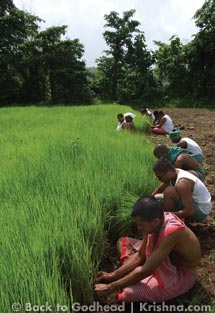
God is our supreme father, and one of His energies, nature, is our mother. A mother nourishes her child with the milk from her body, and she also sees to the overall development of her child by imparting proper culture and education. Similarly Mother Nature cares for her innumerable children by providing grains, fruits, flowers, and medicinal herbs, and she showers her motherly affection on us by giving invaluable lessons, guiding us on the journey of life.
During one rainy season, I got an opportunity to stay at a
small village named Galtare, 120 km north of Mumbai, India. I've had
some attraction for rural life since childhood, and upon spending some
time in the countryside, I could understand why Srila Prabhupada quoted
the English poet Cowper: "God made the country, and man made the town." I
could see how the materialistic civilization prevalent in cities makes
us godless. In the city, not seeing the hand of God in any aspect of
life becomes natural. It is so easy to believe that industry and the
Internet fulfill our needs. Packaged foods give us the sense that
machines have manufactured them. Life goes on uninterrupted even if no
rain falls for many years. But in the village, one can experience God
closely. There life is absolutely dependent on agriculture, which
depends on rain, and rain depends on God.
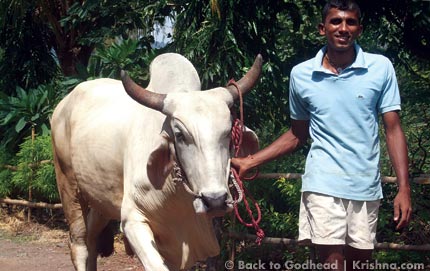
When we're close to nature, the intoxication of the materialistic way of
life gradually starts fading away. In my experience, the knowledge
enunciated in Bhagavad-gita, Srimad-Bhagavatam, and Srila Prabhupada's purports becomes clearer.
The chirping of the birds, the symphony of the running stream, the
mooing of the cows, and the sound of the swift breeze provide
inexplicable happiness to the ears. Seeing the unlimited blue sky above,
the thousands of stars at night, the giant mountains, the stretch of
the green fields below swaying in the wind, and the love of a mother cow
for her little calf is total perfection for the eyes. The mystical
aroma of the soil, the scent of clear pollution-free air, the smell of
freshly bloomed flowers, and the fragrance of cow dung deeply purify the
sense of smell. The joy of touching soil, cows, green plants, and clear
river water seems to reach even our souls. And the taste of fresh
fruits, vegetables, grains, water, and pure cow milk impels us to think
how the artificial ways of modern life give us untainted miseries in the
name of happiness.
While living in the countryside, I tried to visualize Srila Prabhupada
priceless teachings. And I reaped satisfaction of the soul and enhanced
faith. Understanding our supreme father becomes easy when our mother,
nature, gives us personal lessons as she holds us in her loving embrace.
In these pages, I present a few of the numerous teachings that Mother
Nature helped plainly illustrate for me during my stay at Galtare.
Photo captions:
Human beings need not eat animals. There are ample food grains, milk,
fruit, and vegetables so that the human beings as well as the animals
can eat sumptuously and to their heart's content. If all living beings
are satisfied with food and shelter and obey the prescribed rules, there
cannot be any disturbance between one living being and another. (Srimad-Bhagavatam 1.4.12, Purport)
In India, the women go to draw water from the well and they keep the
waterpot on their head. They are going, but the head is so balanced that
the waterpot will never fall down. If you learn how to keep the
balance, in spite of your movement the waterpot on the head will not
fall. Similarly, if you mold your life in such a way that Krishna should
always be remembered, then in spite of your mind being very agitated,
your mind will be fixed up in Krishna. That is required. (Lecture on Srimad-Bhagavatam 6.2.12–14, Allahabad Kumbha Mela, January 17, 1971)
All the living entities within the universe are conducted by the
Vedic directions, as a bull is directed by the rope attached to its
nose. No one can violate the rules laid down in the Vedic literatures.
To the chief person, who has contributed the Vedas, we offer our respect! (Srimad-Bhagavatam 3.15.8)
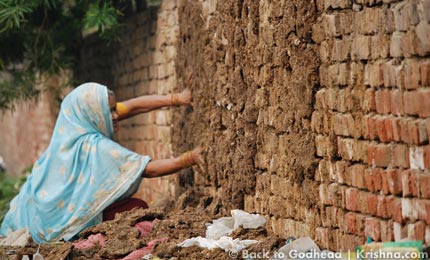
The web is created by the spider, and it is maintained by the spider,
and as soon as the spider likes, the whole thing is wound up within the
spider. The spider is covered within the web. If an insignificant spider
is so powerful as to act according to its will, why can't the Supreme
Being act by His supreme will in the creation, maintenance, and
destruction of the cosmic manifestations? (Srimad-Bhagavatam 2.9.28, Purport)
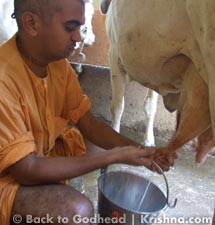
We find that in Bhagavad-gita Lord Krishna advises go-rakshya,
the protection of cows. This is essential because if cows are cared for
properly they will surely supply sufficient milk. We have practical
experience in America that in our various ISKCON farms we are giving
proper protection to the cows and receiving more than enough milk. In
other farms the cows do not deliver as much milk as in our farms;
because our cows know very well that we are not going to kill them, they
are happy, and they give ample milk. (Srimad-Bhagavatam 9.15.25, Purport)
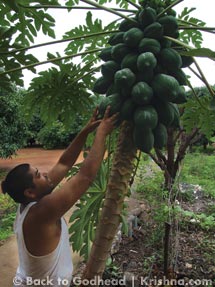
When there is a river, one can take drinking water, wash his clothes,
bathe and so on, for that water will serve all purposes. Similarly, if
one worships the Supreme Personality of Godhead, Krishna, all his goals
will be achieved. (Chaitanya-charitamrita, Adi-lila 14.66, Purport)
We have to follow. If we follow the footprints of great personalities, then there is no danger. Mahajano yena gatah sa panthah. Just like in the villages there is a track. One who follows that track is not lost. Similarly, if we follow the track of the mahajana—on which a great personality has traversed—then we'll not fall. (Lecture on Srimad-Bhagavatam 7.9.10, Montreal, July 9, 1968)
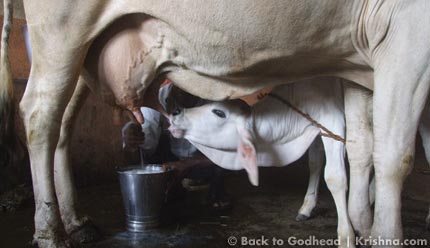
The cow's calf not only is beautiful to look at, but also
gives satisfaction to the cow, and so she delivers as much milk as
possible. But in the Kali-yuga, the calves are separated from the cows
as early as possible for purposes which may not be mentioned in these
pages of Srimad-Bhagavatam. (Srimad-Bhagavatam 1.17.3, Purport)
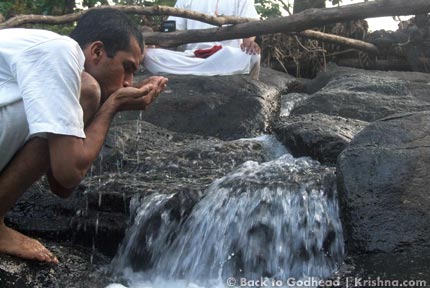
Now, our next program will be to organize farming land to set an example
to the whole world how people can be peaceful, happy, and free from all
anxieties simply by chanting the Hare Krishna maha-mantra and living an honorable life in Krishna consciousness. (Letter, October 19, 1975)
Stick to your own place and grow your food. There is no question of transport. A little transport is required, the bullock cart. Krishna was being carried on a bullock cart. There is no use of petrol. Simply use the bull. They are already there. Utilize them. (Morning Walk, Rome, May 25, 1974)
They are simply misusing their advancement, and they are
satisfied when they have got a motorcar instead of bullock cart. That's
all. They think, "Now I am advanced. We had bullock carts, and now we
have got motorcars with three hundred thousand parts. And every part
will give me trouble." And that is advancement. (Morning Walks, October
1-3, 1972, Los Angeles)
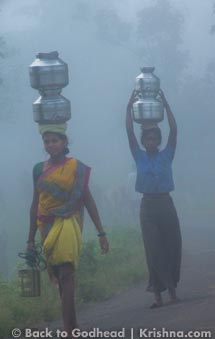
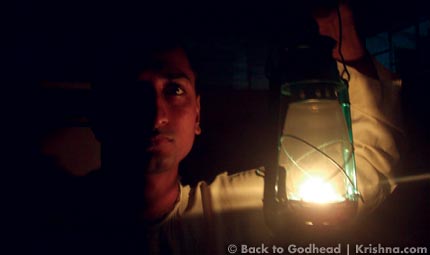
When the flame in a lamp burns the wick improperly, the lamp is
blackened, but when the lamp is filled with ghee and is burning
properly, there is bright illumination. Similarly, when the mind is
absorbed in material sense gratification, it causes suffering, and when
detached from material sense gratification, it brings about the original
brightness of Krishna consciousness. (Srimad-Bhagavatam 5.11.8)
Cow dung dried in the sunshine is kept in stock for utilizing them as fuel in the villages. They get wheat and other cereals produced from the field. There is milk and vegetables, and the fuel is cow dung, and thus they are independent in every village. There are hand weavers for the cloth. And the country oil-mill (consisting of a bull walking in circle round two big grinding stones, attached with yoke) grinds the oil seeds into oil. The whole idea is that … the less we are anxious for maintaining our body and soul together, the more we become favorable for advancing in Krishna consciousness. (Letter, June 14, 1968)
Just like the trees, plants, grass. They
cannot move. They have no legs. They have got legs, but they cannot
move. They are eating through the legs. Therefore they are called pada-pa,
which means "collecting water through the leg." These trees are
drinking water from within the earth with their legs. Therefore they
push their roots very deep to find out where is water. (Lecture on Bhagavad-gita 13.4, Miami, February 27, 1975)
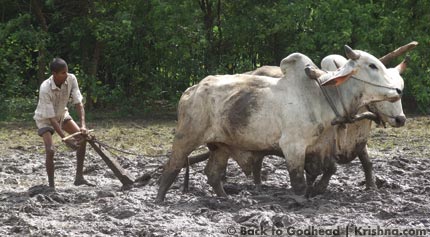
Just like the cow and bull. The bull helps, plowing. That is the
original system. Now they have invented tractors, and the bulls are
being killed. Why should they be killed? Engage them in tilling the
field. They will have an occupation. And the men also will have an
occupation. There is immense land. So there will be no question of
unemployment. (Conversation, Melbourne, July 2, 1974)
According to smriti regulation, the cow is the
mother and the bull the father of the human being. The cow is the mother
because just as one sucks the breast of one's mother, human society
takes cow's milk. Similarly, the bull is the father of human society
because the father earns for the children just as the bull tills the
ground to produce food grains. Human society will kill its spirit of
life by killing the father and the mother. (Srimad-Bhagavatam 3.2.29, Purport)
Krishna's navel resembles a lotus, He is garlanded with lotuses, and His eyes are also compared to the petals of a lotus (alola-candraka-lasad-vanamalya-vamshi).
So if we simply think of only this one verse, which describes Krishna's
body with reference to the lotus, we can meditate our whole life on how
beautiful Krishna is, how wise Krishna is, and how Krishna manifests
His creation. This is meditation—thinking of Krishna. (Teachings of Queen Kunti, Chapter 5)
 English
 Español