Lord
Caitanya and the Muslim Chand Kazi
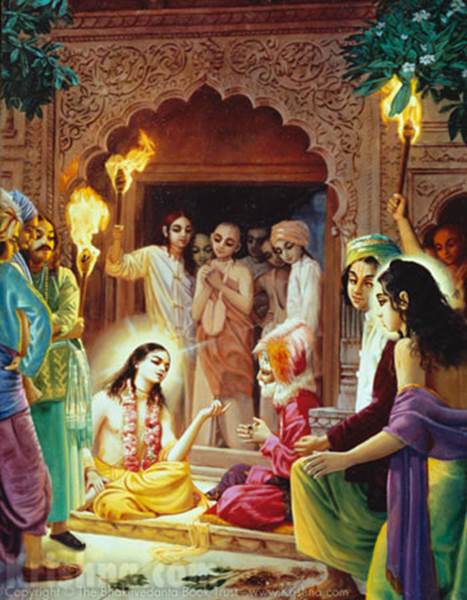
Chand Kazi: When
Lord Caitanya Mahaprabhu was in Mayapur, Chand Kazi was the Chief Magistrate of
Navadvipa. It is described in Sri Navadvipa Dhama Mahatmya by Srila
Bhaktivinoda Thakura, when Lord Nityananda Prabhu while taking Jiva Gosvami on
Navadvipa-Mandala Parikrama, entered Chand Kazi’s Village, Lord said, "O
Jiva, hear My words. The Chand Kazi's village is none other than Mathura. After
performing kirtana, Gauranga gave love of God to the Kazi and liberated him.
Mathura's King Kamsa of Krishna-lila became Chand Kazi in Gaura-lila. For that
reason Gauranga addressed the Kazi as His maternal uncle, and out of fear the
Kazi took shelter of Gauranga's lotus feet. Under orders from Hussain Shah, who
was the king of the Bengal empire, the Kazi caused
disturbance during kirtana performance by breaking the mrdangas. The Lord,
appearing in the form of Nrsimhadeva put fear in the Kazi's heart. Like Kamsa,
the Kazi cowered in fear. Sri Caitanya, however, gave him prema and thus made
the Kazi a great devotee. The very fortunate hear this story of the Kazi's
liberation.”
"Just
see the difference between Vraja-tattva and Navadvipa-tattva. Those who offend
Krishna are liberated by merging into the Lord's effulgence, whereas in
Navadvipa the offenders receive the treasure of love of God. Therefore, Lord
Gauranga's pastimes are considered the highest. Gauranga's abode, name, form,
and qualities do not consider offense; rather, they expertly deliver one from
any offense. If the devotee has some offense in his heart, then Krishna's name
and abode will deliver him only after a long time. But Gauranga's name and
abode immediately bestow prema on the devotee, for offenses create no obstacle
and are easily overcome. O Jiva, see the Kazi's samadhi. By seeing this samadhi
the living entities' old age and disease are vanquished."
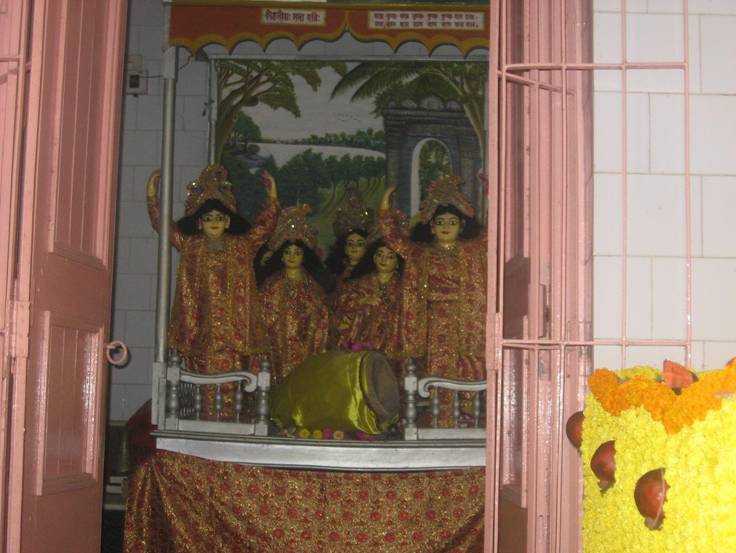
“Khol Banga Danga” the place where mrdanga
was broken by Chand Kazi at Srivasa Pandita’s house to stop Harinam Sankirtana
Lord Caitanya started His sankirtana
movement and preached to all the citizens of Navadvipa to chant the Hare
Krishna maha-mantra. In each and every home devotees
began performing sankirtana regularly. When the sankirtana movement thus
started, no one in Navadvipa could hear any other sound except the words
"Hari! Hari!". Hearing the continuous
chanting of the Hare Krishna, the local Muslims became very disturbed and
submitted a formal complaint to the Chand Kazi, who was the Chief Magistrate of
Navadvipa.
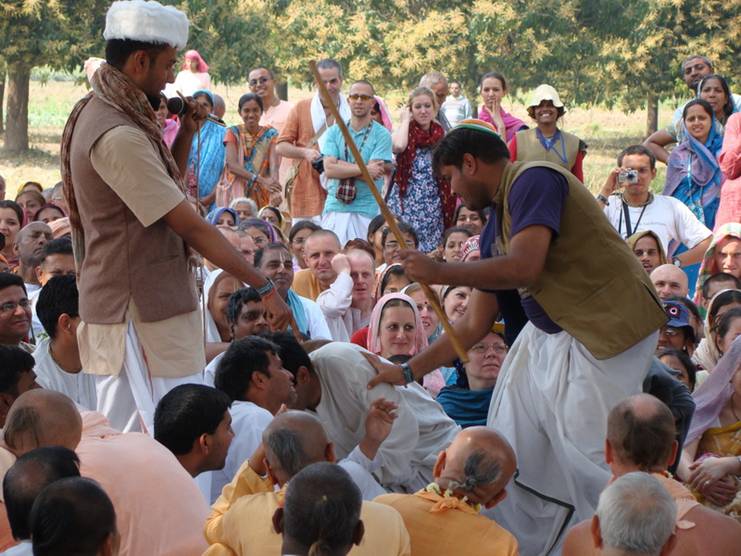
Drama: Chand Kazi’s
soldiers beating the devotees performing Harinama Sankirtana
Chand Kazi was a devout and strict
Muslim who was well versed in the Koran. As the Chief Magistrate, he kept law
and order for the king Hussein Shah. He was a tyrannical ruler and the Hindus
were oppressed in their religious practices. Angry that
devotees were not obeying his order forbidding chanting of the Holy
names during the kirtana, Chand Kazi went with two boats of soldiers to Srivasa
Pandita's house to personally enforce his ordinance.
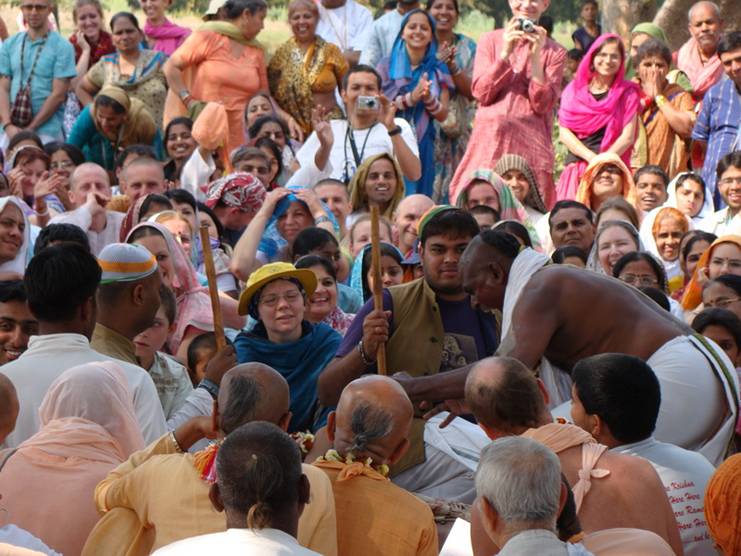
When
Chand Kazi saw kirtana going on, he broke the mrdanga drum. He spoke as follows: "For
so long you all did not follow the regulative principles of the Hindu religion,
but now you are following them with great enthusiasm. May I know by whose
strength you are doing so?" He then threatened, "No one should
perform sankirtana on the streets of the city. Today I am excusing the offense
and returning home. The next time I see someone performing such sankirtana, I
shall certainly chastise him by not only confiscating all his property but also
converting him into a Muslim."
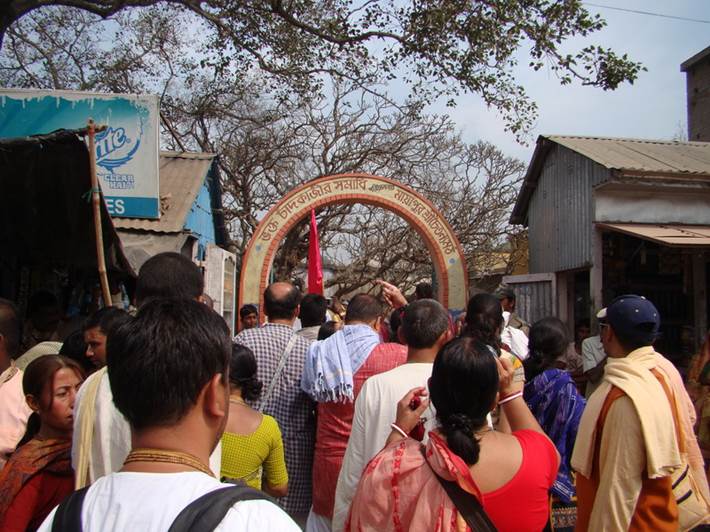
Entrance to Chand
Kazi’s Samadhi at Simantadvipa in Navadvipa Dhama. “O Near that place (Simantadvipa,
where Paravati had darshana of Lord Gauranga Mahaprabhu) is the city of
Mathura, where in the age of Kali, Kamsa took birth in a yavana family.”
(Navadvipa-dhama-mahatmya,
Pramana-khanda 4.34). The
place of the Kazi is compared to the city of Mathura. Here Gauranga Mahaprabhu
delivered Chand Kazi by giving him the jewel of Krishna.
The devotees were greatly shocked
that they were forbidden to chant Hare Krishna. They went to the Lord Caitanya
and reported to Him, “We have stopped our kirtana out of fear for the Kazi,
whose men in hundreds search the streets and houses. We will have to leave
Navadvipa and settle elsewhere, we have come to tell You
this.” When Lord Caitanya heard that someone was trying to stop the Sankirtana
movement He became infuriated, He looked awesome, almost like Lord Siva at the
time of the cosmic annihilation. He roared loudly like the rumbling of thunder
and the devotees afraid of this sudden change in the Lord held their ears as if
begging forgiveness from the Lord for a mistake they had not committed.
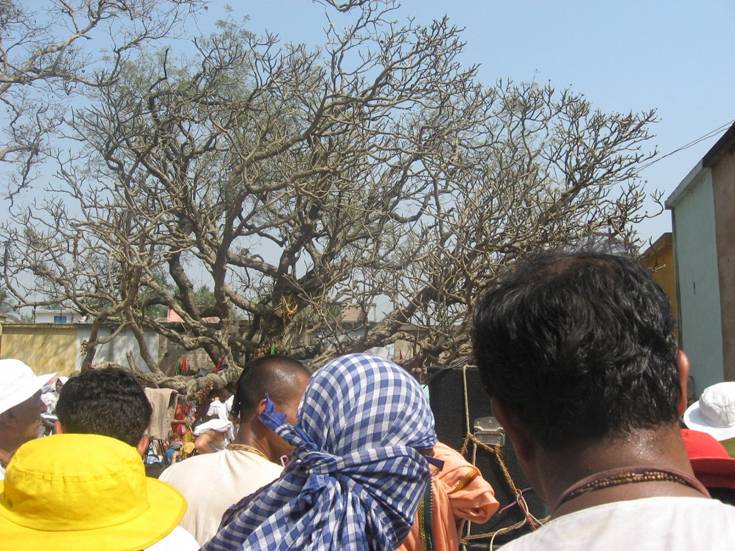
Champaka
Tree at Chand Kazi’s Samadhi. This tree witnessed this pastime with the Lord. Even
though truck of this tree is hallow, it is still in full bloom and gives
champaka flowers all year round, even when it is not flowering season.
The Lord
said, “Nityananda! Be prepared, go immediately to all the Vaishnavas, and
assemble them on the streets. I shall bring out a kirtana party and take it all
over Navadvipa. I will see what anyone can do to Me.
You will see how I burn the Kazi's house down. Today I shall shower incessant
rains of love of Godhead on everyone. Today the atheist's will face the final
hour. So do not waste a moment My brothers go and
deliver this message to everyone. Tell them that if they are desirous of seeing
Krishna's mystic potency in action then let them bring a flaming torch with
them. I will smash the Kazi's palace and I will do kirtana all along. The
entire creation is full of My devotees and when I am
present here then what is there to fear! Go and put a stop to your anguish!
Come and assemble in the afternoon after lunch.”
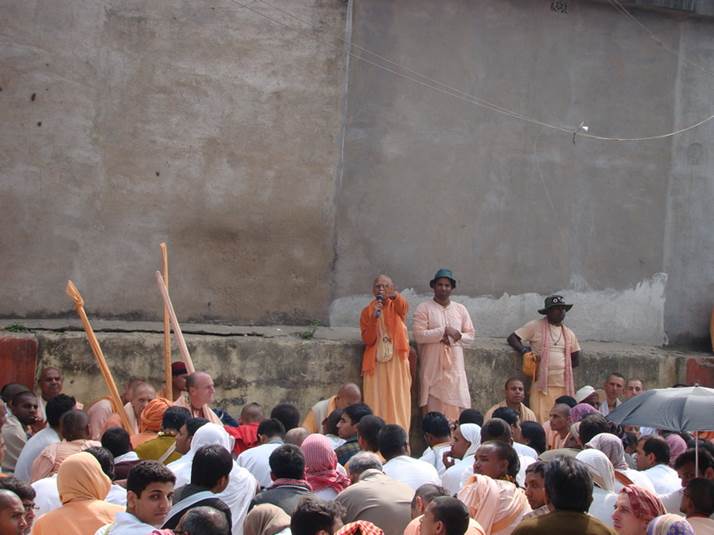
Transcendentalists
discussing Lord Caitanya and Chand Kazi’s pastimes during annual
Navadvipa-Mandala Parikrama
The
devotees dispersed right away, each going his way in great anticipation not
caring about eating or anything. Excited talks filled every home that, “Nimai Pandita
will take out a Sankirtana and dance in the streets of Navadvipa.” For the many
thousands who were lamenting for so long that they could not see Nimai
Pandita's dancing, this news was cause of great rejoicing. So everyone prepared
their own torch. Huge barrels of oil were kept in readiness. Navadvipa in those
days was very thickly populated. The constant flow of people with torches
poured out of the houses onto the streets. The women, children, and old men
were excited with great anticipation. Slowly the clusters of devotees moved
towards Nimai Pandita 's house.
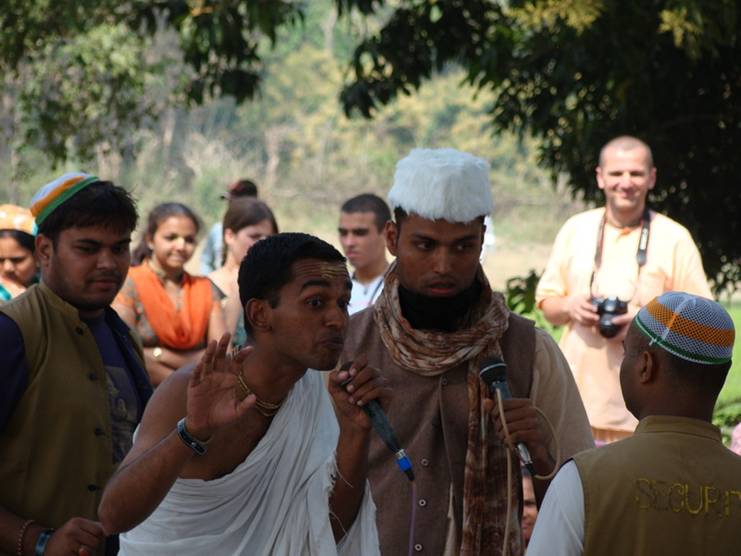
Drama performance of
Lord Caitanya and Chand Kazi’s pastimes
When Lord Caitanya heard that all
the Vaishnavas had assembled, He went to meet them and organize them in groups.
Advaita Acarya was to head up a group, Haridasa Thakura was the leader of
another group and was backed by a kirtana group. Another group was to be led by
Srivasa Pandita. The Lord's eyes fell on Nityananda and immediately He said, “I
will not leave Your side My Lord. My only duty is to
always be near You. I can never leave Your lotus feet imbedded in My heart. What power do I
possess to dance independently away from You. My
devotional service to You is I am always with You.”
When Lord Caitanya saw the streams of ecstasy flowing from Nityananda's eyes He
embraced Him and kept Him near Him.
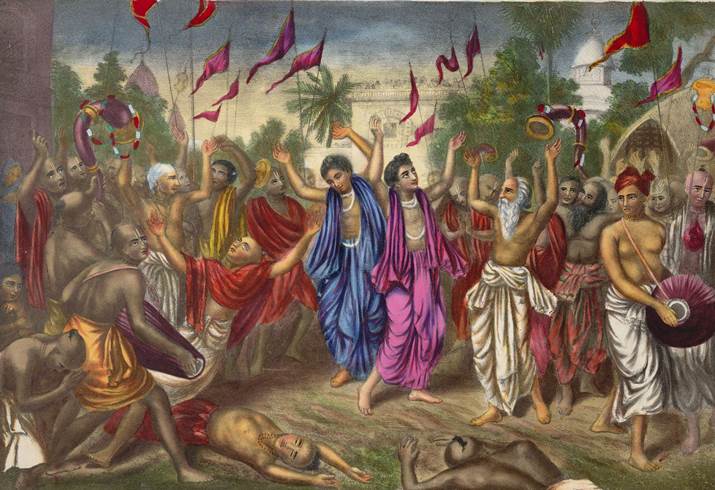
Led by the Supreme Lord Himself, a
tumultuous uproar of the holy names: Hare Krishna Hare Krishna Krishna Krishna
Hare Hare/Hare Rama Hare Rama Rama Rama Hare Hare burst forth as the massive
ocean of people rhythmically surged towards Chand Kazi’s palace in the first
ever public kirtana. For the citizens of Navadvipa it was a momentous occasion
as it was the first time they were able to see Gauranga’s exquisite dancing and
His ecstatic chanting of His own holy names. Overwhelmed with spiritual
emotions from seeing Caitanya Mahaprabhu’s supreme bliss, they became
captivated by the intoxicating sweetness of the congregational chanting of the
holy names. They left their homes and families unattended and spontaneously
joined the devotees in the unbounded ecstasy of chanting and dancing in kirtana.
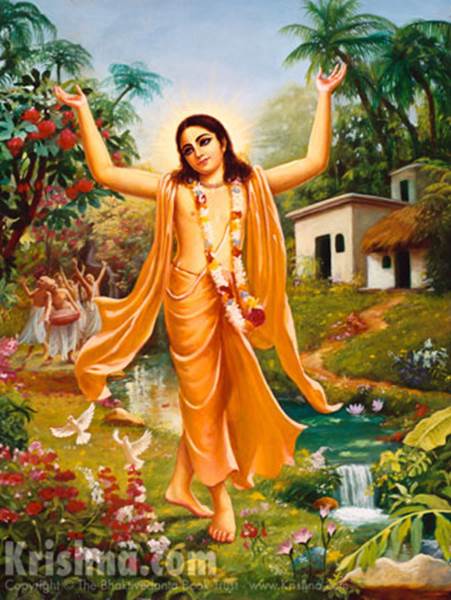
Lord Caitanya, opening the
flood-gates of His own Krishna-prema, drowned everyone in that ocean and, in
doing so, personally inaugurated the first public performance of His Harinama-Sankirtana
movement - the only means of deliverance in the age of Kali. Everyone looking
at Him commented on His divine and beautiful presence. The millions who came
around for this momentous occasion were very fortunate in spite of their large
number they all received the Lord's benedictions by being able to see the
Lord's exquisite transcendental face. The devotees became inebriated and danced
liked madmen. Their first experience of public congregational chanting
transported them to unknown heights of spiritual intoxication.
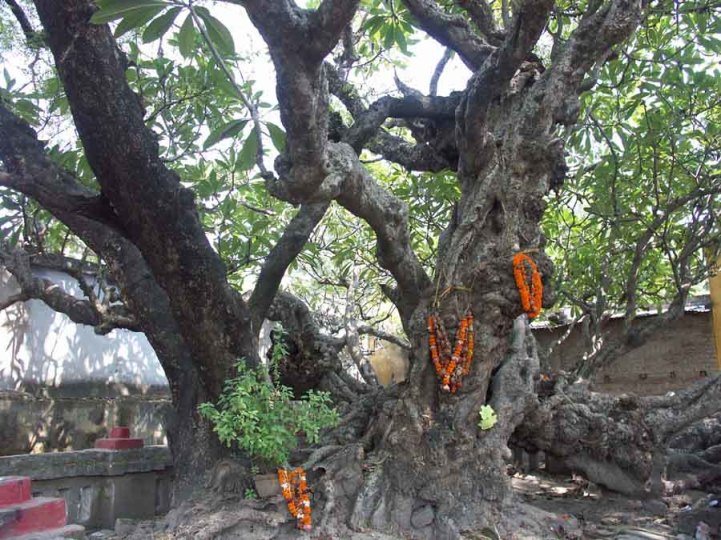
Champaka Tree at Chand
Kazi’s Samadhi
Chanting of this kirtana was so loud, the Kazi could hear it from his house, over 1 km away.
The crowd expanded to millions and extended for miles. While the devotees
chanted and danced in ever-increasing heights of bliss, Kazi’s men ran away in
fear of their lives. Chand Kazi also became overwhelmed seeing the massive
procession heading his way. Lord Caitanya’s voice boomed in anger above the
thunderous roar of the kirtana, “Where is that rascal Kazi? I have advented to
propagate the congregational chanting of the holy names. If anyone so much as
tries to cause obstruction, I will annihilate him. Yet even if the most lowly sinner takes part in this chanting, I shall
remember him and save him.” Kazi, shaking in fear, quickly ran and hid himself
inside his palace. Arriving both intoxicated with the nectar of the Holy Name
and enraged at Kazi’s ban on kirtana, some of the people who were very much
agitated began to retaliate the Kazi’s actions by wrecking his house and
garden.
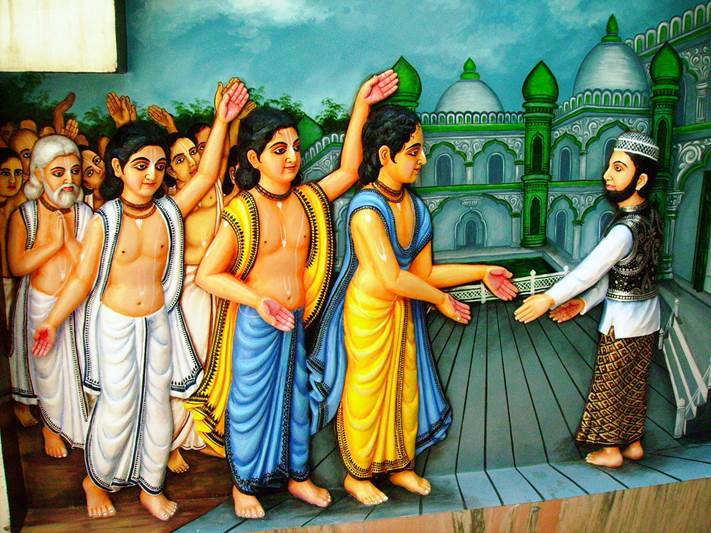
Lord Caitanya meeting
Chand Kazi
When Gauranga Mahaprabhu reached the
Kazi’s house, He sat down by the doorway and sent some respectable persons to
call for the Kazi. Kazi finally appeared before Lord Caitanya and pacified Him
by reminding Him of their village relationship. Chand Kazi used to be a
neighbour and friend of Sacimata’s father so he addressed Lord Caitanya saying,
“Nilambara Cakravarti Thakura was my uncle and he is Your
maternal grandfather, so You are my nephew. When a nephew is very angry, his
maternal uncle is very tolerant and also when the uncle makes an offense, the
nephew does not take it very seriously.” In this way the Kazi and the Lord
talked with each other with various indications, but no outsider could
understand the inner meaning of their conversation.
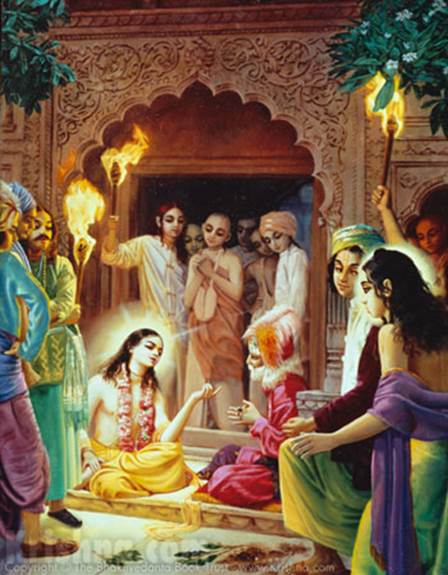
Lord Caitanya’s discussion
with Chand Kazi on cow killing
[ref. Sri Caitanya Caritamrta Adi-lila chapter 17 verses 152
to 171]
Lord said to Chand Kazi, “My dear
uncle, I have come to your home just to ask you some questions.”
go-dugdha khao, gabhi tomara mata
vrsa anna upajaya, tate tenho pita
The Lord Caitanya said, “You
drink cows’ milk; therefore the cow is your mother. And the bull produces
grains for your maintenance; therefore he is your father. Since the bull and
cow are your father and mother, how can you kill and eat them? What kind of
religious principle is this? On what strength are you so daring that you commit
such sinful activities?” (Sri Caitanya Caritamrta Adi-lila 17.153-54)
Kazi replied, “As You have
Your scriptures called the Vedas and Puranas, we have our scripture, known as
the holy Koran. According to the Koran, there are two ways of advancement -
through increasing the propensity to enjoy, and through decreasing the
propensity to enjoy. On the path of decreasing attachment [nivrtti-marga], the
killing of animals is prohibited. On the path of material activities, there is
regulation for killing cows. If such killing is done under the guidance of
scripture, there is no sin.” As a learned scholar, the Kazi challenged Caitanya
Mahaprabhu, “In Your Vedic scriptures there is an injunction for killing a cow.
On the strength of this injunction, great sages performed sacrifices involving
cow-killing.”
Refuting Chand Kazi’s statement, the Lord Caitanya
immediately replied,
·
“The Vedas clearly enjoin that cows should not be
killed. Therefore every Hindu, whoever he may be, avoids indulging in
cow-killing. In the Vedas and Puranas there are injunctions declaring that if
one can revive a living being, one can kill it for experimental purposes.
Therefore the great sages sometimes killed old cows, and by chanting Vedic
hymns they brought them back to life for perfection. The killing and
rejuvenation of such old and invalid cows was not truly killing but an act of
great benefit.
·
Formerly there were powerful brahmanas who could make
such experiments using Vedic hymns, but now, because of the Kali-yuga,
brahmanas are not so powerful. Therefore the killing of cows and bulls for
rejuvenation is forbidden. ‘In this Age of Kali, five acts are forbidden: the
offering of a horse in sacrifice, the offering of a cow in sacrifice, the
acceptance of the order of sannyasa, the offering of oblations of flesh to the
forefathers, and a man’s begetting children in his brother’s wife.’
·
Since you Muslims cannot bring killed cows back to
life, you are responsible for killing them. Therefore you are going to hell;
there is no way for your deliverance. Cow-killers are condemned to rot in
hellish life for as many thousands of years as there are hairs on the body of
the cow.
·
There are many mistakes and illusions in your
scriptures. Their compilers, not knowing the essence of knowledge, gave orders
that were against reason and argument.”
After hearing these statements by Sri Caitanya
Mahaprabhu, the Kazi, his arguments stunned, could not put forward any more
words. Thus, after due consideration, the Kazi accepted defeat and spoke as
follows. “My dear Nimai Pandita, what You have said is
all true. Our scriptures have developed only recently, and they are certainly
not logical and philosophical. I know that our scriptures are full of
imagination and mistaken ideas, yet because I am a Muslim I accept them for the
sake of my community, despite their insufficient support. The reasoning and
arguments in the scriptures of the meat-eaters are not very sound,” the Kazi
concluded.
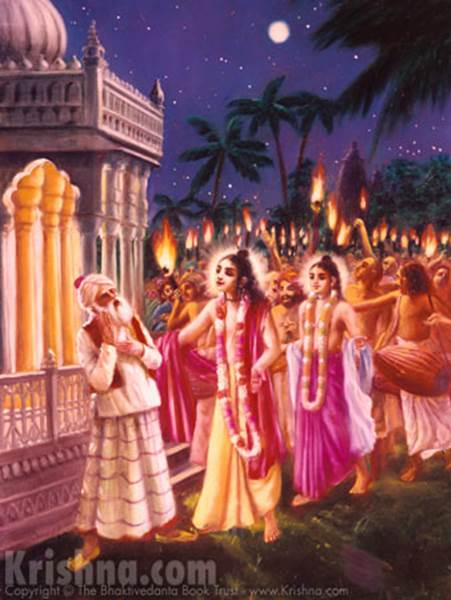
Lord Caitanya smiled and inquired
from him as follows, “My dear maternal uncle, I wish to ask you another
question. Please tell Me the truth. In your city there
is always congregational chanting of the holy name. A tumultuous uproar of
music, singing and dancing is always going on. As a Muslim magistrate, you can
oppose the performance of Hindu ceremonies, but now you do not forbid them.
What is the reason?”
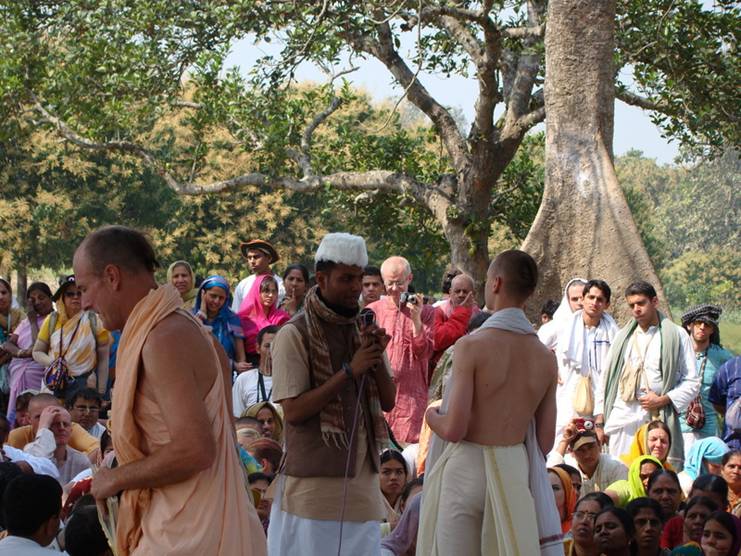
Kazi said, “After going to
Hindu’s house (Srivasa Thakura) and forbidding congregational chanting, in my
dreams that very night I saw a greatly fearful lion roaring very loudly. His
body was human and His face was like that of a lion. This lion jumped on me and
with His sharp nails, He pierced my chest and laughed fiercely.
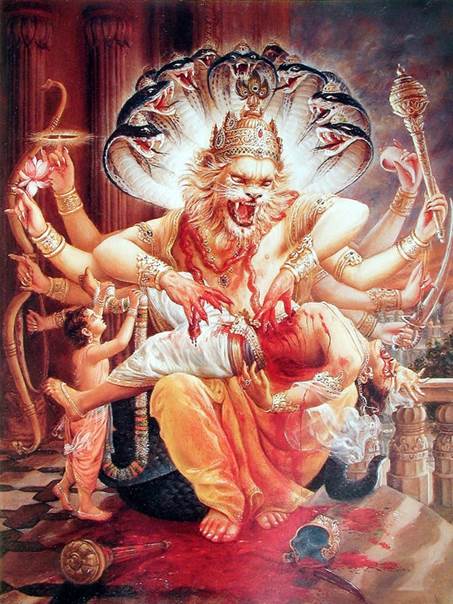
Lord Nrsimhadeva
appears to Chand Kazi
Gnashing
His teeth He told me, “I shall immediately bifurcate
your chest just as you broke the mrdanga drum. You have forbidden the
performance of My congregational chanting of Hare Krishna so I must destroy
you.’ seeing me so afraid the lion then said, ‘I have defeated you to teach you
a lesson. Because you never created a very great disturbance I must be merciful
to you, but if you do the same again then I will not be so tolerant. I will kill
you, your entire family, and all the meat-eaters here.’ The lion then left, but
just see the marks of His nails on my chest!” The devotees were amazed to see
the nail-marks and they realized that this lion was none other than Lord
Nrsimhadeva. “That same day,” continued Kazi, “my orderlies came to me saying
that whenever one of them tried to stop kirtana, fire suddenly stuck all of
their faces and their beards burst into flames. I told them to go home and
forget about stopping the kirtana.”
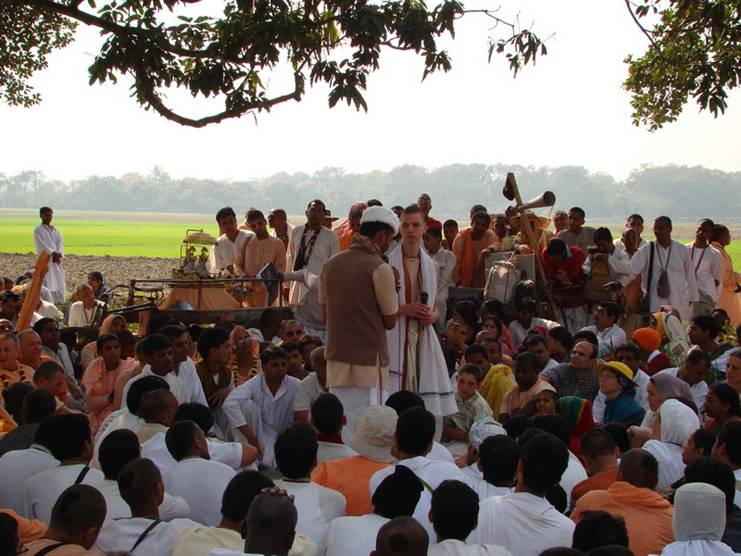
Kazi then revealed his heart to
Gauracandra saying, “I know that Narayana is the Supreme God of the Hindus, and
I think that You are the same Narayana. This I feel
within my mind.”
Lord Caitanya touched Kazi and
smilingly spoke as follows, “The chanting of the holy name of Krishna from
your mouth has performed a wonder - it has nullified the reactions of all your
sinful activities. Now you have become supremely pure. Because you have chanted
three holy names of the Lord - Hari, Krishna and Narayana - you are undoubtedly
the most fortunate and pious.”
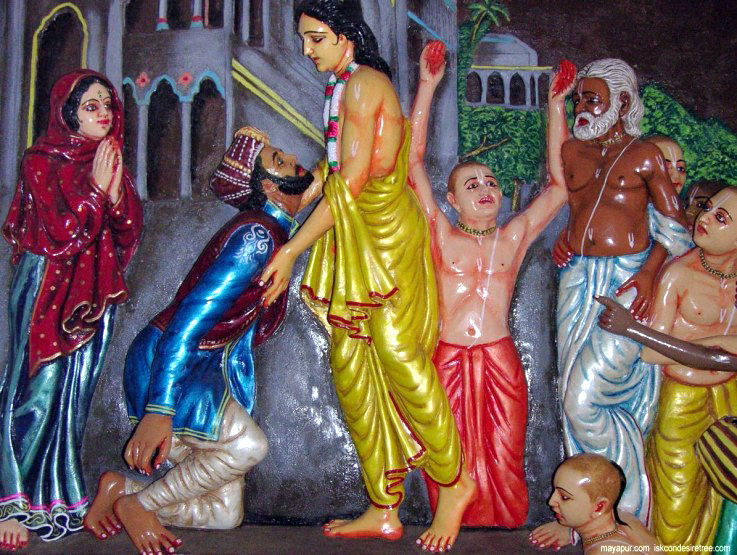
Lord Caitanya delivers
Chand Kazi
Tears welled up in Chand Kazi’s eyes.
Crying, he touched Caitanya Mahaprabhu’s lotus feet and prayed, “Only by
Your mercy have my bad intentions vanished. May my devotion always be fixed on You.”
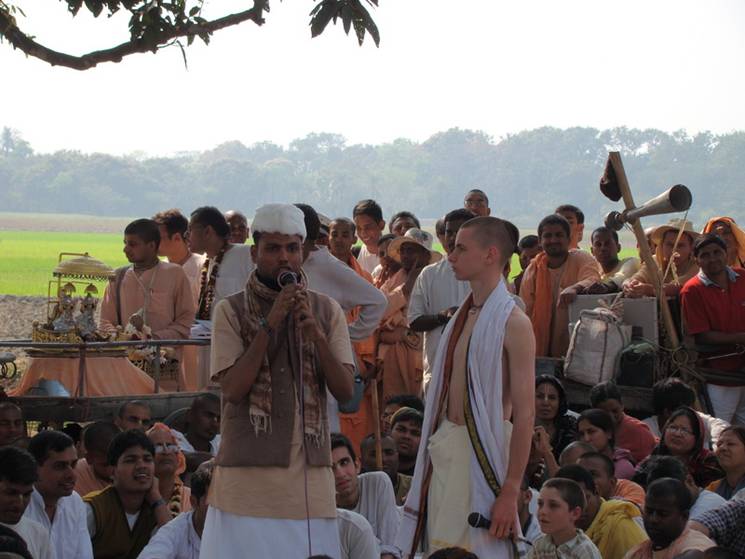
Gauranga
Mahaprabhu then asked Chand Kazi, “I wish to beg one favour in charity. You
must pledge that this Sankirtana movement will not be checked, at least within
the district of Nadia.”
Kazi said, “To as many descendants as take birth in my dynasty in the
future, I give this grave admonition: No one should check the sankirtana
movement.” Hearing this,
Gaurasundara and the devotees jumped up in joy chanting “Hari! Hari!” and, with
Kazi joining them, Caitanya Mahaprabhu led the Vaishnavas home in a victorious
kirtana.
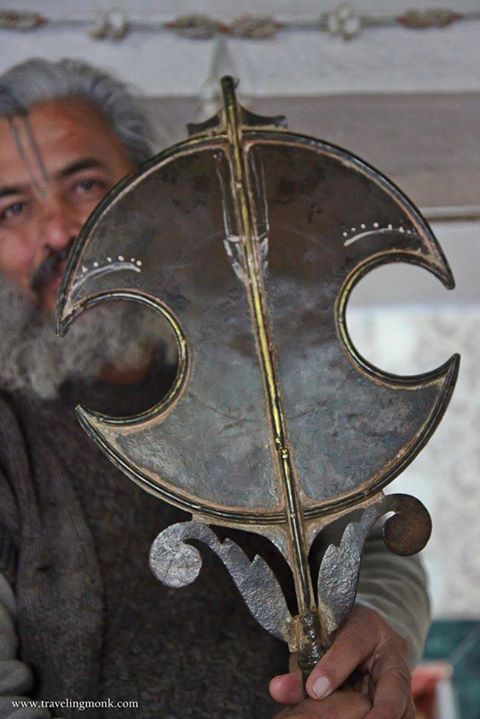
This is called a
‘kunti.’ This particular piece was given by the Chand Kazi to Lord Nityananda,
as proof that the Chand Kazi authorized public chanting of the holy names
within his district. Originally it was a symbol of the Kazi’s authority. The sankirtan
party carried it everywhere.
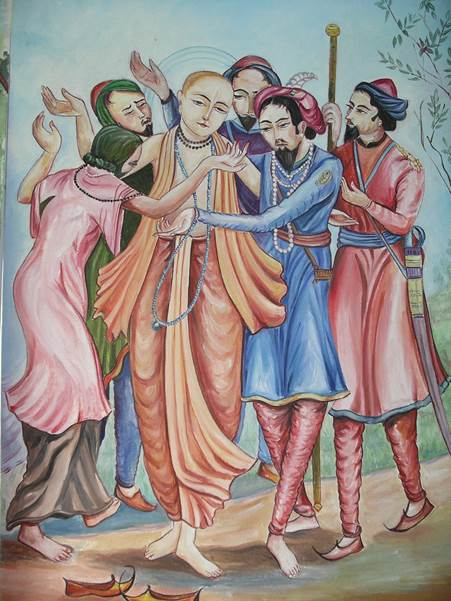
As a result of this grave injunction
by the Kazi, even at present the descendants of the Kazi’s family do not oppose
the Sankirtana movement under any circumstances. Even during the great
Hindu-Muslim riots in neighbouring places, the descendants of the Kazi honestly
preserved the assurance given by their forefather.
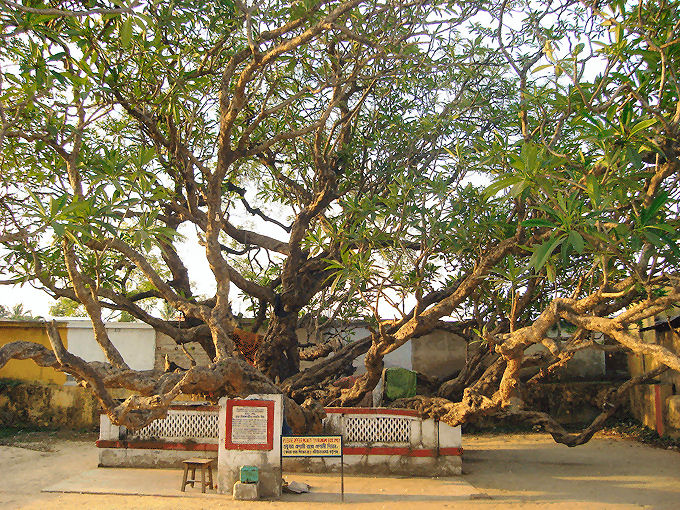
Chand Kazi Samadhi,
is 1 km north of Yogapitha and 3½ km from ISKCON Mayapur temple. The stone samadhi
of Chand Kazi has two trees growing out of it. The champaka tree
represents Chand Kazi (who was also known as Champa). It is over 500 years old
and therefore witnessed the events of Chand Kazi's pastimes with the Lord. Even
though the trunk of this tree is hollow, it is still in full bloom and gives champaka
flowers all year round, even when it is not flowering season. The neem tree
around the champaka tree represents Lord Nimai (Caitanya) who is in
ecstasy embracing the great devotee Chand Kazi. This area is the village of
Chand Kazi, which is none other than Mathura of Vrindavana. Just by seeing this
samadhi, one is released from old age and death. Being Mathura, this
place is more auspicious than Vaikuntha and by residing here for one day, a person will develop devotional service to the Lord.
Srila Vrindavana Das Thakura in Sri
Caitanya Bhagavata states that only the most fortunate people hear the
wonderful pastime of Mahaprabhu and Chand Kazi and about his deliverance.
Anyone who hears this is also freed from all offenses.
Lord
Caitanya and Chand Kazi Pastime
Lord
Caitanya Mahaprabhu appeared in the late 15th century, 1486. He took birth in
Bengal, India, which at the time was being governed by the Pathana Muslims. At
the age of seventeen Caitanya Mahaprabhu started His sankirtana movement
(the congregational chanting of Lord’s holy names). He preached to all the
citizens of Navadvipa to chant the Hare Krishna maha-mantra, and in each
and every home they began performing sankirtana regularly. When the sankirtana
movement thus started, no one in Navadvipa could hear any other sound except
the words "Hari! Hari!" and beating of the mrdanga and clashing of
hand bells. Hearing the continuous chanting of the Hare Krishna, the local
Muslims became very disturbed and submitted a formal complaint to the Chand
Kazi, who was the Chief Magistrate of Navadvipa.
Chand Kazi
was a devout and strict Muslim who was well versed in the Koran. As the
Chief Magistrate, he kept law and order for the king Hussein Shah and was also
his spiritual advisor. He was a tyrannical ruler and the Hindus were oppressed
in their religious practices. Angry that devotees were
not obeying his order forbidding chanting of the Holy names during the kirtana,
Chand Kazi went with two boats of soldiers to Srivasa Pandita's house to
personally enforce his ordinance. When he saw kirtana going on, he broke the
mrdanga drum. He spoke as follows: "For so long you all did not
follow the regulative principles of the Hindu religion, but now you are
following them with great enthusiasm. May I know by whose strength you are
doing so?" He then threatened, "No one should perform
sankirtana on the streets of the city. Today I am excusing the offense and
returning home. The next time I see someone performing such sankirtana, I shall
certainly chastise him by not only confiscating all his property but also
converting him into a Muslim."
The
envious atheists were siding with the Kazi. They commented, “God's name should
be chanted in the mind. Which scripture enjoins one to make a hue and cry in
chanting God's name. This is a correct punishment they
have received for transgressing the Vedic injunctions. They have no fear of
flouting the social norms. That Nimai Pandita who acts so proud will now be
cowered by the Kazi. And that Nityananda who roams about everywhere will soon
see the end of all the fun. They call us atheists for speaking out the truth, at long last Nadia will be rid of these charlatans.”
The
devotees were greatly shocked that they were forbidden to chant Hare Krishna.
They went to the Lord Caitanya and reported to Him, “We have stopped our
kirtana out of fear for the Kazi, whose men in hundreds search the streets and
houses. We will have to leave Navadvipa and settle elsewhere, we have come to
tell You this.” When Lord Caitanya heard that
someone was trying to stop the Sankirtana movement He became infuriated,
He looked awesome, almost like Lord Siva at the time of the cosmic
annihilation. He roared loudly like the rumbling of thunder and the devotees
afraid of this sudden change in the Lord held their ears as if begging
forgiveness from the Lord for a mistake they had not committed.
The
Lord said, “Nityananda! Be prepared, go immediately to all the Vaishnavas,
and assemble them on the streets. I shall bring out a kirtana party and take it
all over Navadvipa. I will see what anyone can do to Me.
You will see how I burn the Kazi's house down. Today I shall shower incessant
rains of love of Godhead on everyone. Today the atheist's will face the final
hour. So do not waste a moment My brothers go and
deliver this message to everyone. Tell them that if they are desirous of seeing
Krishna's mystic potency in action then let them bring a flaming torch with
them. I will smash the Kazi's palace and I will do kirtana all along. The
entire creation is full of My devotees and when I am
present here then what is there to fear! Go and put a stop to your anguish!
Come and assemble in the afternoon after lunch.”
The
devotees dispersed right away, each going his way in great anticipation not
caring about eating or anything. Excited talks filled every home that, “Nimai
Pandita will take out a Sankirtana and dance in the streets of Navadvipa.”
For the many thousands who were lamenting for so long that they could not see
Nimai Pandita's dancing, this news was cause of great rejoicing. So everyone
prepared their own torch. Huge barrels of oil were kept in readiness. Navadvipa
in those days was very thickly populated. The constant flow of people with
torches poured out of the houses onto the streets. The women, children, and old
men were excited with great anticipation. Slowly the clusters of devotees moved
towards Nimai Pandita 's house.
When Lord Caitanya heard that all
the Vaishnavas had assembled at His behest and were at His door steps. He went to meet them and began to
organize them in groups. Advaita Acarya was to head up a group and was the
chief dancer and he would be supported by a kirtana group. In another
group Haridasa Thakura was the leader and he also was backed by a kirtana group.
Yet another group was to be led by Srivasa Pandita. The Lord's eyes fell on
Nityananda and immediately He said, “I will not leave Your
side My Lord. My only duty is to always be near You. I
can never leave Your lotus feet imbedded in My heart.
What power do I possess to dance independently away from You.
My devotional service to You is I am always with You.”
When Lord Caitanya saw the streams of ecstasy flowing from Nityananda's eyes He
embraced Him and kept Him near Him. Gadadhara Pandita also stayed along with
the Lord.
Led by the Supreme Lord Himself, a
tumultuous uproar of the holy names: Hare Krishna Hare Krishna Krishna
Krishna Hare Hare/Hare Rama Hare Rama Rama Rama Hare Hare burst forth as
the massive ocean of people rhythmically surged towards Chand Kazi’s palace in
the first ever public kirtana. For the citizens of Navadvipa it was a momentous
occasion as it was the first time they were able to see Gauranga’s exquisite
dancing and His ecstatic chanting of His own holy names. Overwhelmed with
spiritual emotions from seeing Caitanya Mahaprabhu’s supreme bliss, they became
captivated by the intoxicating sweetness of the congregational chanting of the
holy names. They left their homes and families unattended and spontaneously
joined the devotees in the unbounded ecstasy of chanting and dancing in kirtana.
Lord
Caitanya, opening the flood-gates of His own Krishna-prema, drowned
everyone in that ocean and, in doing so, personally inaugurated the first
public performance of His Harinama-Sankirtana movement - the only
means of deliverance in the age of Kali. Everyone looking at Him commented on
His divine and beautiful presence. The millions who came around for this
momentous occasion were very fortunate in spite of their large number they all
received the Lord's benedictions by being able to see the Lord's exquisite
transcendental face. The devotees became inebriated and danced liked madmen.
Their first experience of public congregational chanting transported them to
unknown heights of spiritual intoxication.
The dust from rolling on the ground made
Gauranataraja’s body glisten in the rays of light from the unlimited number of
torch-lights that lit up the sky. At times He became stunned and stood in the
three-fold bending form of Krishna playing His flute, revealing Himself as the
Supreme Personality of Godhead. Then, in the mood of a humble devotee, He cried
aloud, begging the Lord for devotion to His lotus feet. Lord's charming looks
overshadowed the attractiveness of millions of Cupids put together. He glowed
like a mountain of gold, His body being smeared with sandal paste sometimes
looked like the rising full moon. His curly dark tresses were decorated with
the fragrant malati garlands; a sweet smile clung intimately to His lips that
can win the hearts of all the muses. The clear markings of sandalwood tilaka
with a red dot of vermillion adorned His beautiful broad forehead. He raised
His arms up in the sky chanting the name of Hari and danced; the knee long
flower garland around His neck swayed with each movement. His upraised arms
glistened like fine tapering pillars of gold, His body
became drenched with the incessant flow of ecstatic tears from His lotus petal
eyes. As His ecstatic feelings increased the hairs of His body stood on end
like the ever fresh kadamba flower. The moist reddish lips so exquisite and
when parted revealed a symmetrical set of pearl like white teeth; the long
arched eyebrows languished almost all the way up to the beginning of His ears.
His strong shoulders shamed the king of elephants and His chest was broad and
full.
The
Harinama procession went along the banks of Ganga to Madhai Ghata,
Barakrona Ghata and then to Nagariya Ghata. The chanting of this kirtana
was so loud, the Kazi could hear it from his house,
over one kilometre away. Proceeding through the villages of Ganganagara and
Simuliya, the crowd expanded to millions and extended for miles. While the
devotees chanted and danced in ever-increasing heights of bliss, Kazi’s men ran
away in fear of their lives. Chand Kazi also became overwhelmed seeing the
massive procession heading his way. Lord Caitanya’s voice boomed in anger above
the thunderous roar of the kirtana, “Where is that rascal Kazi? I
have advented to propagate the congregational chanting of the holy names. If
anyone so much as tries to cause obstruction, I will annihilate him. Yet even
if the most lowly sinner takes part in this chanting,
I shall remember him and save him.” Kazi, shaking in fear, quickly ran and
hid himself inside his palace. Arriving both intoxicated with the nectar of the
Holy Name and enraged at Kazi’s ban on kirtana, some of the people who
were very much agitated began to retaliate the Kazi’s actions by wrecking his
house and garden.
Lord Caitanya’s
conversations with Chand Kazi
When
Gauranga Mahaprabhu reached the Kazi’s house, He sat down by the doorway and
sent some respectable persons to call for the Kazi. Kazi finally appeared
before Lord Caitanya and pacified Him by reminding Him of their village
relationship. Chand Kazi used to be a neighbour and friend of Sacimata’s father
so he addressed Lord Caitanya saying, “Nilambara Cakravarti Thakura was my
uncle and he is Your maternal grandfather, so You are
my nephew. When a nephew is very angry, his maternal uncle is very tolerant and
also when the uncle makes an offense, the nephew does not take it very seriously.”
In this way the Kazi and the Lord talked with each other with various
indications, but no outsider could understand the inner meaning of their
conversation.
Lord Caitanya’s discussion with Chand Kazi on cow
killing:
[ref. Sri Caitanya Caritamrta
Adi-lila chapter 17 verses 152 to 171]
Lord said to Chand Kazi, “My dear uncle, I have come to
your home just to ask you some questions.”
go-dugdha khao, gabhi tomara mata
vrsa anna upajaya, tate tenho pita
The
Lord Caitanya said, “You drink cows’ milk; therefore the cow is your mother.
And the bull produces grains for your maintenance; therefore he is your father.
Since the bull and cow are your father and mother, how can you kill and eat
them? What kind of religious principle is this? On what strength are you so
daring that you commit such sinful activities?” (Sri Caitanya Caritamrta
Adi-lila 17.154-55)
Kazi replied, “As You have
Your scriptures called the Vedas and Puranas, we have our scripture, known as
the holy Koran. According to the Koran, there are two ways of advancement -
through increasing the propensity to enjoy, and through decreasing the
propensity to enjoy. On the path of decreasing attachment [nivrtti-marga], the
killing of animals is prohibited. On the path of material activities, there is
regulation for killing cows. If such killing is done under the guidance of
scripture, there is no sin.” As a learned scholar, the Kazi challenged Caitanya
Mahaprabhu, “In Your Vedic scriptures there is an injunction for killing a cow.
On the strength of this injunction, great sages performed sacrifices involving
cow-killing.”
Refuting the Kazi’s statement, the Lord Caitanya
immediately replied,
·
“The Vedas clearly enjoin that cows should not be
killed. Therefore every Hindu, whoever he may be, avoids indulging in
cow-killing. In the Vedas and Puranas there are injunctions declaring that if
one can revive a living being, one can kill it for experimental purposes.
Therefore the great sages sometimes killed old cows, and by chanting Vedic
hymns they brought them back to life for perfection. The killing and
rejuvenation of such old and invalid cows was not truly killing but an act of
great benefit.
·
Formerly there were powerful brahmanas who could make
such experiments using Vedic hymns, but now, because of the Kali-yuga,
brahmanas are not so powerful. Therefore the killing of cows and bulls for
rejuvenation is forbidden. ‘In this Age of Kali, five acts are forbidden: the
offering of a horse in sacrifice, the offering of a cow in sacrifice, the
acceptance of the order of sannyasa, the offering of oblations of flesh to the
forefathers, and a man’s begetting children in his brother’s wife.’
·
Since you Muslims cannot bring killed cows back to
life, you are responsible for killing them. Therefore you are going to hell;
there is no way for your deliverance. Cow-killers are condemned to rot in
hellish life for as many thousands of years as there are hairs on the body of
the cow.
·
There are many mistakes and illusions in your
scriptures. Their compilers, not knowing the essence of knowledge, gave orders
that were against reason and argument.”
After hearing these statements by Sri Caitanya
Mahaprabhu, the Kazi, his arguments stunned, could not put forward any more
words. Thus, after due consideration, the Kazi accepted defeat and spoke as
follows. “My dear Nimai Pandita, what You have said is
all true. Our scriptures have developed only recently, and they are certainly
not logical and philosophical. I know that our scriptures are full of
imagination and mistaken ideas, yet because I am a Muslim I accept them for the
sake of my community, despite their insufficient support. The reasoning and
arguments in the scriptures of the meat-eaters are not very sound,” the Kazi
concluded.
Lord Nrsimhadeva’s appears to Chand Kazi:
Upon
hearing this statement, Sri Caitanya Mahaprabhu smiled and inquired from him as
follows, “My dear maternal uncle, I wish to ask you another question. Please
tell Me the truth. Do not try to cheat Me with tricks. In your city there is always congregational
chanting of the holy name. A tumultuous uproar of music, singing and dancing is
always going on. As a Muslim magistrate, you have the right to oppose the
performance of Hindu ceremonies, but now you do not forbid them. I cannot
understand the reason why.”
Kazi
said,
·
“When I went to the Hindu’s house (Srivasa Thakura),
broke the drum and forbade the performance of congregational chanting, in my
dreams that very night I saw a greatly fearful lion, roaring very loudly, His
body like a human being’s and His face like a lion’s. While I was asleep, the
lion jumped on my chest, laughing fiercely and gnashing His teeth.
·
Placing its nails on my chest, the lion said in a grave
voice, ‘I shall immediately bifurcate your chest as
you broke the mrdanga drum! ‘You have forbidden the performance of My congregational chanting. Therefore I must destroy you!’
Being very much afraid of Him, I closed my eyes and trembled. Seeing me so
afraid, the lion said, ‘I have defeated you just to teach you a lesson, but I
must be merciful to you. On that day you did not create a very great
disturbance. Therefore I have excused you and not taken your life. But if you
perform such activities again, I shall not be tolerant. At that time I shall
kill you, your entire family and all the meat-eaters.’
·
After saying this, the lion left, but I was very much
afraid of Him. Just see the marks of His nails on my heart!”
·
After this description, the Kazi showed his chest. All
the devotees were amazed to see the nail-marks and they realized that this lion
was none other than Lord Nrsimhadeva. “That same day,” continued Kazi,
“my orderlies came to me saying that whenever one of them tried to stop
kirtana, fire suddenly stuck all of their faces and their beards burst into
flames. I told them to go home and forget about stopping the kirtana.”
Lord Caitanya delivers Chand Kazi:
Kazi continued, “I did not speak to anyone about this
incident, but on that very day one of my orderlies came to see me. After coming
to me, the orderly said, ‘When I went to stop the congregational chanting,
suddenly flames struck my face. My beard was burned, and there were blisters on
my cheeks.’ Every orderly who went gave the same description. After seeing
this, I was very much afraid. I asked them not to stop the congregational
chanting but to go sit down at home. Then all the meat-eaters, hearing that
there would be unrestricted congregational chanting in the city, came to submit
a petition. ‘The religion of the Hindus has increased unlimitedly. There are
always vibrations of “Hari! Hari!” We do not hear anything but this.’ One meat-eater
said, ‘The Hindus say, “Krishna, Krishna,” and they laugh, cry, dance, chant
and fall on the ground, smearing their bodies with dirt. ‘Vibrating “Hari,
Hari,” the Hindus make a tumultuous sound. If the king [patasaha] hears it,
certainly he will punish you.’ I then inquired from these yavanas, ‘I know that
these Hindus by nature chant “Hari, Hari.” The Hindus chant the name
Hari because that is the name of their God. But you are Muslim meat-eaters. Why
do you chant the name of the Hindus’ God?’ The meat-eater replied, ‘Sometimes I
joke with the Hindus. Some of them are called Krishna dasa, and some are called
Ramadasa. Some of them are called Haridasa. They always chant “Hari, Hari,” and
thus I thought they would steal the riches from someone’s house. Since that
time, my tongue also always vibrates the sound “Hari, Hari.” I have no
desire to say it, but still my tongue says it. I do not know what to do.’
Another meat-eater said, ‘Sir, please hear me. Since the day I joked with some
Hindus in this way, my tongue chants the Hare Krishna hymn and cannot give it
up. I do not know what mystic hymns and herbal potions these Hindus know.’
After hearing all this, I sent all the mlecchas back to their homes.
Five or seven nonbelieving Hindus then approached me. Coming to me, the Hindus
complained, ‘Nimai Pandita has broken the Hindu religious principles. He has
introduced the sankirtana system, which we never heard from any
scripture. When we keep a night-long vigil to observe religious performances
for the worship of Mangalacandi and Visahari, playing on musical instruments,
dancing and chanting are certainly fitting customs. Nimai Pandita was
previously a very good boy, but since He has returned from Gaya He conducts
Himself differently. Now He loudly sings all kinds of songs, claps, and plays
drums and hand cymbals, making a tumultuous sound that deafens our ears. We do
not know what He eats that makes Him become mad, dancing, singing, sometimes
laughing, crying, falling down, jumping up and rolling on the ground. He has
made all the people practically mad by always performing congregational
chanting. At night we cannot get any sleep; we are always kept awake. Now He
has given up His own name Nimai and introduced Himself by the name Gaurahari.
He has spoiled the Hindu religious principles and introduced the irreligion of
non-believers. Now the lower classes are chanting the Hare Krishna maha-mantra
again and again. For this sinful activity, the entire city of Navadvipa will
become deserted. According to Hindu scripture, God’s name is the most powerful
hymn. If everyone hears the chanting of the name, the potency of the hymn will
be lost. Sir, you are the ruler of this town. Whether Hindu or Muslim, everyone
is under your protection. Therefore please call Nimai Pandita and make Him
leave the town.’ After hearing their complaints, in sweet words I told them,
‘Please go back home. I shall certainly prohibit Nimai Pandita from continuing
His Hare Krishna movement.”
Kazi then revealed his heart to Gauracandra saying, “I
know that Narayana is the Supreme God of the Hindus, and I think that You are the same Narayana. This I feel within my mind.”
Sri
Caitanya Mahaprabhu touched Kazi and smilingly spoke as follows, “The
chanting of the holy name of Krishna from your mouth has performed a wonder -
it has nullified the reactions of all your sinful activities. Now you have
become supremely pure. Because you have chanted three holy names of the Lord -
Hari, Krishna and Narayana - you are undoubtedly the most fortunate and pious.”
Tears
welled up in Kazi’s eyes. Crying, he touched Caitanya Mahaprabhu’s lotus feet
and prayed, “Only by Your mercy have my bad intentions vanished. May my
devotion always be fixed on You.”
Gauranga
Mahaprabhu then asked Chand Kazi, “I wish to beg one favour in charity. You
must pledge that this Sankirtana movement will not be checked, at least within
the district of Nadia.”
Kazi
said, “To as many descendants as take birth in my dynasty in the future, I
give this grave admonition: No one should check the sankirtana movement.” Hearing
this, Gaurasundara and the devotees jumped up in joy chanting “Hari! Hari!”
and, with Kazi joining them, Caitanya Mahaprabhu led the Vaishnavas home in a
victorious kirtana. As a result of this grave injunction by the Kazi, even at
present the descendants of the Kazi’s family do not oppose the Sankirtana
movement under any circumstances. Even during the great Hindu-Muslim riots in
neighbouring places, the descendants of the Kazi honestly preserved the
assurance given by their forefather.
Srila Vrindavana Das Thakura in Sri Caitanya Bhagavata
states that only the most fortunate people hear the wonderful pastime of
Mahaprabhu and Chand Kazi and about his deliverance. Anyone who hears this is
also freed from all offenses.
[References: Sri Caitanya Bhagavata by Srila Vrindavana
Das Thakura and Sri Caitanya Caritamrta Adi-lila chapter 17]
ceto-darpana-marjanam bhava-maha--davagni-nirvapanam
shreyah-kairava-chandrika-vitaranam vidya-vadhu-jivanam
anandambudhi-vardhanam prati-padam purnamritaswadanam
sarvatma-snapanam param vijayate sri-krishna-sankirtanam
All glories to the Sri
Krishna Sankirtana, which cleanses the heart of all the dust accumulated for
years and extinguishes the fire of conditional life, of repeated birth and
death. This Sankirtana movement is the prime benediction for humanity at large
because it spreads the rays of the benediction moon. It is the life of all
transcendental knowledge. It increases the ocean of transcendental bliss, and
it enables us to fully taste the nectar for which we are always anxious. (Sri Shiksastakam
1)
Directions to Chand Kazi Samadhi:
Chand
Kazi Samadhi is 1 km north of Yogapitha and 3½ km from ISKCON Mayapur temple.
The samadhi is on the left side of the road, in the middle of the first
village after the Yogapitha, called Bamanpukur bazaar (market). From the road
you will see a small archway in-between some shops and a large tree in the
background.
The
stone samadhi of Chand Kazi has two trees growing out of it. The champaka
tree represents Chand Kazi (who was also known as Champa). It is over 500 years
old and therefore witnessed the events of Chand Kazi's pastimes with the Lord.
Even though the trunk of this tree is hollow, it is still in full bloom and
gives champaka flowers all year round, even when it is not flowering
season. The neem tree around the champaka tree represents Lord
Nimai (Caitanya) who is in ecstasy embracing the great devotee Chand Kazi. This
area is the village of Chand Kazi, which is none other than Mathura of
Vrindavana. Just by seeing this samadhi, one is released from old age
and death. Being Mathura, this place is more auspicious than Vaikuntha and by
residing here for one day, a person will develop
devotional service to the Lord.
Sri Navadvipa Mandala
Parikrama: http://www.dandavats.com/?p=14426
Mayapur TV: http://Mayapur.tv / Vrindavana
TV: http://Vrindavana.tv
Holy
Pilgrimages: www.Holy-Pilgrimages.com
Holy
Dham: www.HolyDham.com
HARE KRISHNA HARE
KRISHNA KRISHNA KRISHNA HARE HARE |
HARE RAMA HARE RAMA
RAMA RAMA HARE HARE ||