Of the late, mantra meditation has sparked an
interest in the lives of many, regardless of whether their history and background might be of Indian or Asian origin, or of an ethnic or aboriginal group.
However, meditation does not appeal to the majority of today’s world. Have you
ever tried to sit down, close your eyes, and meditate for 10 hours straight? Me
neither. Sitting with an upright back and folded legs in the lotus yoga position, controlling your breathing until it steadily slows down, keeping the eyes half-closed and concentrated at the tip of the nostril... phew! In this day and age, such
practices are obviously impractical and difficult to do so.
This is where ‘kirtan’ comes into the
picture. While being just as effective and potent as mantra meditation, the art
of kirtan involves the call-and-response chanting technique, using ancient Sanskrit
mantras and instruments from vedic India, and the main difference between
mantra meditation and group chanting is the sense of togetherness and unity
among one another, and its practicality in today's day and age. Kirtans utilizes various instruments, such as the harmonium,
the mrdanga (a type of Indian drum), and karatals (large symbols). Occasionally,
modern instruments such as violins, saxophones, trumpets, and other traditional instruments are used as
well.
Kirtan is a very different kind of chant, and it even has its own genre in the music industry! Everyone experiences kirtans differently, according to one’s tastes and dislikes, and it does not necessarily have to be a religious experience. Imagine it to be a concert. A kirtan concert, or ‘Kirtan Mela’, as they call it, is not your normal scene at the Sydney Opera House or the Royal Albert Hall, mind you! Everyone sits on the floor, on a cushion, or a mat – chairs are usually provided – and the performers sit on a slightly raised platform, along with the performers playing the musical instruments, while vocal back-up singers sit around the main leader and chant together with the audience.
Kirtans effortlessly carries us to a place of
peace and serenity, and its invokes spiritual energies which aid to discipline
the mind and the senses, remove obstacles in our paths, and bring us back to
our perception of things as it is. If you have ever chanted responses in Arabic
or Hebrew, or in other languages in your religious sects and groups, then you
must know how personal and powerful singing in an ancient, and holy language
can be. You can be completely immersed in vibrations, with no words and
thoughts to distract the mind and the senses. The magic of the chants can then
purify the heart.
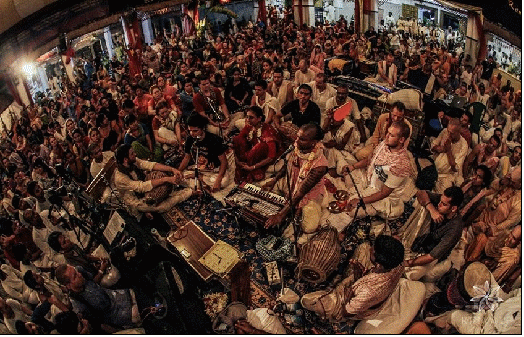
‘Kirtan
Mela’, a congregational chanting event in Mayapur, West Bengal,
India.
Source: Jagannath Kirtan,
https://www.facebook.com/kriyateco?fref=ts
The performers (known as kirtaniyas, or kirtan mandalis, for
group singers) are quite accessible, and much more humane and real in their songs, and love for music. The leader chants the mantra first, and then the audience
sings it back (the call-and-response method). A single chant may go on for up
to forty minutes, close to an hour sometimes. As you sing with one another, you
experience a almost magical and reciprocal connection with the all-powerful mantra,
the musicians, the other audience members, and yourself. And when the music
stops, your mind is quiet.
By reciting these simple mantras again and
again, first slowly, then faster, and then back to a slow, meditative chant, kirtans
have become a simple and enjoyable way for people to experience some sort of
freedom and withdrawal from society, and the thoughts of the mind. The music
does the work for you as you simply stick to the flow of the melody and rhythm.
While it is factually true that these chants can be sung from the confinements
and solitude of your own home, there is literally nothing like the magic of
chanting, live with various singers, and instruments, and with hundreds of
eager and enthusiastic response singers - from kids to teenagers to seniors - adding
all their different energies and vibes to the chant (the proof of the pudding
is in the eating!). People often say that they feel spiritually connected for
days following such an intense and loving experience in a kirtan.
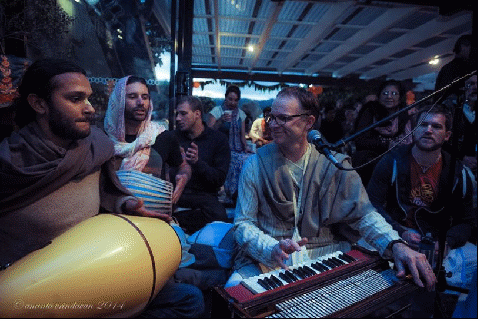
A
meditative kirtan chant on a farm community in Gold Coast, Australia.
A harmonium and two ‘mrdangas’ are used. Source: Ananta
Vrindavana, https://www.facebook.com/anantav?fref=ts
While nurturing an
inner calmness and maintaining a healthy state of body, mind and soul, kirtans actually
helps one develop and maintain both mental and spiritual health. It betters the
quality of one’s particular work, service, and life. Day-to-day activities go
on, and occasionally knock one off balance – it is a natural thing of life, and
unavoidable. It does take discipline, though, and this can prove to be a
challenge for us all. Mantra meditation through kirtan is an essential tool to
focus the mind. Focusing the ever turbulent and obstinate mind can help
one to develop calmness, and develop a sense of serenity and clarity in life.
Although kirtan
involves using various instruments and different melodies and tunes, the true art
of kirtan chanting is not actually about musical ability or training - it really
is about the quality, and sense of prayer. Everyone can participate, regardless
of age or cultural background, and the purpose of this genre is to get us out
of our heads and into our hearts. Typically, each kirtan slot can last for 30
minutes each, with a few moments of silence in between each song so you can
soak it all up. The longer chants allow for deeper experience of the effects,
with the same, same lyrics (it is a ‘chant’, after all!), and so we do not
really have to think much about the words, just about its potency and glories.
In the last ten to fifteen years,
kirtans have become a phenomenon across the United States, and has transformed musically
to appeal to the ears of the western audience. Western tunes are being
practices and used, and everyone – from Africa, to London, to Kuala Lumpur, to
Australia and to Russia even! – is getting into the awe-inspiring and
reciprocal kirtan generation.
The simplest mantra to chant is the Hare Krishna Maha-mantra, which goes: Hare
Krishna Hare Krishna Krishna Krishna Hare Hare/Hare Rama Hare Rama Rama Rama
Hare Hare.
http://hinduism.about.com/od/audiomusic/a/kirtan.htm
http://newworldkirtan.com/what-is-kirtan/
http://www.iskcon-london.org/61-activities/mantra-lounge/586-mantra-meditation.html
http://www.iskcondesiretree.net/profiles/blogs/the-science-of-mantra-meditation
http://www.iskcondesiretree.net/profiles/blogs/benefits-of-mantra-meditation
Name:
Vinodh Pillai
Student ID: 0321648