Sri
Ahobilam Yatra
Sri Nava Narasimha Ksetra
Place where Lord Nrsimhadeva emerged from the pillar of
Hiranyakasipu’s palace,
killed the demon and saved Prahlada
Ahobilam
(Ahobalam) is
the place where Supreme Personality of Godhead incarnated Himself as Lord
Nrsimhadeva to killed the demon Hiranyakasipu and save His dear-most devotee
Prahlada. Here at Ahobilam, Lord Nrsimhadeva emerged from the pillar of
Hiranyakasipu’s palace, killed him after a fierce fight, simultaneously
honouring the boons that Hiranyakasipu received from Lord Brahma. The pillar
from where Lord Nrsimhadeva appeared, the ruins of the palace of Hiranyakasipu,
the exact spot where Lord Nrsimhadeva killed Hiranyakasipu, the pond where Lord
Nrsimhadeva washed His lotus hands after killing Hiranyakasipu and the school
where Prahlada studied still exist at Ahobilam. Lord Caitanya Mahaprabhu visited Ahobilam during His south India
pilgrimage as mentioned in Sri Caitanya Caritamrta Madhya-lila chapter 9 verses
16-17 and Madhya-lila chapter 1 verse 106. Lord Ramacandra also came here and
sung five verses named “Narasimha Panchamritam”. Ahobilam is located in Kurnool district of Andhra Pradesh
amidst the majestic hills of the Eastern Ghats range. It is 256 km from
Tirupati, 110 km from Cuddapah, 68 km from Nandyal and 24 km from Allagadda. To
visit Ahobilam, the best is to travel from Tirupati. It is approximately 5
hours drive from Tirupati to Ahobilam (256 km).
Ahobilam
- The Great Strength
Ahobalam means: “Aho Balam (what
great strength!)”
When
Lord Nrsimhadeva, the half-lion and half-man incarnation of Supreme Lord,
emerged out of pillar in His fierce and effulgent form, all the devatas
(demigods) exclaimed “Aho Balam (what great strength!)”. Sthala purana mentions
this wonderful pastime an additional note to Lord Narasimha Lila mentioned in
7th canto of Srimad-Bhagavatam.
“aho viryam aho shauryam aho
bahuparakramah
narasimham param daivam ahobilam aho
balam”
On the
plea of Prahlada, Lord Nrsimhadeva continues to reside at Ahobilam on the peak
“Garudachala”. Since this place was contaminated by blood of Hiranyakasipu and
his army, Lord invoked River Mandakini to clean it. Since the river cleansed
the dirt (sins) that causes birth (bhava), she came to be called as River
“Bhavanashini”. Laxmi Devi appeared and sat on the folded leg of the lord. The
forest grove thus got their name as Laxmivan. Seeing this beautiful sight of
Lord and her consort, all great sages assembled and sang praises and hymns from
Vedas. The mountain from where they chanted came to be called as “Vedadri”. Ahobilam also got its name because of bila (cave). Long,
long ago (even before Lord Nrsimhadeva’s appearance to kill Hiranyakasipu),
Garuda once performed severe penance with a desire to see the darshan of Lord
in Narasimha form. Pleased with him, Lord guided Garuda to see His Narasimha
avatar form in a nearby huge cave. Garuda proceeded and was benedicted to see
this beautiful form in this cave. Hence this area also got its name place of
beautiful cave “Ahobilam”. The mountain on which Garuda performed austerities
came to be known as Garudachala, Garudadri and Garudashailam.
It is very popularly known that the Nallamalai range of mountain
(Eastern Ghats) is the manifestation of Sri Adi Sesha - the great serpent bed
of Lord Vishnu. On His seven hoods lays Tirupati, on stomach Ahobilam and
on the tail lays Sri Shailam. The Brahmanda Purana states that Ahobilam was the
dwelling of the demon king Hiranyakasipu who was killed by the
Lord. Mention of legends connected with Ahobalam can be found in
Kurma Purana, Padma Purana and Vishnu Purana. This place is known by
many names: Ahobalam, Nava Narasimha Kshetra, Singavel Kundram, Pancha krosa
Kshetra, Garudachala and Vedachala.
Many
great devotees like Sripad Ramanujacarya, Vedanta Desika also rendered services
here and many of them composed beautiful prayers and songs at feet of Lord
Nrsimhadeva. Ramanujacarya visited here in 11th Century A.D and
Vedanta Desika in 1268-1379 A.D. The great king, Vikramaditya (1076-1106 A.D)
of the western Chalukyas, also worshipped the main deity of the temple. “Sri
Laxmi Nrsimha pancaratna stotra” and “Karaavalamba stotra” are two
very famous hymns composed by Adi Sankaracharya when he came here. “Angan
naalam” - was sung by the great Thirumanghai Alwar.
Sri Nava
Narasimha Temples in Ahobilam
Ahobilam
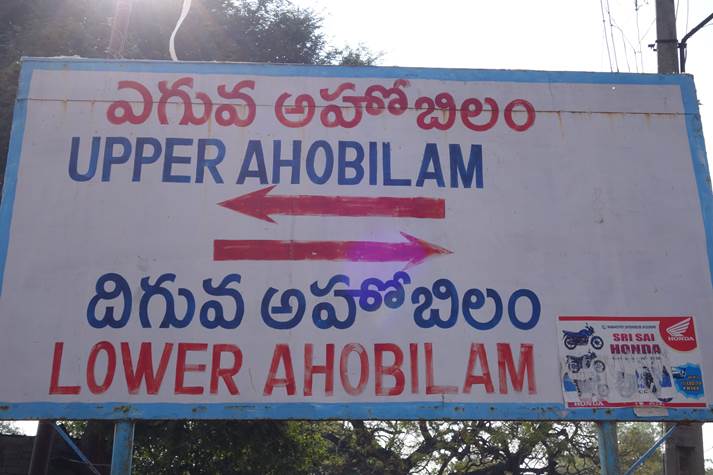
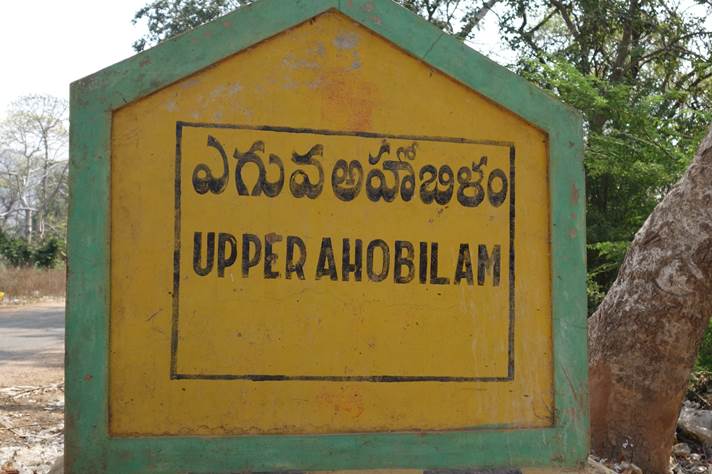
consists of two parts: Lower Ahobilam (also known as Chinna
Ahobilam or Diguva Tirupati) and Upper Ahobilam (also known as
Pedda Ahobilam and Eguva Tirupati; which is 8 km from Lower Ahobilam). The
place is surrounded by beautiful dense forests of Eastern ghats, and several
wild animals like bears and tigers are said to be living there. Within these
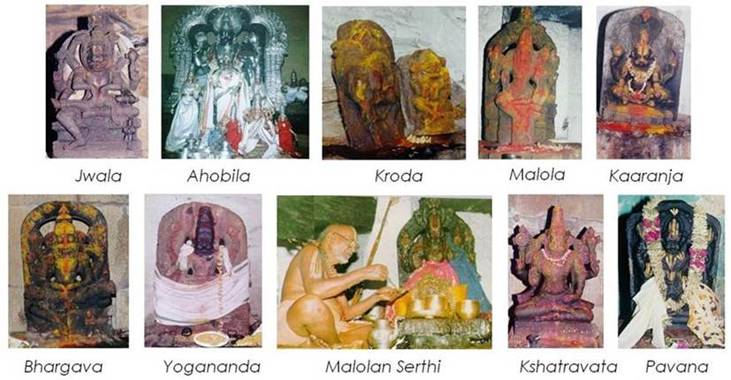
forests, on mountaintops, are located nine temples of Lord Nrsimhadeva (Nava
Narasimha Ksetra), which house the self-manifested Deities of the Lord, all
having different forms and moods that the Lord manifested in order to please
His devotees. There are many places, where Lord Vishnu in the form of Narasimha
is worshipped, but it is only at Ahobilam that all the nine forms of Lord Nrsimhadeva
are worshipped.
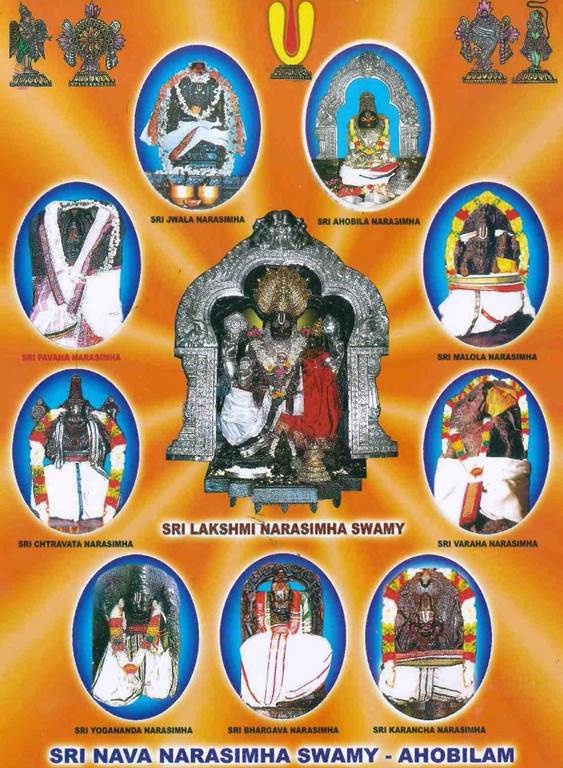
jwala ahobila malola
kroda karanja bhargava
yogananda kshatravata
pavana nava murthayaha
The nine Deities are Sri Jwala Narasimha, Sri Ahobila Narasimha,
Sri Malola Narasimha, Sri Kroda Narasimha, Sri Karanja Narasimha, Sri Bhargava
Narasimha, Sri Yogananda Narasimha, Sri Chatravata Narasimha and Sri Pavana
Narasimha.
Temples in Lower Ahobilam:
·
Sri Bhargava Narasimha Temple
·
Sri Yogananda Narasimha Temple
·
Sri Chatravata Narasimha Temple
·
Sri Karanja Narasimha Temple
·
Sri Prahlada Varada Narasimha Temple
Temples in Upper Ahobilam:
·
Ugra Stambha (Pillar from where Lord
Nrsimhadeva emerged)
·
Sri Jwala Narasimha Temple
·
Sri Ahobila Narasimha Temple
·
Sri Malola Narasimha Temple
·
Sri Krodha (Varaha) Narasimha Temple
·
Prahlada Mettu (School where Prahlada
studied)
·
Sri Pavana Narasimha Temple
·
Sri Prahlada Varada Narasimha Temple
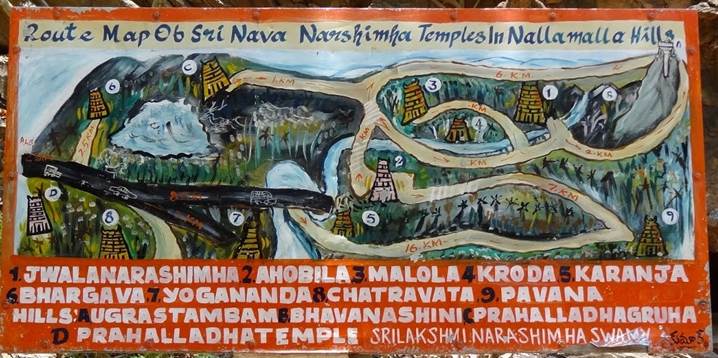
Route Map of Sri Nava
Tirupati Temple in Nallamalla Hills
Ahobilam is 256 km from Tirupati,
110 km from Cuddapah, 68 km from Nandyal and 24 km from Allagadda. To visit
Ahobilam, the best is to travel from Tirupati. It is approximately 5 hours
drive from Tirupati to Ahobilam (256 km).
Useful information:
·
Hiring Guide: If you
are visiting Ahobilam for the first time, it is highly recommended to hire a
Guide for a fee to take you around all the temples.
·
Visiting Pavana Narasimha temple: The
starting point for Pavana Narasimha temple is also Ahobila Nrisimha temple in
Upper Ahobilam, but the route is on the opposite side of Jwala Temple. First,
one has to climb some 250 very steep steps, and then walk for about 4 km on
fairly plain ground. The round trip may take about 3 hours. Recently, a path
has been made for Jeeps to go to Pavana. It is a very rough 2 hour drive from
Lower Ahobilam.
·
One can cover eight out of nine Lord Nrsimhadeva temples at
Ahobilam in one day. It is highly recommended that Sri Pavana Narasimha temple
be covered on the second day since it is on another side and it will take at
least 3-4 hours to cover this temple.
·
Prasadam: Sri Ahobila Mutt has
established a trust called Annamacharya Nitya Annadanam Trust which
provides free prasadam to devotees. Free prasadam is offered three time a day. Dadiyannam
(Curd rice) is offered morning and evening. At noon time Tadiyaradhanam
(full course meals) is offered.
·
Accommodation: There
are a few Guest House accommodations available at Lower Ahobilam.
·
To visit Ahobilam, the best is to travel
from Tirupati. It is approximately 5 hours drive from Tirupati to Ahobilam (256
km).
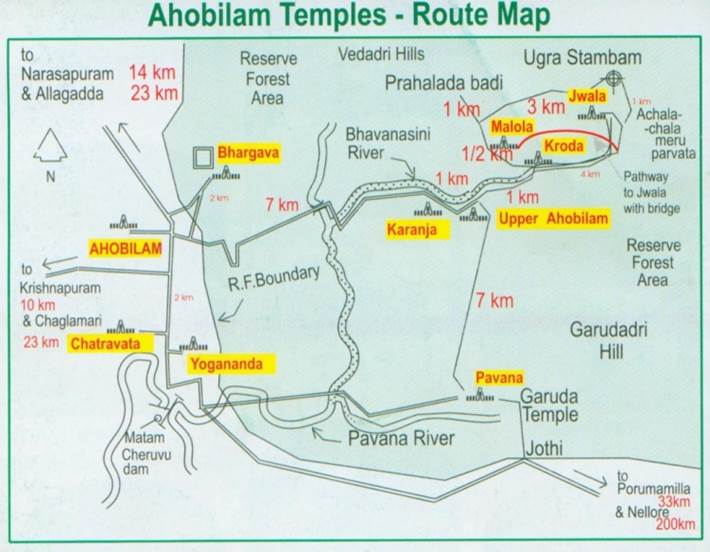
Ahobilam Temples -
Route Map
Ugra
Stambha
Pillar
from which Lord Nrsimhadeva emerged
satyam vidhathum nijabruthya bhaashitham
vyaaptham swabhutheshu swachirey swachaathmanaha
adhrushyathaam adhbutharoopam udhvaham
sthamba sabhamam na mrugam na manusham
na bhootho na ambharey mruthyuhu na
naraih na mugrairapi surasura
mahorakhai
At
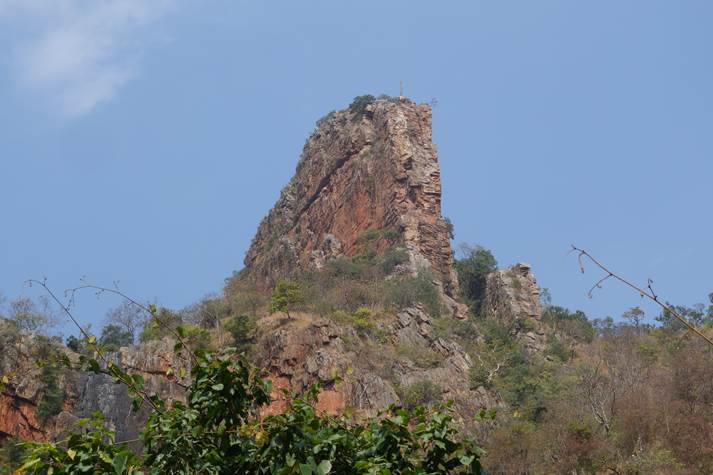
a distance of 8 km from the Upper Ahobilam is Ugra Stambha, the pillar
from which Lord Nrsimhadeva emerged after
Hiranyakasipu angrily struck the pillar. This a cleft
of the mountain dividing itself into two visible parts. When Lord Nrsimhadeva
emerged out of the pillar, the whole pillar was shattered to pieces. His first
step produced 172 sounds which are the first basic tenets of 172 classical ragas.
One can climb up the Ugra Stambha, however the path way to this place is
very steep and arduous. When Lord Caitanya Mahaprabhu came to Ahobilam, He
climbed up the Ugra Stambha. Atop Ugra Stambha there is an
impression of the lotus feet of Sri Caitanya Mahaprabhu and a flag. From
near Sri Jwala Narasimha temple there is a steep climb towards Ugra Stambha.
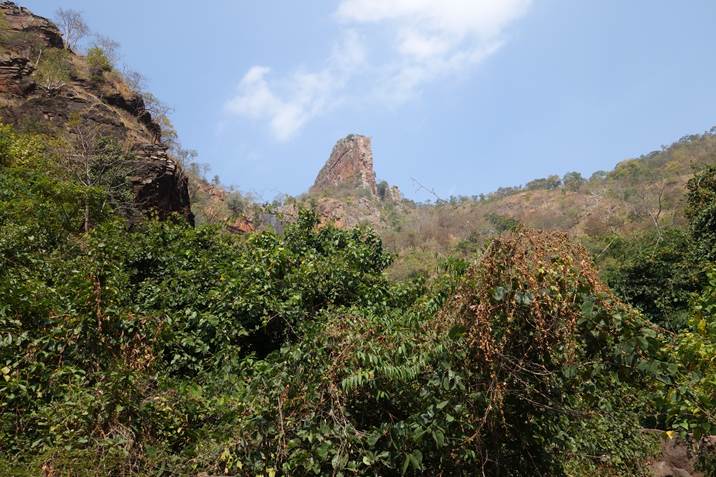
Ugra Stambha
This is the pillar from which Lord
Nrsimhadeva emerged after Hiranyakasipu angrily struck the pillar.
Ugra Stambha
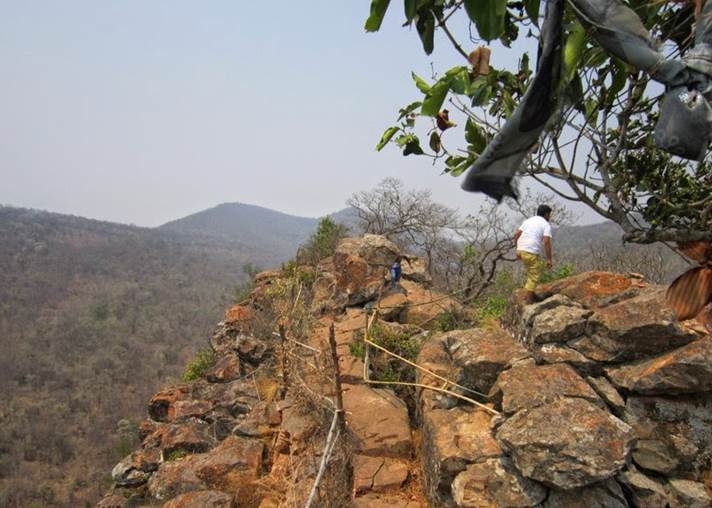
Climbing the Ugra
Stambha
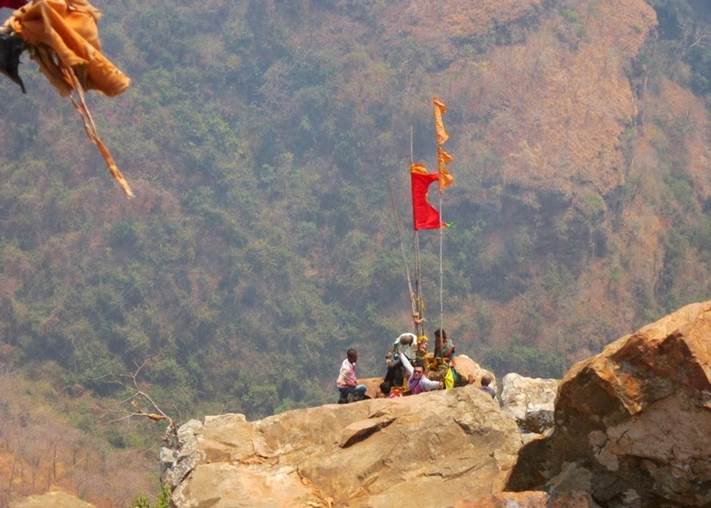
Atop the Ugra Stambha
Atop Ugra Stambha
there is an impression of the lotus feet of Sri Caitanya Mahaprabhu and a flag.
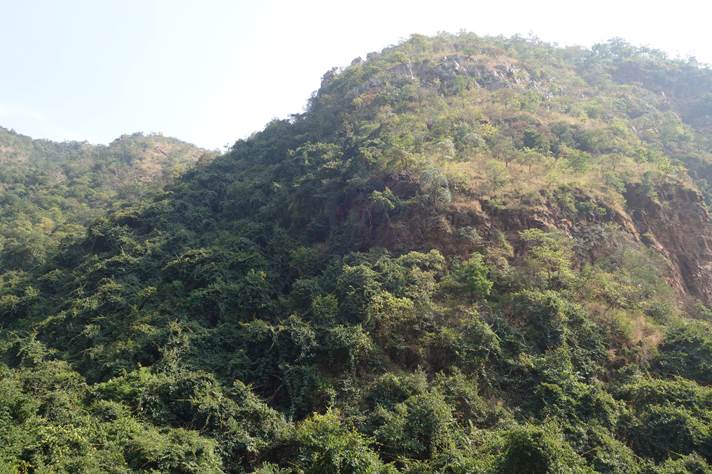
This is where
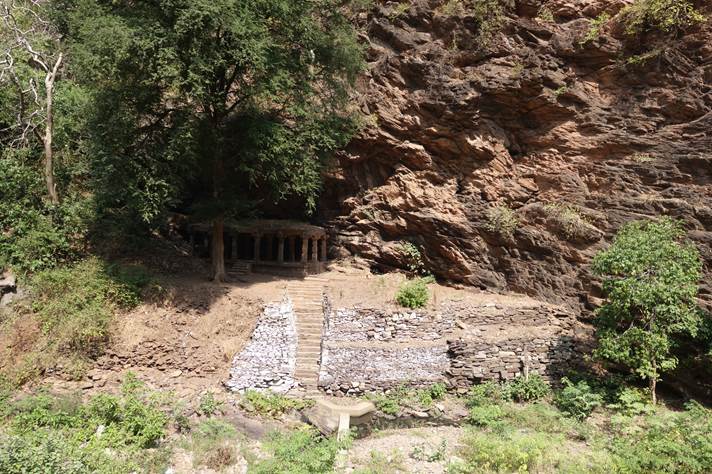
Hiranyakasipu’s palace existed
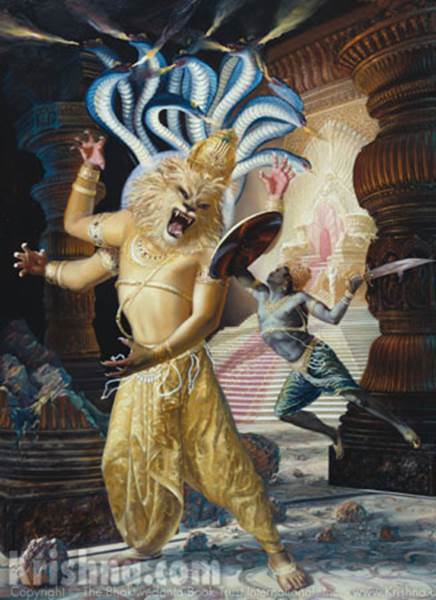
Lord Nrsimhadeva
Battles the King of the Demons
Hiranyakasipu could see that Lord
Vishnu was standing before him in the form of a half-man, half-lion, but out of
his pride, Hiranyakasipu thought, "Who can fight with me?" Raising
his club, he attacked Lord Nrsimhadeva, and appeared just like a small insect
who flies forcefully into a fire. Such was the effulgence of the Lord. Lord
Nrsimhadeva captured the demon; and then gave him a chance to escape. Foolishly
thinking the Lord was afraid of his prowess, Hiranyakasipu attacked again.
1. Sri
Jwala Narasimha Temple
Exact place where the fierce anger of the Lord
Nrsimhadeva reached its culmination when He tore Hiranyakasipu
hiranyashtambha sambhuthiprakhyat paramaatamaney
prahladhaarthimushey jwaala narsimhaya mangalam
The temple
of Sri Jwala Narasimha Swamy, lies higher up the Sri Malola Narasimha
temple, on a hill called 'Achalachaya Meru' and is on the base of
Ugra Stambha. This is the exact place where the fierce anger of the Lord
Nrsimhadeva reached its culmination when He tore Hiranyakasipu. The spot where
Jwala Narasimha is sitting with Hiranyakasipu on His lap, is the threshold of
the main entrance door of the spacious palace of Hiranyakasipu. The temple
is in a natural cave. There are three deities in the temple: Ashtabuja
Narasimha, Chaturbhuji Narasimha and Narasimha chasing Hiranyakasipu.
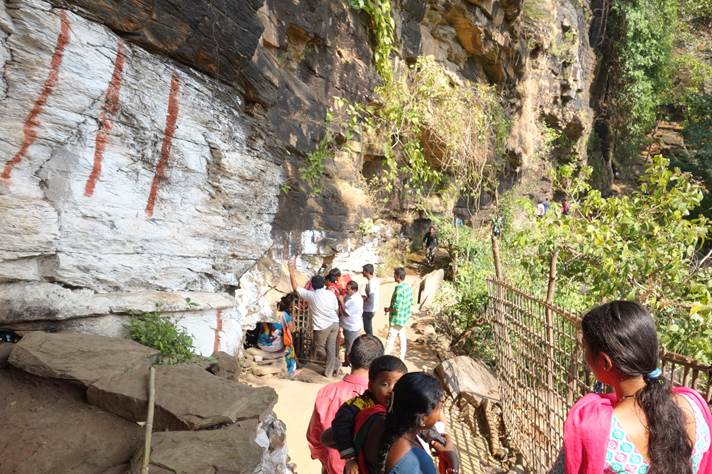
Temple is about 4 kilometres from the Upper Ahobilam temple. One has to go
under the waterfall of the Bhavanashini River to reach this temple.
In front of
the Jwala Narasimha temple is a pond called “Rakta Kunda tirtha”,
below a fully open cave, where Lord Nrsimhadeva after killing the demon
Hiranyakasipu, washed His blood-stained hands and hence the water of this kunda
turned red. One can see the red strains around this tirtha. The water of
this kunda is crystal clear and is very sweet.
Ashtabuja Narasimha:
The main
Deity here has eight hands, and the Lord is seen tearing the demon’s abdomen
and garlanding Himself with the demon’s intestine. The Deity manifests massive
energy and vigorous action. The first pair of hands catches hold of
Hiranyakasipu’s crown and renders him motionless, while the other pair by
tightly gripping the sword-carrying hand of Hiranyakasipu completely disarms and
overpowers him. The second pair of hands is engaged in tearing open the
entrails of the demon lying on the folded right leg of the Lord. The pair of
hands holds sankha and chakra and the fourth pair holds the
intestine of the demon in the shape of a garland.
Chaturbhuji Narasimha:
This
Deity is in the standing posture coming out of the pillar (Stambhodbhava-murti).
This is said to represent the Kevala Narasimha form. This is very rare
form. It has 4 hands, the 2 upper hands holding chakra and sankha
and the lower hands are downwards as though He is tearing the demon. Laxmi is
seated to the right and Prahlada stands to the left.
Narasimha
chasing Hiranyakasipu:
The
third Deity, Lord Nrsimhadeva is advancing towards Hiranyakasipu from the
right, as the latter is approaching in a defiant attitude, with his sword
lifted up to strike. Lord Nrsimhadeva is made to take hold of the body of
Hiranyakasipu so as to overpower him. The right hand of Lord Nrsimhadeva is
held up as if He is going to deal a blow to the enemy with the open palm of the
hand.
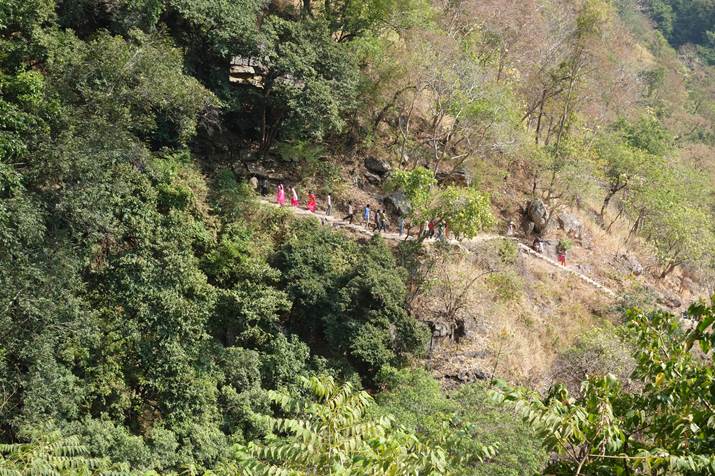
Way to Sri Jwala
Narasimha Swamy temple
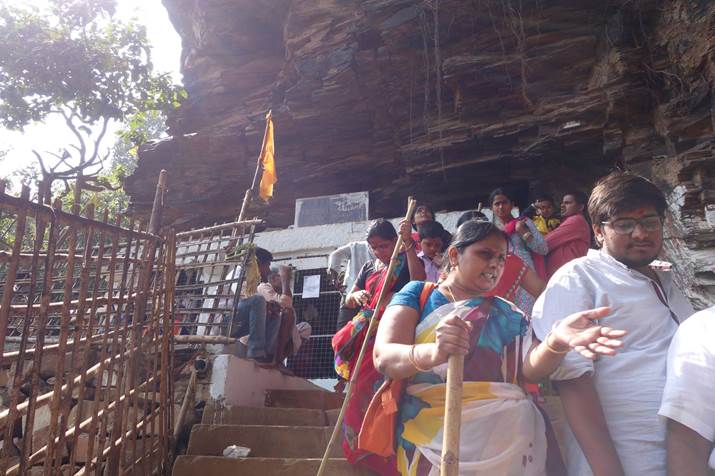
Sri Jwala Narasimha Swamy
temple
This place is the exact place where
the fierce anger of the Lord Nrsimhadeva reached its culmination when He tore
Hiranyakasipu.
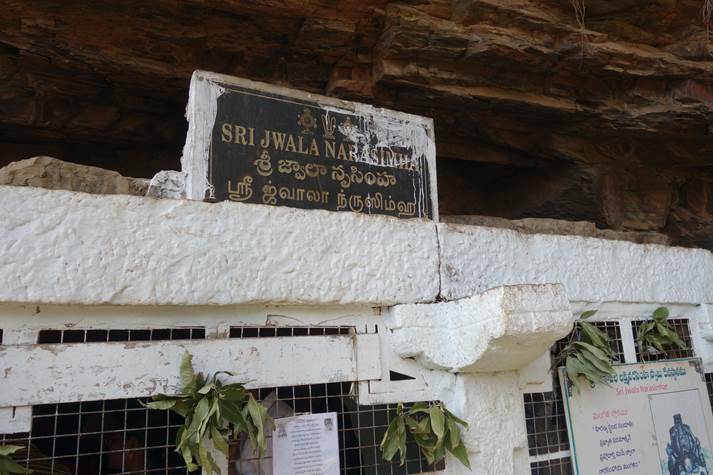
Sri Jwala Narasimha
Swamy temple
The spot where Jwala Narasimha is
sitting with Hiranyakasipu on His lap, is the threshold of the main entrance
door of the spacious palace of Hiranyakasipu.
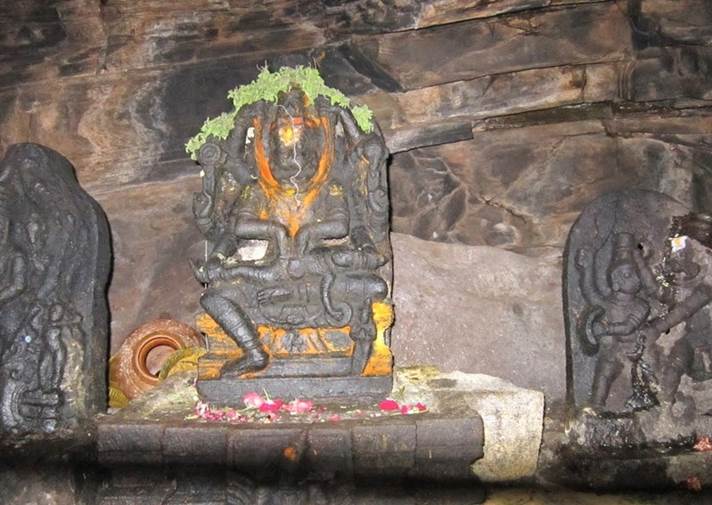
Lord Sri Jwala
Narasimha Swamy
There are three deities in the
temple: Ashtabuja Narasimha, Chaturbhuji Narasimha and Narasimha chasing
Hiranyakasipu.
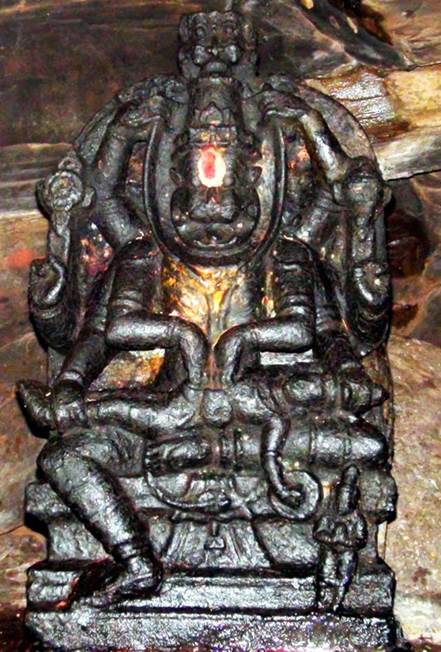
Sri Jwala Narasimha
namas te narasimhaya
prahladahlada-dayine
hiranyakasipor vaksah-
sila-tanka-nakhalaye
ito nrsimhah parato nrsimho
yato yato yami tato nrsimhah
bahir nrsimho hrdaye nrsimho
nrsimham adim saranam prapadye
tava kara-kamala-vare nakham
adbhuta-srngam
dalita-hiranyakasipu-tanu-bhrngam
kesava dhrta-narahari-rupa jaya
jagadisa hare
jaya jagadisa hare jaya jagadisa
hare
(Lord Nrsimhadeva Prayers)
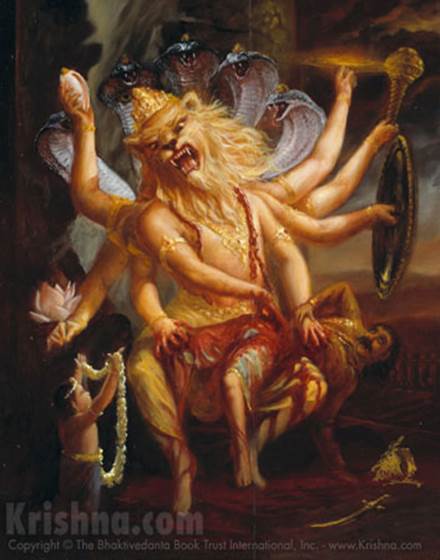
Lord Nrsimhadeva Kills
Hiranyakasipu
The Supreme Lord laughed loudly and
captured the demon again. Hiranyakasipu moved his limbs all around, but the
Lord simply placed the demon on His lap and with the sharp nails on His lotus
hands, He easily tore into Hiranyakasipu's body.
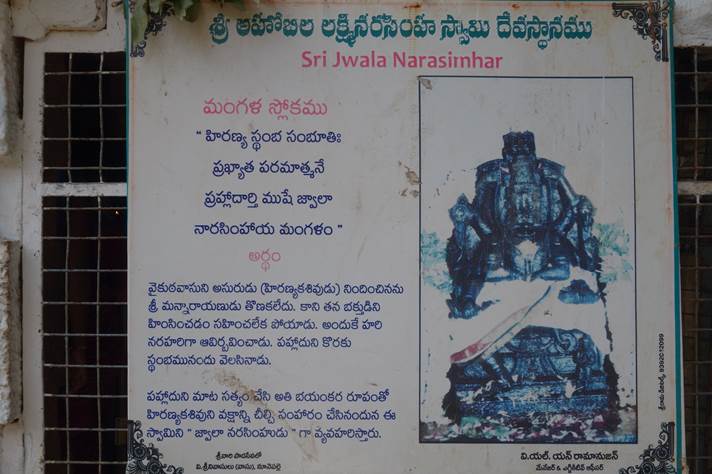
Sri Jwala Narasimha
Swamy temple
Rakta Kunda tirtha
In front of the Jwala Narasimha
temple is a pond called “Rakta Kunda tirtha”, below a fully open cave, where
Lord Nrsimhadeva after killing the demon Hiranyakasipu, washed His
blood-stained hands and hence the water of this kunda turned red.
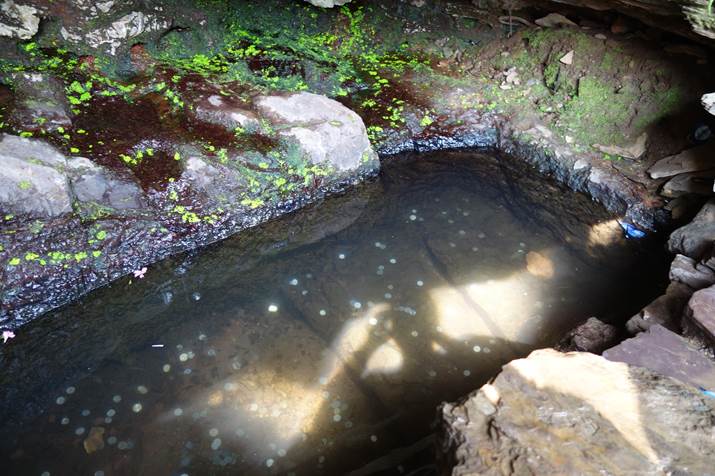
Rakta Kunda tirtha
The water of this kunda is crystal
clear and is very sweet.
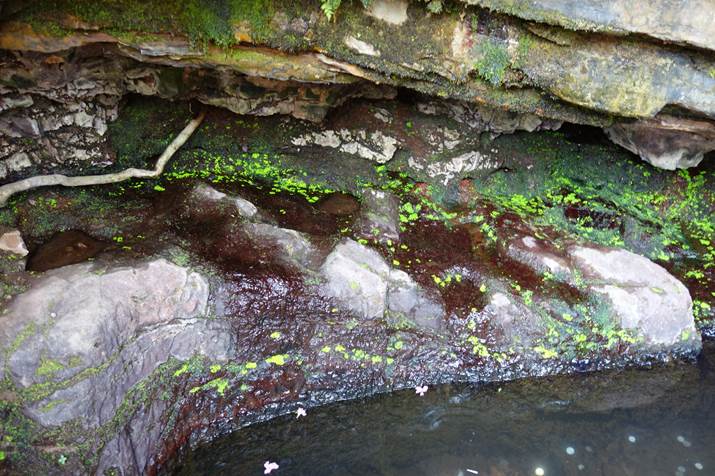
Rakta Kunda tirtha
One can see the red
strains around this tirtha.
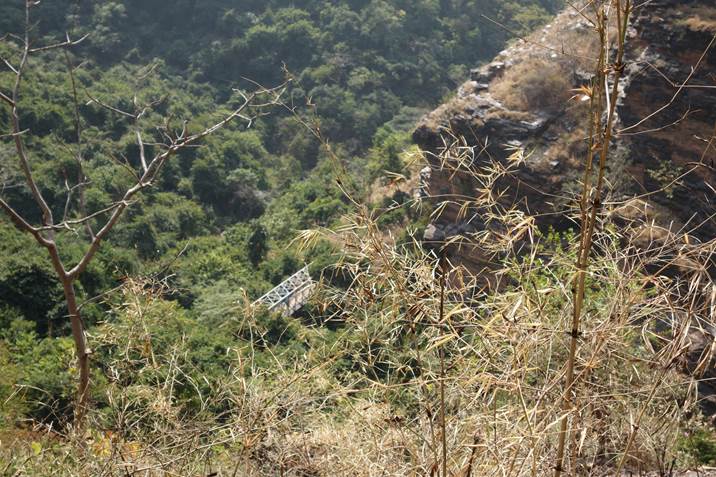
Stunning views looking
downwards from Sri Jwala Narasimha Temple
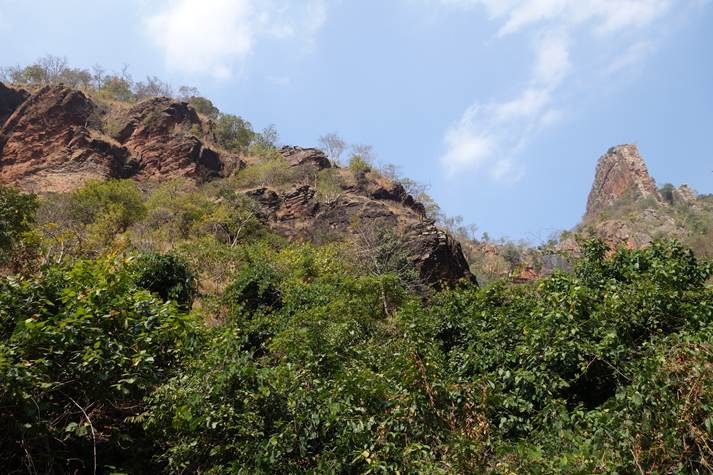
Area of
Hiranyakasipu’s palace
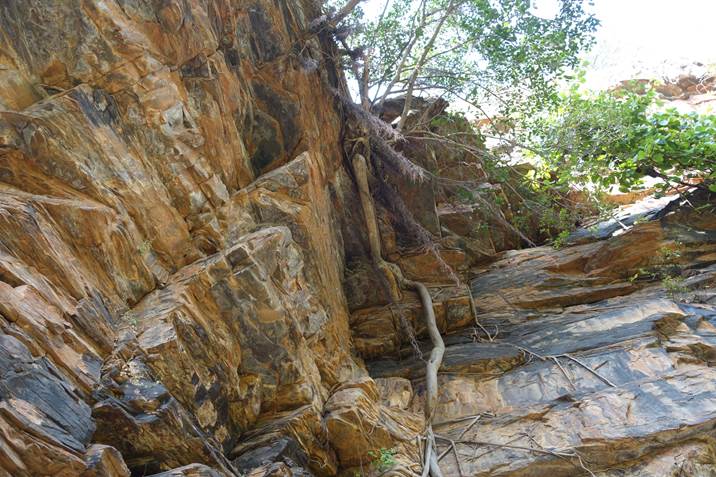
Area of
Hiranyakasipu’s palace
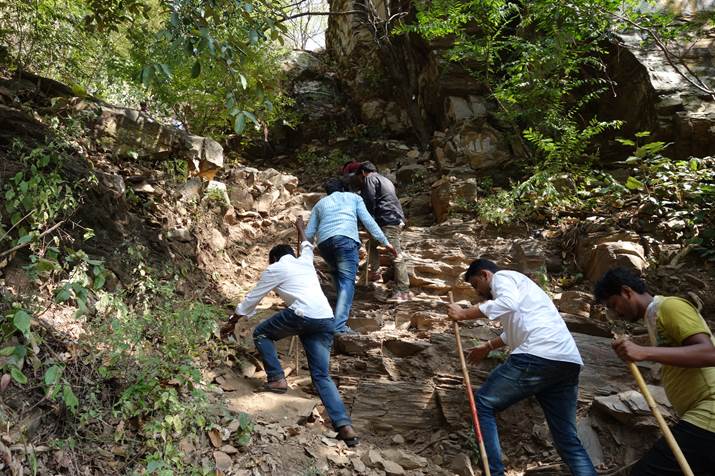
Way to Ugra Stamba
from near Jwala Narasimha temple
2. Sri
Ahobila Narasimha Temple
garudadri guhagehe gajakhundasarittate
hiranyasthaanvahankaarhaari simhaya mangalam
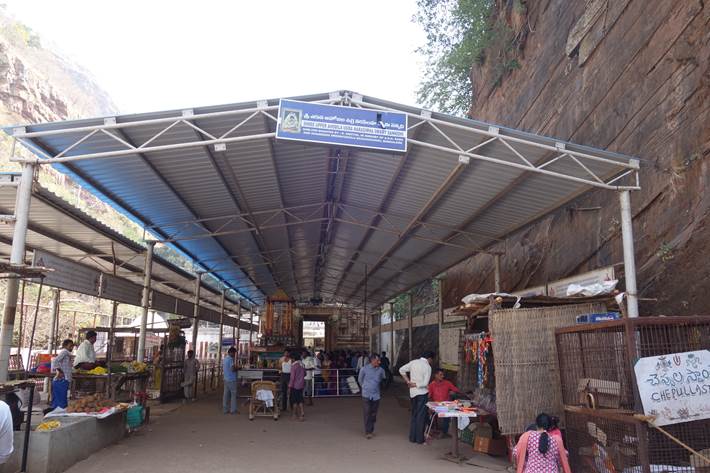
Sri Ahobila Narasimha temple, situated on the Upper Ahobilam, at a
distance of 8 km from the Lower Ahobilam, is the main temple and the earliest
of all the nine temples in Ahobilam. The Lord here appears in his fierce aspect,
called Ugra Narasimha, who is the presiding deity of the temple and is
known as Ahobila Nrisimha Swamy. Lord is seen tearing apart the chest of
Hiranyakasipu. In front of the Lord is Prahlada. Lord’s eternal consort Srimati
Chenchu Lakshmi is also giving darshan to the devotees. She is seated in
padmasana. The temple is situated in a naturally formed cave.
Sri Ahobila Narasimha
temple is on the Upper Ahobilam
Cave near Sri
Ahobila Narasimha temple
Sri Ahobila Narasimha
temple
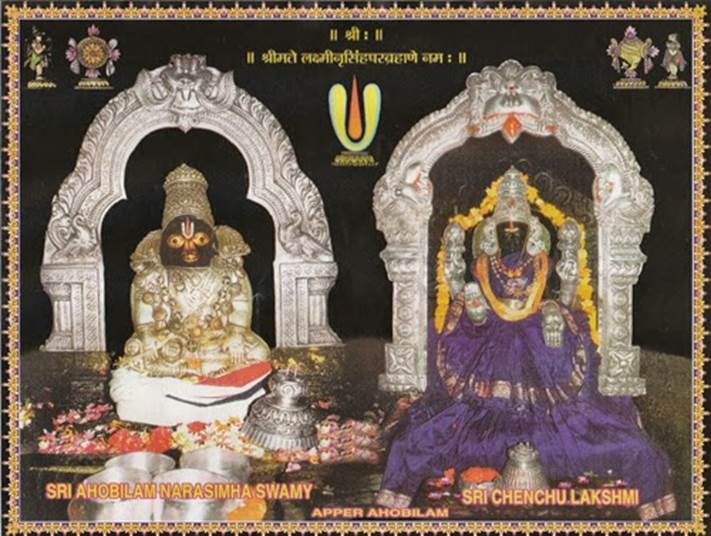
Sri Ahobila Narasimha
and Sri Chenchu Lakshmi
The Lord here appears in
his fierce aspect, called Ugra Narasimha, who is the presiding deity of the
temple and is known as Ahobila Nrisimha Swamy. Lord is seen tearing apart the chest
of Hiranyakasipu. In front of the Lord is Prahlada. Lord’s eternal consort
Srimati Chenchu Lakshmi is also giving darshan to the devotees.
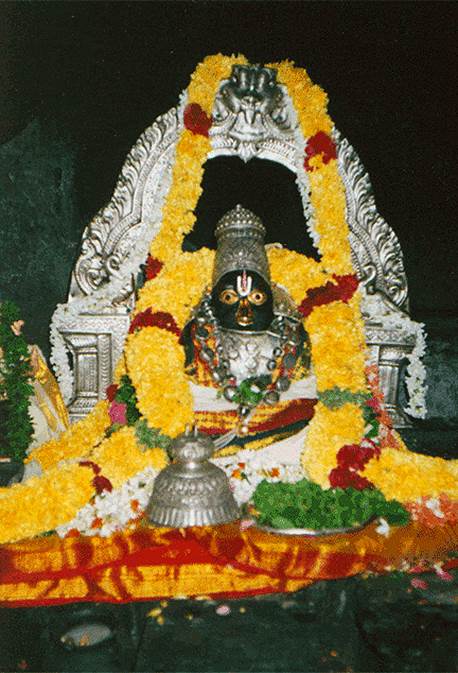
Sri Ahobila Narasimha
Sri Ahobila Narasimha
temple
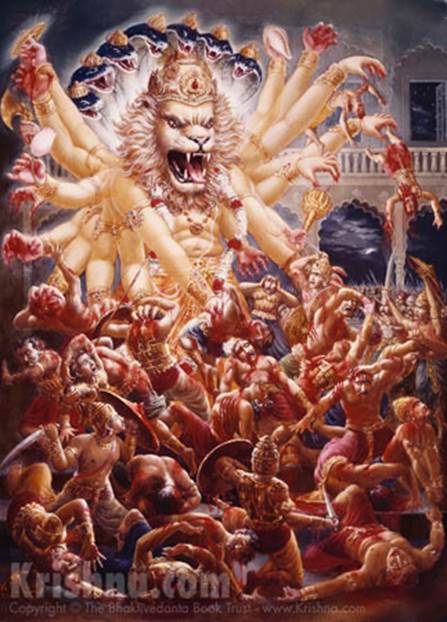
After killing
Hiranyakasipu, Lord Nrsimhadeva's mouth and mane was sprinkled with drops of
blood. Lord Nrsimhadeva pierced Hiranyakasipu's abdomen with His nails and wore
his intestines as a garland, which enhanced the Lord's beauty. He then uprooted
Hiranyakasipu's heart and threw his body aside. The faithful soldiers of
Hiranyakasipu came in thousands to fight with Him, raising their weapons, but
Lord Nrsimhadeva killed all of them merely with the ends of His nails.
3. Sri
Malola Narasimha Temple
vaarijaavaaritha bhayay vaneepathi mukhaiswarai
mahithaaya mahodhaara malolyasthu mangalam
Sri Malola Narasimha temple is 2 km from the main temple of Upper
Ahobilam. Lord Nrsimhadeva here appears in 'Soumya' (peaceful) form. Ma
means Mother Lakshmi and lola means beloved. Lord
Nrsimhadeva is the beloved of mother Lakshmi and hence is glorified as Malola
Narasimha. This place is also known as Markonda Lakshmi ksetra. The
temple is on a level surface of a peak of the Vedadri Mountain. Lord
Nrsimhadeva is seated here in Sukhasana posture with His left leg folded while
the right leg is dangling at an angle. The goddess Laxmi is seated on the left
thigh of the Lord with Kataka and Parisaritya vamahasta. The feet
of the Laxmi rest on padma which appears to have sprouted from the
earth. The Lord’s two upper hands hold chakra and sankha, His
lower right hand is in abhaya pose and the lower left hand is embracing
His consort. The utsava murti of Sri Malola Narasimha travels with the
Jeeyar of Ahobila Mutt.
Pastime:
There was a young devotee named Srinivasacharya at Melkote. One
day Lord Lakshmi Narasimha appeared in his dream and ordered him to come to
Ahobilam, take sannyasa and carry on his future mission from Ahobilam. Young
Srinivasacharya could not believe his dream and rushed to his guru, Sri
Ghatikasatam Ammal who was also known as Varada Vishnuvarcharya and sought his
instructions. He immediately told Srinivasacharya to follow the order of the
Lord without any delay.
Blessed by his guru, Srinivasacharya rushed to Ahobilam. There he
was received by Mukundaraya, a local chieftain, who also had an order from the
Lord to receive Srinivasacharya at Ahobilam. Lord Narasimha appeared before
Srinivasacharya in the form of a saint and initiated him into the sannyasa
asrama and also formed the Ahobilam Mutt. The Lord awarded him the name -
Sathakopa Jeeyar. He instructed him to go door to door to preach the message of
Vaishnavism, and take along with him the utsava murti of the Lord. The Lord
also wanted him to be the spiritual master of the disciples.
Sri Sathakopa Jeeyar was confused as to which utsava murti he has
to carry with him. The Lord had instructed him to take utsava murti but had not
told which utsava murti. He started meditating on the Lord requesting Him to
choose the utsava murti. Immediately the utsava murti of Sri Malola Narasimha
came from the temple flying to his hands. The utsava murti of Sri Malola
Narasimha is adorned with a Paduka indicating that the Lord is ready to proceed
on a tour. Since then the utsava murti of Sri Malola Narasimha has been
travelling with the Jeeyars of Ahobilam Mutt and has been blessing devotees
with the mercy and devotional service. Right from the founder, i.e., the first
Jeeyar of Ahobila Mutt down to the 44th pontiff, Srivan Satakopa Sri Vedanta
Desika Yatheendra Mahadesika, the present jeeyar, the utsava murthi of Malola
Narasirnha Swamy is worshipped and it is taken by them whenever they are on
religious tours, visiting the villages every year.
About 1 km away from this temple, on the same mountain, there is Prahlada-mettu,
or the school where Prahlada Maharaja is said to have taken education. There is
a small temple of Nrsimhadeva inside a cave.
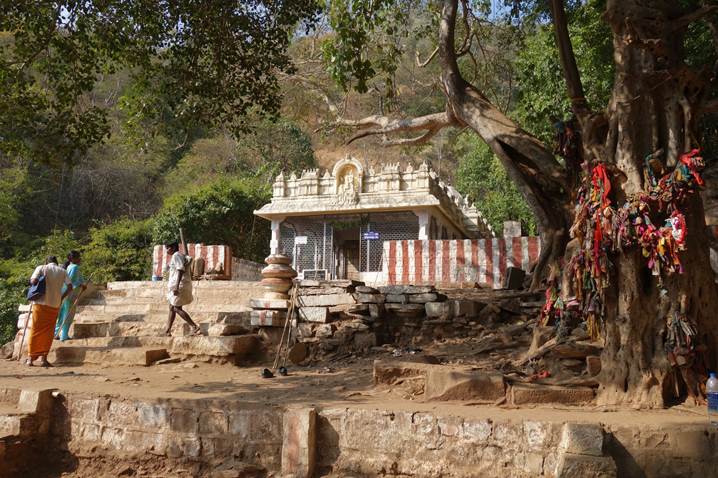
Sri Malola Narasimha
temple
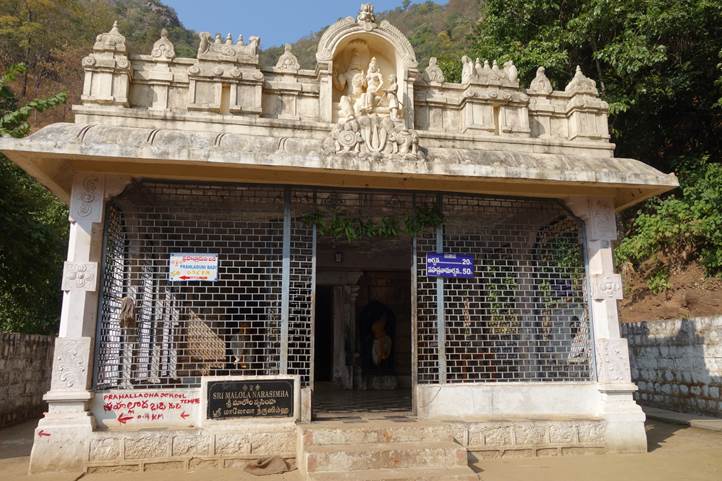
Sri Malola Narasimha
temple
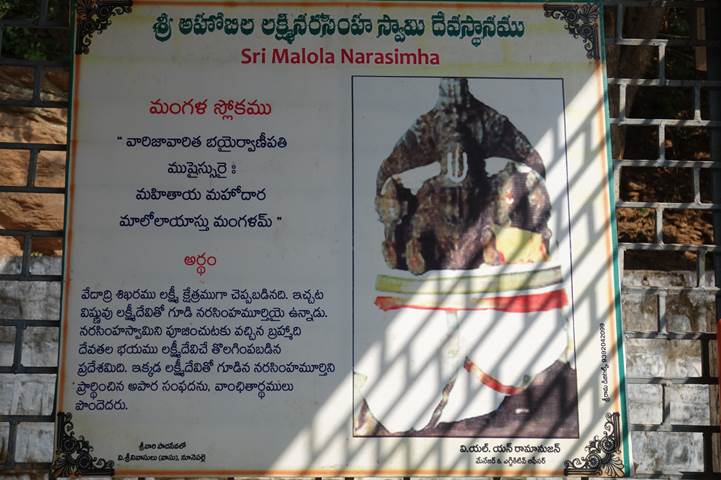
Sri Malola Narasimha
temple
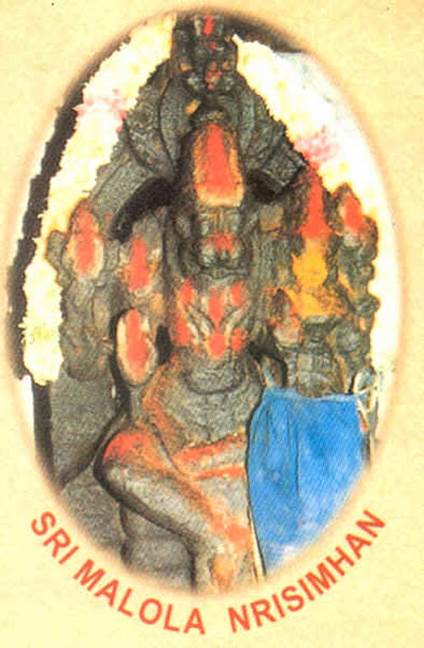
Lord Sri Malola Narasimha
Lord Nrsimhadeva here
appears in 'Soumya' (peaceful) form. Ma means Mother Lakshmi
and lola means beloved. Lord Nrsimhadeva is the beloved of mother
Lakshmi and hence is glorified as Malola Narasimha.
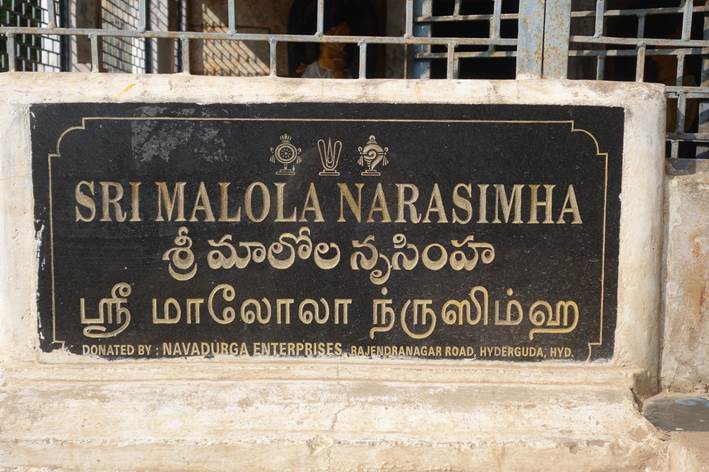
Sri Malola Narasimha
temple
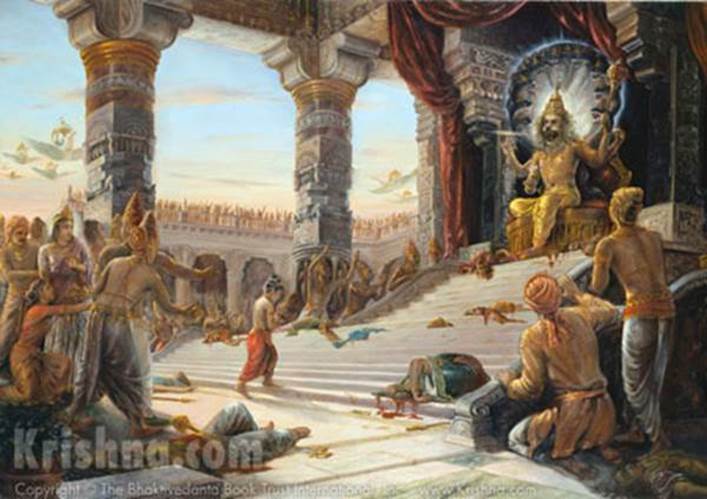
Prahlada Approaches
the Angry Lord Nrsimhadeva
After Lord Nrsimhadeva
(the half-man, half-lion incarnation of the Lord) killed the demon
Hiranyakasipu, He continued to be very angry. All the saintly persons and
demigods offered Him prayers of glorification and praise, but no one could
pacify Him. Lord Brahma then requested Prahlada to go forward and appease Lord
Nrsimhadeva. Prahlada gradually walked toward the Lord and fell down to offer
his respectful obeisances with folded hands. "When Lord Nrsimhadeva saw
the small boy Prahlada Maharaja prostrated at the soles of His lotus feet, He
became most ecstatic in affection toward His devotee. Raising Prahlada, the
Lord placed His lotus hand upon the boy's head because His hand is always ready
to create fearlessness in all of His devotees." [Srimad-Bhagavatam 7.9.5]
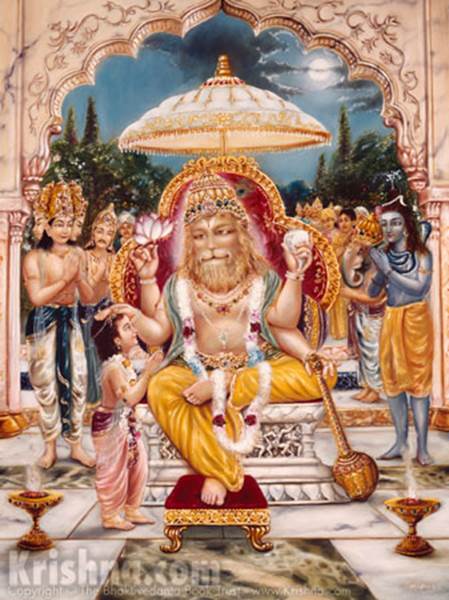
Lord Nrsimhadeva
benedicts Prahlada Maharaja
"When Lord
Nrsimhadeva saw the small boy Prahlada Maharaja prostrated at the soles of His
lotus feet, He became most ecstatic in affection toward His devotee. Raising
Prahlada, the Lord placed His lotus hand upon the boy's head because His hand
is always ready to create fearlessness in all of His devotees."
[Srimad-Bhagavatam 7.9.5]
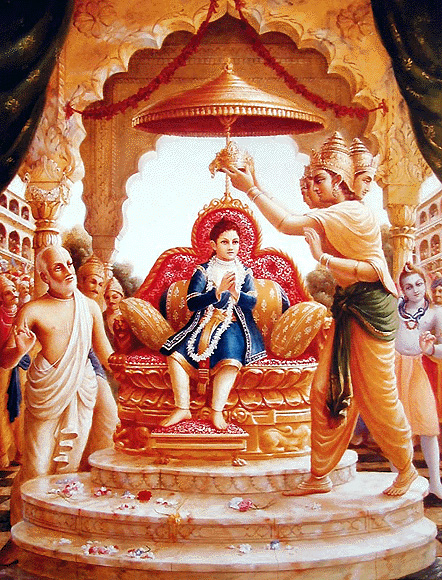
The Supreme Personality
of Godhead, in His form of Lord Nrsimhadeva, ordered Prahlada to accept the
kingdom of his father and rule over the demons. He instructed Prahlada to
perform the proper ritualistic ceremonies and then take charge of the kingdom,
keeping his mind always fixed on Him. After the Supreme Lord disappeared from
that place, Lord Brahma, along with other great saints assembled there, made
Prahlada king.
4. Sri
Krodha (Varaha) Narasimha Temple
varahkundey medhinyai varaahaarthapradhaayiney
dhanthalagna hiranyaksh dhamshtra simhaaya mangalam
Sri Krodha (Varaha) Narasimha temple is 1 km from the main temple of Ahobila
Narasimha Swamy on the Upper Ahobilam. Sri Kroda Narasimha also
glorified by devotees as Varaha Narasimha is a very special form of the Lord
with the face of a boar. After killing Hiranyakasipu, Lord Nrsimhadeva was very
upset with Lord Brahma because of the boon he had awarded to Hiranyakasipu. He
summoned Lord Brahma but Brahma was afraid to come near the Lord. At that time
Vedas slipped from his hands and fell down. When the Vedas were falling, Bhumi
personified held them and took the Vedas with her to Patala in order to protect
them. Due to the absence of the Vedas, demigods approached Lord Nrsimhadeva who
took the form of Kroda (an animal with a single front horn) and went to Patala
to bring back the Vedas. He then emerged out with Bhumi-devi sitting above His
horn. After bringing out Vedas Lord sat at this kshetra and took the form of
Sri Kroda Narasimha. In the meantime His anger also subsided. Brahma then came
near the Lord begging for forgiveness and requesting the Vedas. Lord
Nrsimhadeva rejected Brahma’s request and said that you have already lost the
Vedas and hence they have to be given only to a responsible person. To which
Brahma suggested that they can be given to Lakshmi-devi. Lord agreed and gave
darshan to Brahma as Sri Malola Narasimha.
Along with Sri Kroda Narasimha, one can also have darshan of Sri
Lakshmi Narasimha in this temple. Lord Nrsimhadeva is seen as though He is
trying to gently pacify Lakshmidevi. Lord Nrsimhadeva had developed attachment
to Chenchu Lakshmi, which annoyed Lakshmidevi, hence the Lord is pacifying Her.
Here one can also have darshan of Sri Varaha Tirtha.
Walking
alongside the Bhavanasini river and Kalakshepa Mandapa, we arrive at the
cave shrine of Krodha (Varaha). Surrounded by attractive natural scenery all
around; the lofty mountains over-grown with tall trees are awe inspiring. In
the narrow valley between Vedari and Garudadadri, the silver
stream of Bhavanasini glides on beautifully.
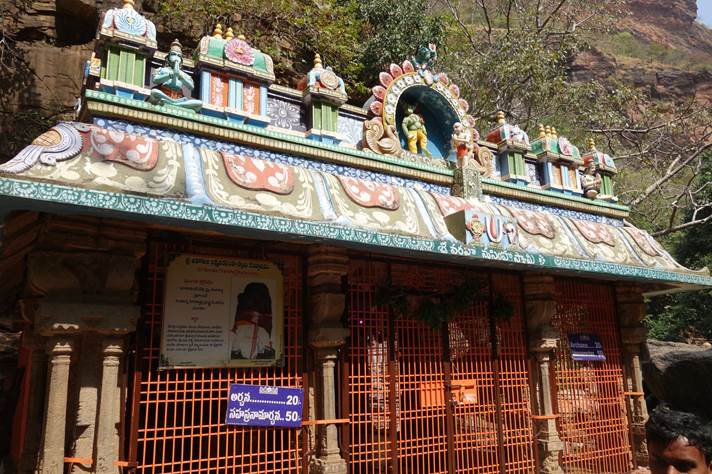
Sri Krodha Narasimha
temple
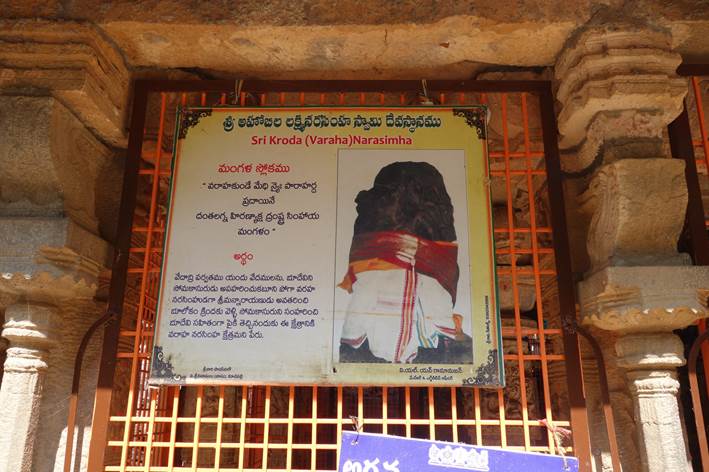
Sri Krodha Narasimha
temple
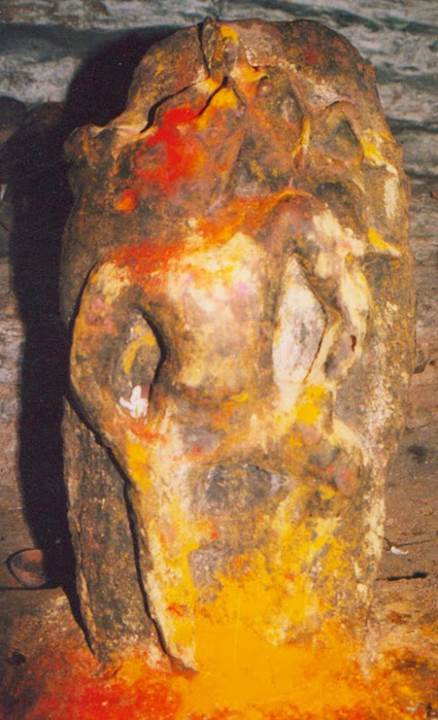
Lord Sri Krodha
Narasimha
Sri Kroda Narasimha also
glorified by devotees as Varaha Narasimha is a very special form of the Lord
with the face of a boar.
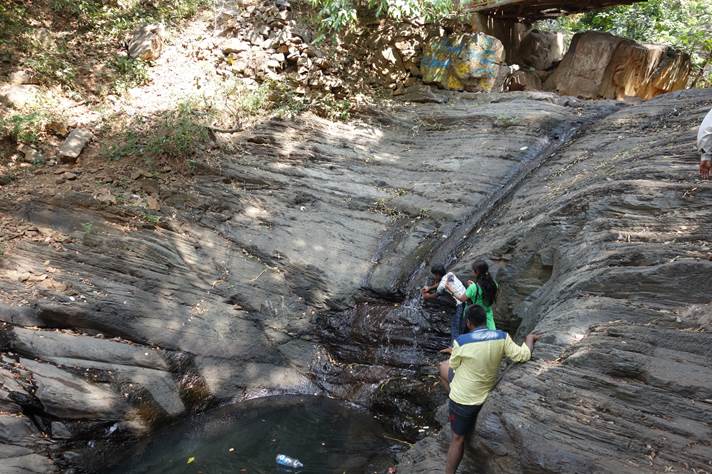
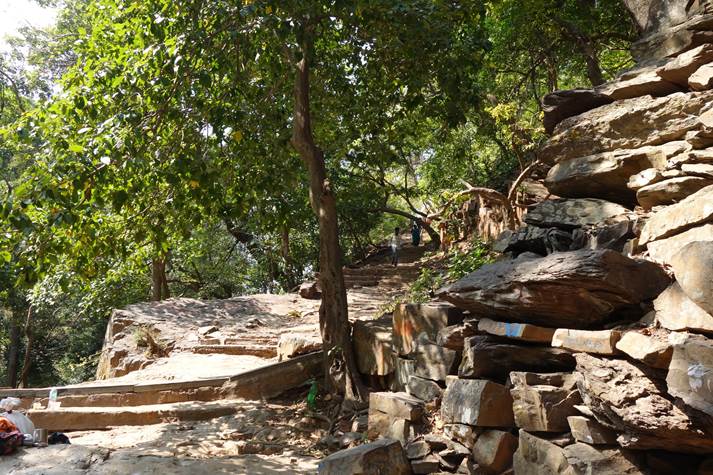
Way to Sri Krodha
Narasimha temple from Sri Ahobila Narasimha temple
Way to Sri Krodha
Narasimha temple
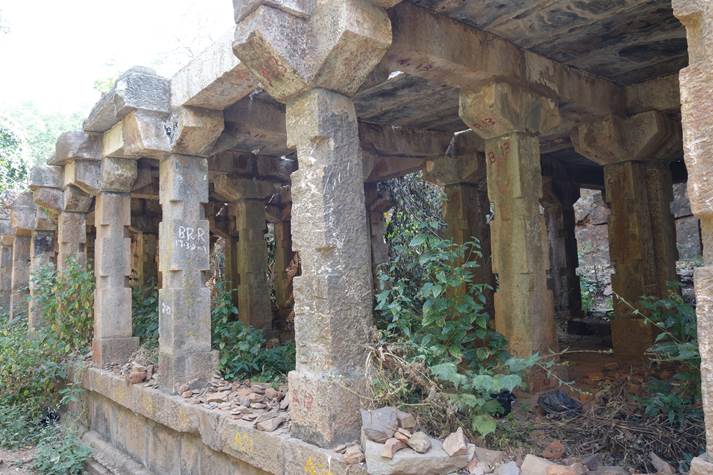
This is where Sripad
Ramanujacarya held his devotional discourses when he visited Ahobilam. This
place is on the way to Sri Krodha Narasimha temple from Sri Ahobila Narasimha
temple
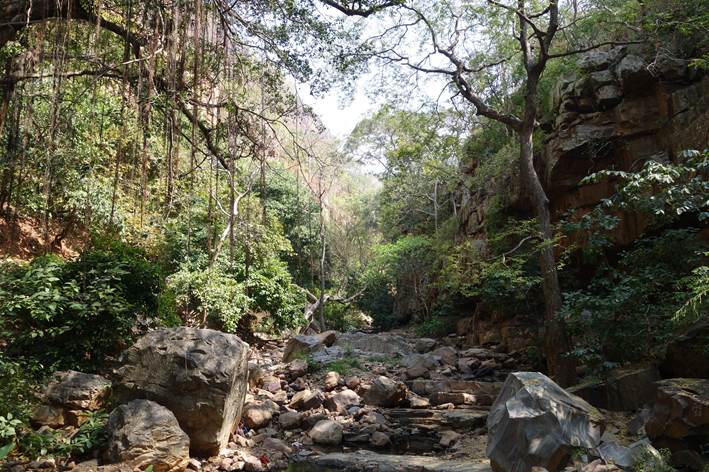
Terrain at Sri Nava
Narasimha ksetra
5. Sri
Karanja Narasimha Temple
karanjamoole maatharaste yathra
saarangaschakra dhrutham
gobhoo hiranya nirvinna gobila
gnyanadhayiney prabanjan sunaaseera
kaaranchaayasthu mangalam
Sri Karanja Narasimha temple is at a distance of 1 km from Upper
Ahobilam and one furlong from the road leading to Lower Ahobilam. Lord
Nrsimhadeva here is under the Karanja Tree, hence He is known as Karanja
Narasimha. Karanja Tree is also called as Honge Mara in the local
language. He is also known as Saranga Narasimha because He is holding
the bow named Saranga. Lord Nrsimhadeva is sitting in meditation, with a
hooded cobra over the head. The upper right hand holds a Chakra and
upper left hand has Saranga bow. The lower hands are in Dhyana mudra.
The Bhavanasini river glides on at the left of the road.
Once
Hanuman was performing austerities in Ahobilam and was continuously chanting
the holy name of Lord Rama. Immediately Lord Nrsimhadeva appeared before him
and asked, “Yes you called Me?” Hanuman was surprised and said to
Nrsimhadeva, “You are disturbing me. Please go away.” Nrsimhadeva
replied, “I am Ramacandra. Because you called Me, I have come.” Hanuman
was again surprised and asked, “How can you be Rama? You don’t have a form
like that of Rama.” Immediately Lord Nrsimhadeva manifested Himself like
Rama with bow in one hand and Sudarsana in the other hand. Hanuman got
convinced and from then on started to worship the form of Sri Karanja
Narasimha. There is a small altar of Hanuman in the temple.
Sage
Gobila had been cursed by Durvasa Muni and had become a dullard. He worshipped
the Lord by reciting the Narasimha Mantra. The Lord was pleased and blessed the
sage that as before he would become very learned and that in due course he
would attain liberation. Since then devotees who seek knowledge come and
worship the Lord here.
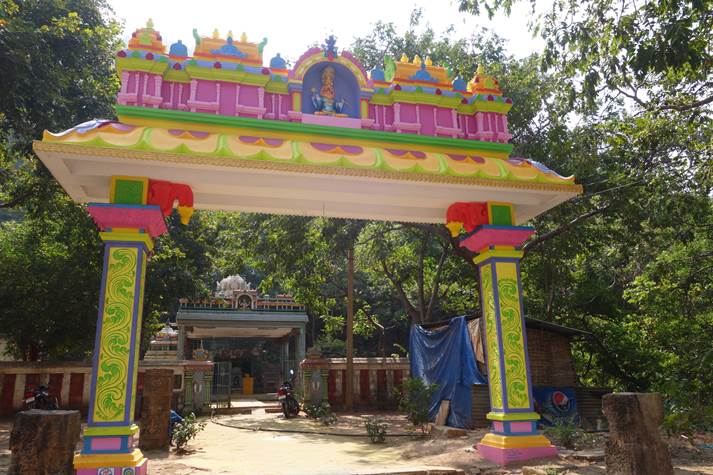
Sri Karanja Narasimha
temple
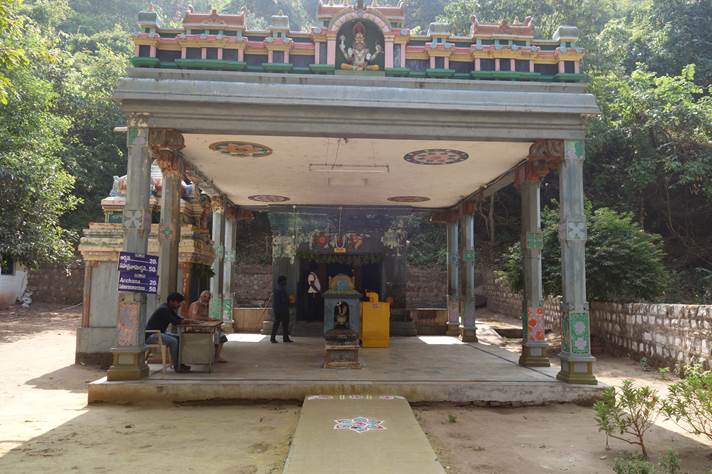
Sri Karanja Narasimha
temple
Lord Nrsimhadeva here is
under the Karanja Tree, hence He is known as Karanja Narasimha.
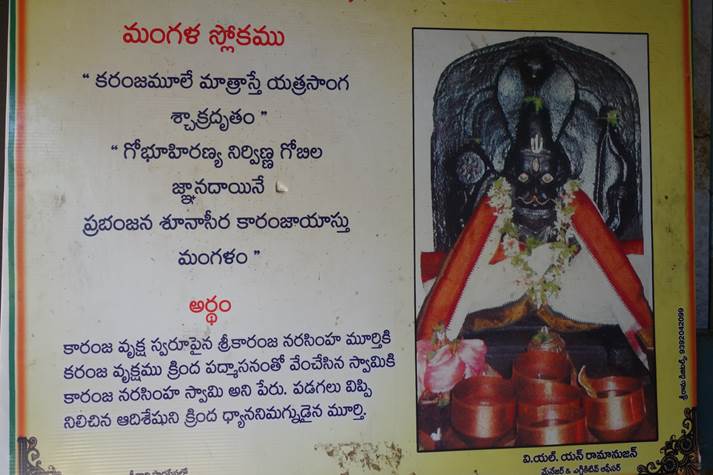
Sri Karanja Narasimha
temple
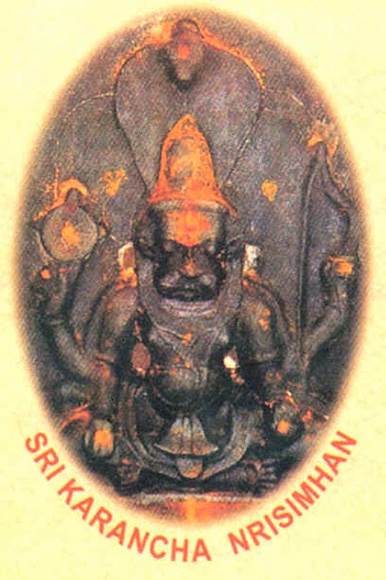
Lord Sri Karanja
Narasimha
Lord Nrsimhadeva is
sitting in meditation, with a hooded cobra over the head. The upper right hand
holds a Chakra and upper left hand has Saranga bow.
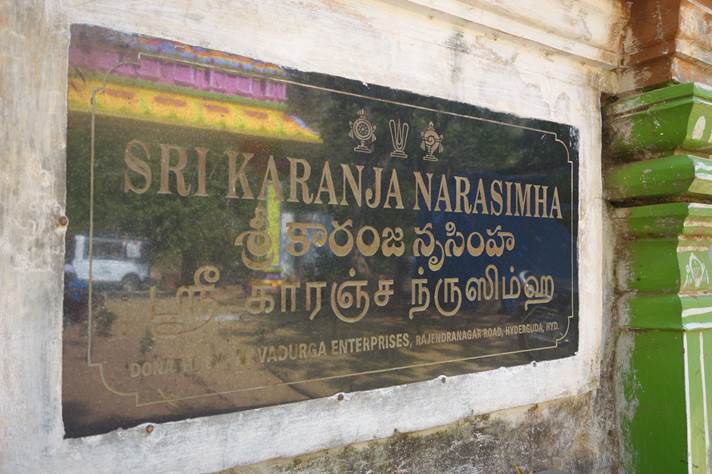
Sri Karanja Narasimha
temple
6. Sri
Bhargava Narasimha Temple
bharagavakhya tapasveesa bhaavanaa bhaavithathmaney
akshaya theera theerthastu bhargavayaasthu mangalam
Sri Bhargava Narasimha temple is at a distance of 2 km from the Lower
Ahobilam, on a hill, near the sacred pond, known as 'Bhargava Tirtham',
where Bhargava Rama performed his penance. Hence the Lord of the temple is
known as Bhargava Narasimha Swamy. Here Parasurama, who is also known as
Bhargava, performed penances to please Lord Nrsimhadeva. Parasurama wanted to
have darshan of the Lord right at the moment when he tore apart the
chest of Hiranyakasipu. Pleased by the penances of Parasurama, Lord Nrsimhadeva
gave Him the desired darshan. When the Lord was giving darshan,
Hiranyakasipu who was lying on the lap of the Lord, looked towards Parasurama.
Parasurama then requested Nrsimhadeva to manifest Himself in that form. And
from then on the Lord is being worshiped here and is known as Sri Bhargava
Narasimha Swamy. This is one of the most ferocious forms of Lord
Nrsimhadeva in Ahobilam. This temple is located on the banks of Akshaya
Tirtha which is considered on par with the sacred Pushkara Tirtha. Parasurama
would bathe in this kunda and use this water for the worship of Lord
Bhargava Narasimha. Sage Vasishtha and other sages had performed penances here.
One can also have darshan of Prahlada at the lotus feet of the Lord.
This temple is surrounded by a thick forest and can be reached only via local
jeep or the autos as the route is like a mountainous terrain.
Lord
Nrsimhadeva here is four-handed. Upper two hands hold the chakra and sankha,
the lower two hands as shown tearing the intestine of Hiranyakasipu.
Hiranyakasipu is holding a sword in his right hand. Prahlada is on the right in
the Sthanaka posture with Anjali hasta.
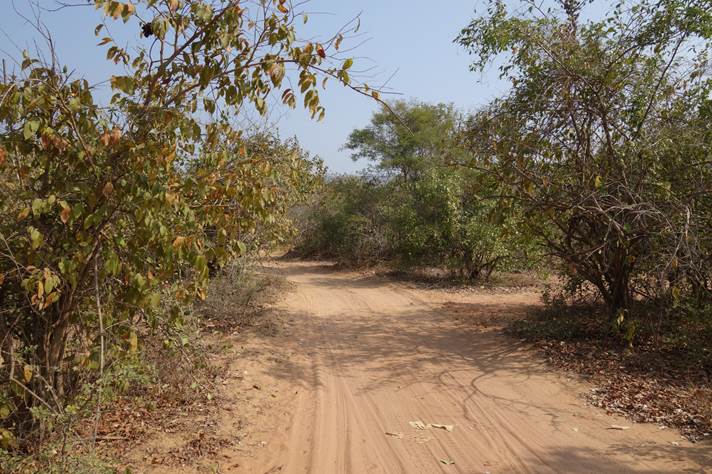
Way to Sri Bhargava
Narasimha temple from Lower Ahobilam
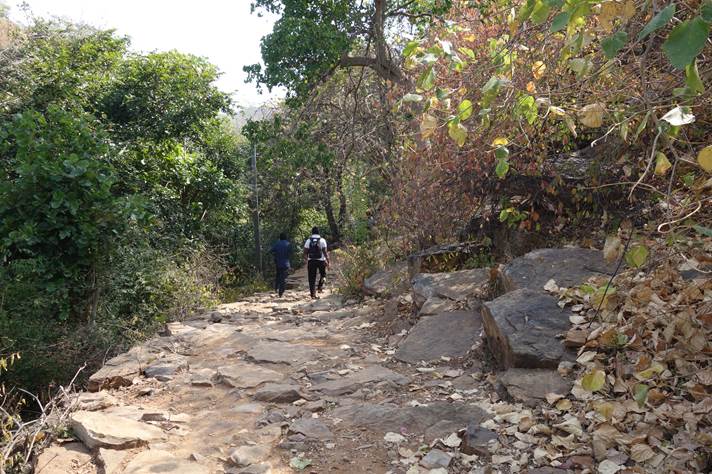
Way to Sri Bhargava
Narasimha temple
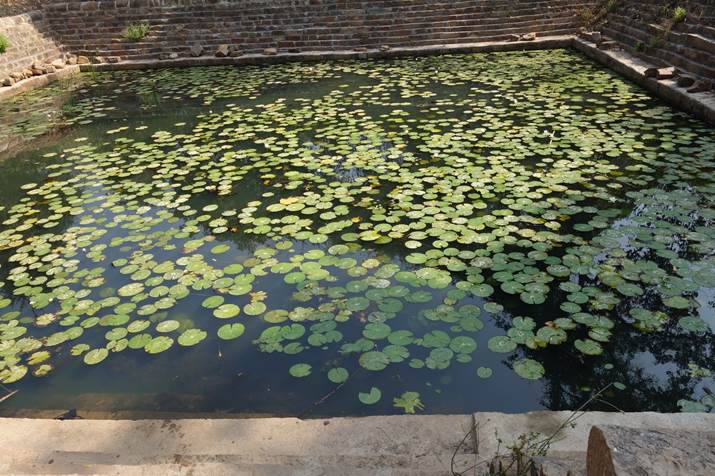
Sacred 'Bhargava
Tirtham' in front of the temple where Bhargava Rama performed his penance
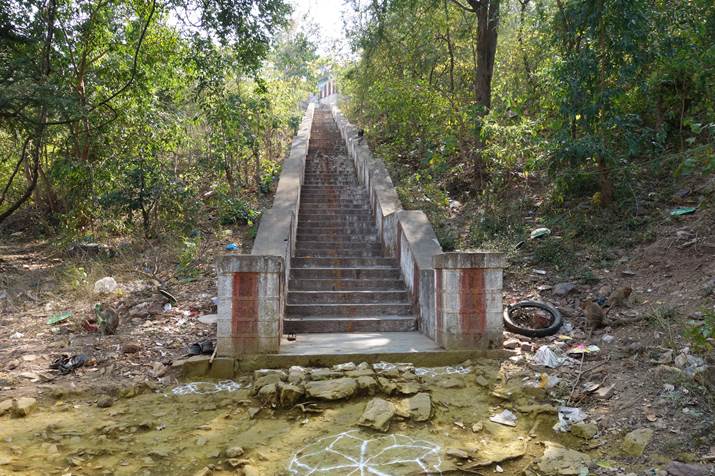
Stairs leading to Sri
Bhargava Narasimha temple
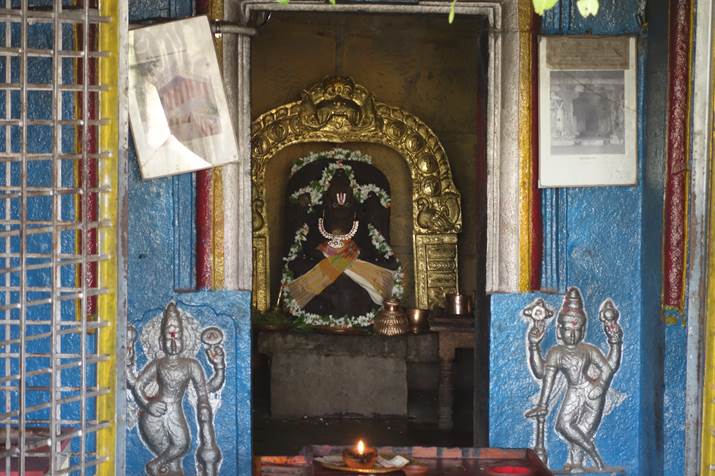
Lord Sri Bhargava Narasimha
Lord Nrsimhadeva here is
four-handed. Upper two hands hold the chakra and sankha, the lower two hands as
shown tearing the intestine of Hiranyakasipu. Hiranyakasipu is holding a sword
in his right hand. Prahlada is on the right in the Sthanaka posture with Anjali
hasta.
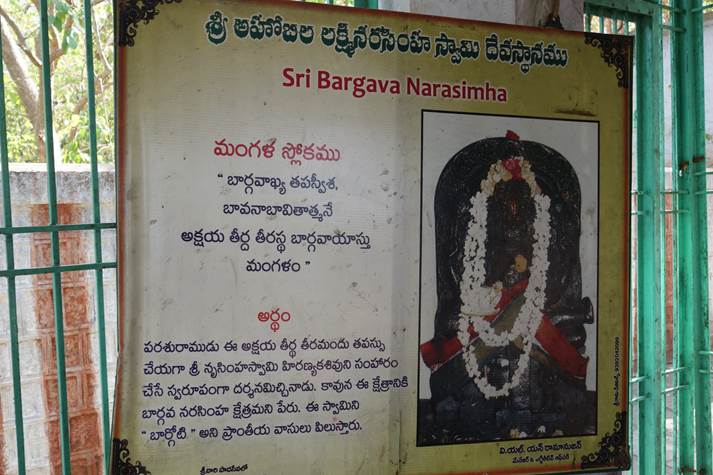
Sri Bhargava Narasimha
temple
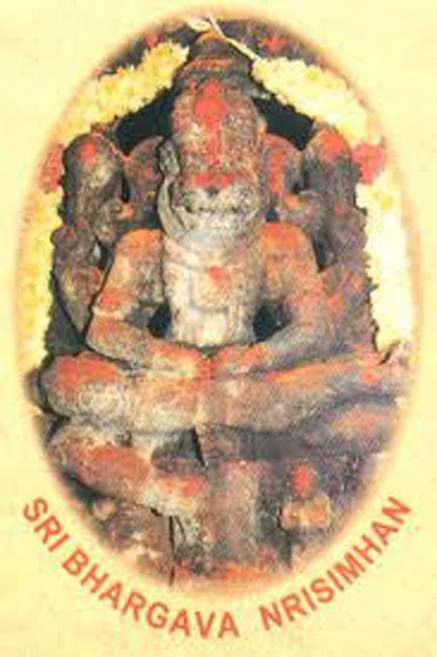
Lord Sri Bhargava
Narasimha
Sri Bhargava Narasimha
temple
7. Sri
Yogananda Narasimha Temple
chathuranana chetobja chitrabhaanu svaroopine
vedadri gahavarasthaaya yogaanandaaya mangalam
Sri Yogananda Narasimha temple is to the south-east of Lower Ahobilam at
a distance of 2 km. The popular legend is that after killing Hiranyakasipu,
Lord Nrsimhadeva taught Prahlada several yogic postures. Therefore, the
Lord in this aspect is called Yogananda Narasimha. Seated on a Garuda pedestal
of 1’2” high, the deity of Lord Nrsimhadeva is about 2’8” high in the yogic
posture of their legs being crossed and tied with a Yogapatta. The deity
is four handed and holds chakra in the upper hand and sankha in
the upper left hand. The other two hands rest on the knees. Once Lord Brahma
visited this place when he was agitated and he returned after attaining peace
by practicing devotion unto Lord Narasimha. The Deity of the Lord was being
worshiped in a deep tunnel and for the sake of ease in his worship, He was
brought out from the tunnel and installed here. This temple is connected by a
good road. This temple is a plain stone structure with a square Garbhagriha
and Ardha mandapa.
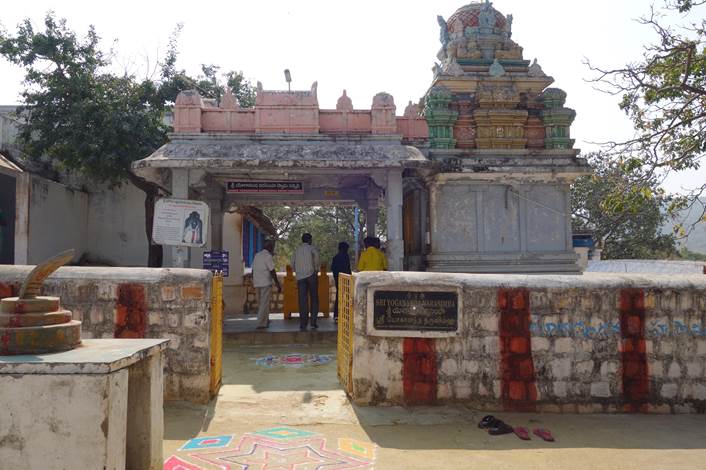
Sri Yogananda
Narasimha temple
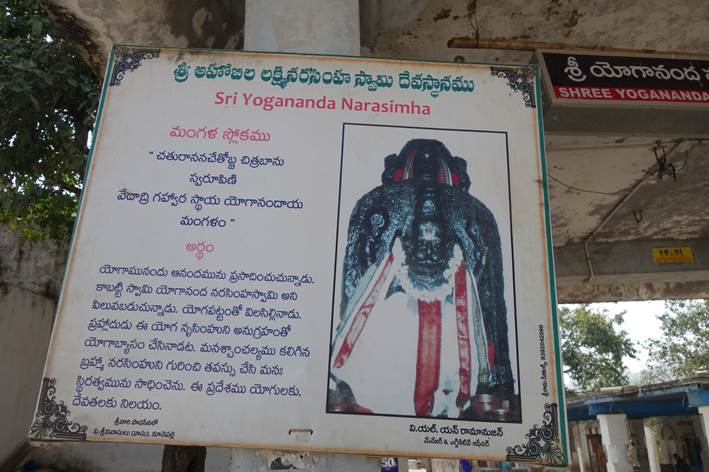
Sri Yogananda
Narasimha temple
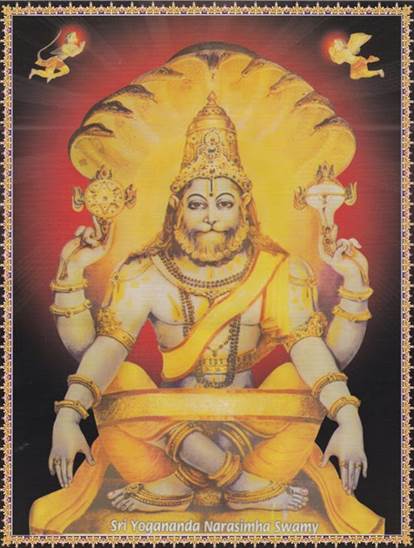
Lord Sri Yogananda
Narasimha
The deity is four handed
and holds chakra in the upper hand and sankha in the upper left hand. The other
two hands rest on the knees.
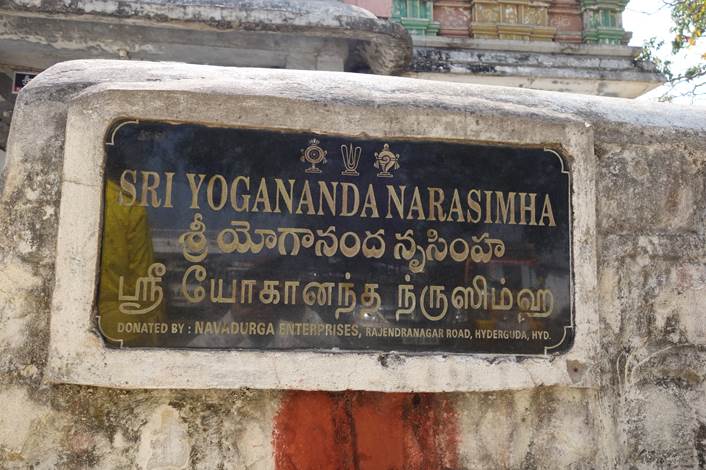
Sri Yogananda
Narasimha temple
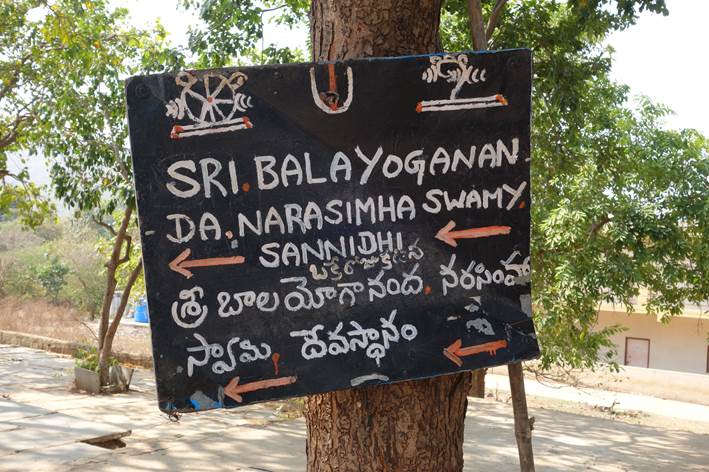
Next to Sri Yogananda
Narasimha temple is Sri Bala Yogananda Narasimha temple
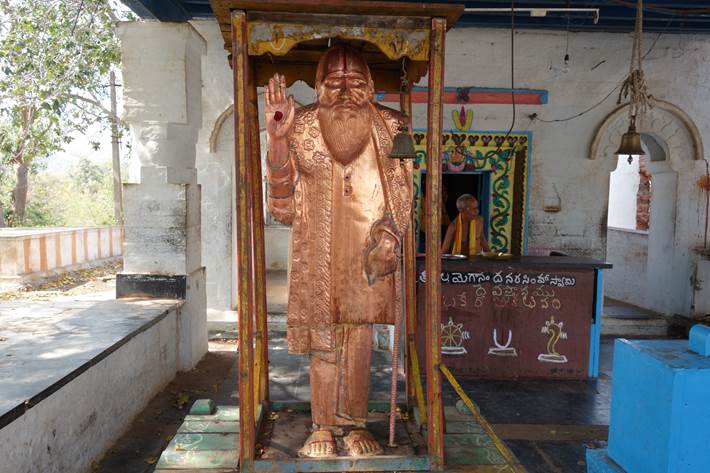
Sri Bala Yogananda
Narasimha temple
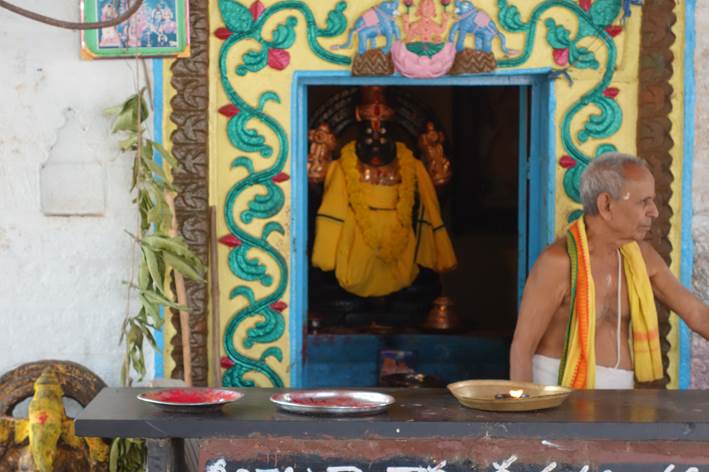
Sri Bala Yogananda
Narasimha temple
8. Sri
Chatravata Narasimha Temple
haahaa hoohoo vakya gandharva nrittageetha hritaatmaney
bhavahantritat chathravataimhaya mangalam
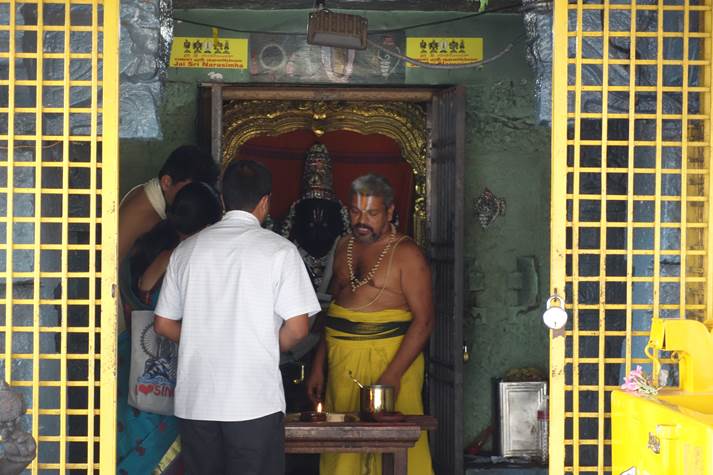
Sri Chatravata Narasimha temple is 3 km from Lower Ahobilam on the same
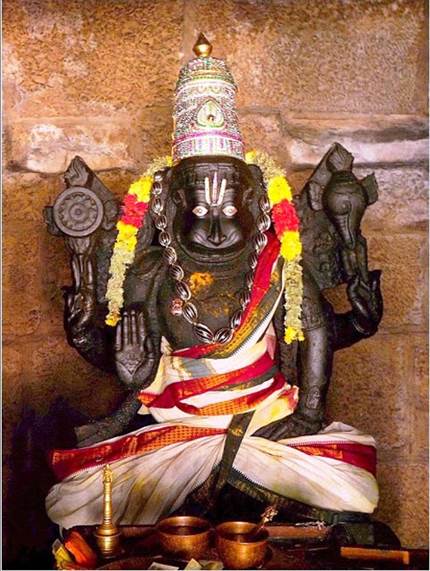
road leading to Yogananda Narasimha temple. Lord Nrsimhadeva here is very
unique as He has got a very beautiful wide smile on His face. Since the Lord is
worshiped under a peepal tree, surrounded by the thorny bushes, He is famous as
Chatravata Narasimha Swamy.
Once
two Gandharvas named Haha and Hoohoo came from Meru parvata
and pleased Sri Chatravata Narasimha with their melodious singing. The Lord
blessed them that they would attain fame as great singers. Even now devotees
who visit this temple sing melodiously before the deity to give Him pleasure.
Lord Indra and the other demigods worshiped the Lord here and requested Him to
kill the demon-king. This temple is also known as Devata-aradhana ksetra.
Sri Chatravata Narasimha is seated in the padmasana pose on a low padmapitha.
The two upper hands hold the chakra and sankha. The lower right
hand is in the abhaya posture, while the lower left hand is a Katihasta,
placed on the waist and the left thigh.
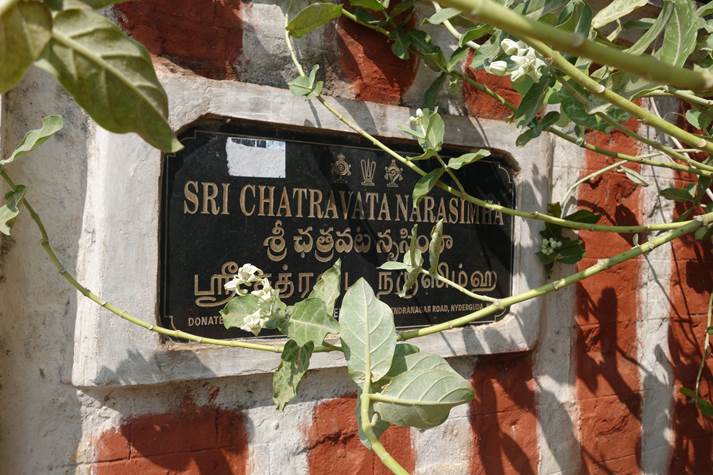
Sri Chatravata
Narasimha temple
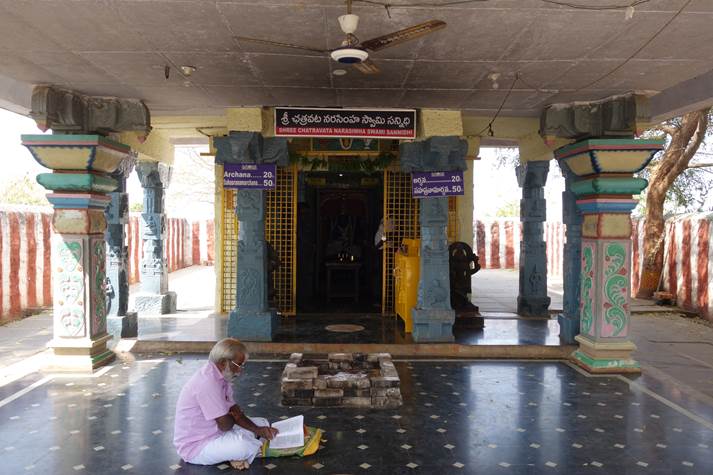
Sri Chatravata
Narasimha temple
Lord Sri Chatravata
Narasimha
Lord Sri Chatravata
Narasimha
Lord Nrsimhadeva here is
very unique as He has got a very beautiful wide smile on His face. Since the
Lord is worshiped under a peepal tree, surrounded by the thorny bushes, He is
famous as Chatravata Narasimha Swamy
9. Sri
Pavana Narasimha Temple
bharadwaja mahayogi mahapaathaka haariney
thaapaneeya rahasyartha paavanayasthu mangalam
Sri Pavana Narasimha temple is on the banks of the river Pavana. This is the most
peaceful form of the Lord amongst the nine Nrsimhadeva temples. He is also
known as Pamuleti Narasimha Swamy. The Lord here liberates devotees from
the all the sins of past lives and the present lives which might have been
committed knowingly or unknowingly. Sage Bharadwaja rid himself of the great
sin of brahma-hatya at this place.
This
temple lies quite far in the midst of the forest. It is about 6 km from the
Upper Ahobilam temple. One has to walk the entire distance from Upper Ahobilam
southwards, a hilly forest track. Devotees climb many steep steps to reach this
temple. The steps begin from behind the temple of Sri Ahobilam Narasimha.
Alternatively devotees can also visit this temple via local jeeps. This temple
is in the middle of a dense forest. The temple is a small rectangular building
with a Garuda stambha in front. The presence of Garuda stambha
suggests that the temple might have been in great prosperity and annual
functions were being regularly conducted. To reach Sri Pavana Narasimha temple
one can hire a four-wheel jeep from Lower Ahobilam. It will take approx. 2-3
hours by jeep to reach Sri Pavana Narasimha temple from Lower Ahobilam. At a distanced
of about 1 km from this temple, chenchus (tribal people) reside. They,
even to this day, sing in their own language the momentous marriage of the Chenchu
bride with Nrsimhadeva.
The
main deity is actually a Lakshmi
Nrsimhadeva deity, with four hands. The upper two hands carry Sankha
and chakra. The lower right hand is in abhaya pose, while the
lower left hand is shown as embracing Lakshmi seated on His left thigh. The
Lord is seated in Sukhasana posture on Adi Sesha with His left
leg folded while the right leg is bent at the knee. Dangling down over the head
of Nrsimhadeva is found a seven-hooded snake (Adisesha) spread like an
umbrella. Lakshmi is seated on the thigh of the Lord with right hand embracing
Lord.
Important information: The starting point for Pavana Narasimha temple is also Ahobila
Nrisimha temple, but the route is on the opposite side of Jwala Temple. First,
one has to climb some 250 very steep steps, and then walk for about 4 km on
fairly plain ground. The round trip may take about three hours. Recently, a
path has been made for Jeeps to go to Pavana. It is a very rough 2 hour drive
from Lower Ahobilam.
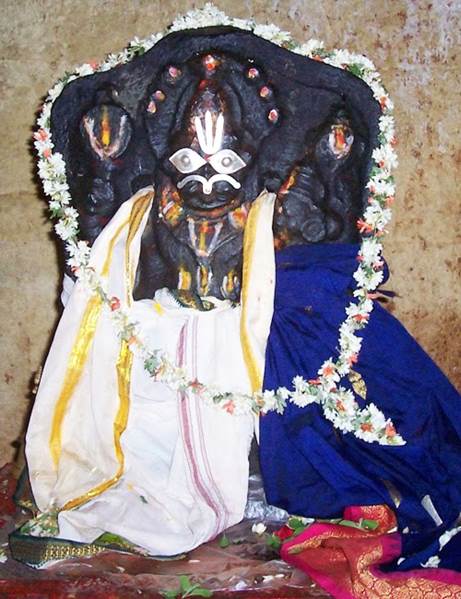
Sri Pavana Narasimha
This is the most
peaceful form of the Lord amongst the nine Nrsimhadeva temples. The Lord here
liberates devotees from the all the sins of past lives and the present lives.
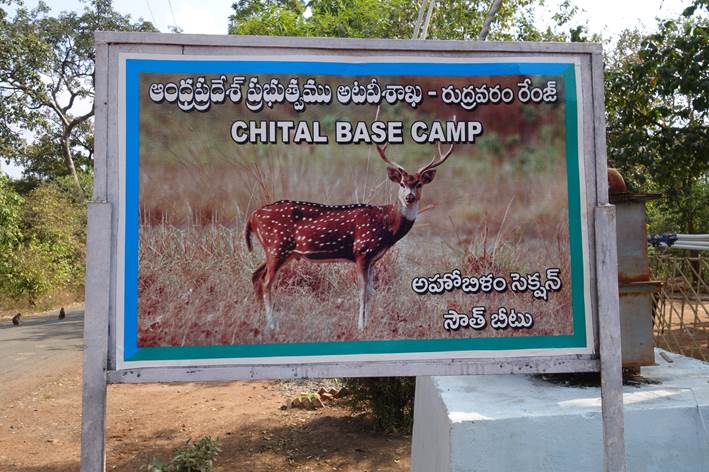
To reach Sri Pavana
Narasimha temple one has to pass through thickly dense forest. The starting
point for Pavana Narasimha temple is also Ahobila Nrisimha temple, but the
route is on the opposite side of Jwala Temple. First, one has to climb some 250
very steep steps, and then walk for about 4 km on fairly plain ground. The
round trip may take about three hours. Recently, a path has been made for Jeeps
to go to Pavana. It is a very rough 2 hour drive from Lower Ahobilam.
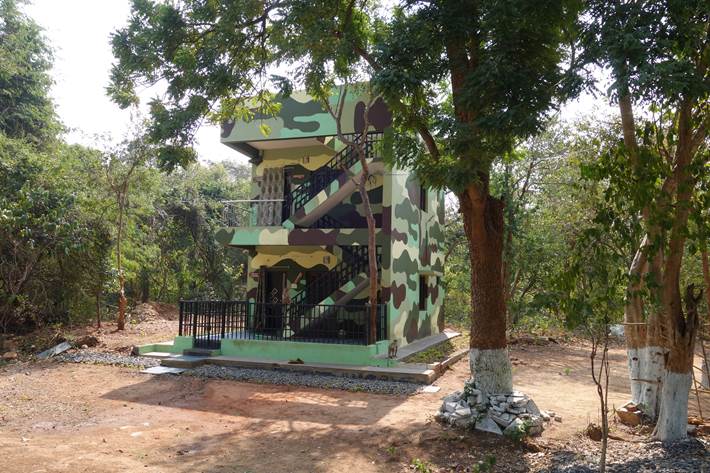
Forest rangers quarter
Sri
Prahlada Varada Narasimha Temple
Sri Prahlada Varada Narasimha Temple, meaning the Lord
whose grace bestows on Prahlada is in Lower Ahobilam. Here Lord Nrsimhadeva
is blessing Prahlada Maharaja. Sri Laxmi Narasimha Swamy is the
presiding deity at the temple. There are also three smaller shrines for
Lakshmi, Andal and Azhwars. On the temple altar are the Utsava deities
of Prahlada Varada, Pavana Narasimha and the processional deity of Jwala
Narasimha endowed with ten hands and with Sreedevi and Bhoodevi on His either
side. A small deity of the first Jeeyar, Sri Adivan Satakopa Swami is also kept
before them. A shrine dedicated to Sri Venkateswara exists to the south west of
this Narasimha temple and depicts the pastime that Lord Venkateswara obtained
the blessings of Narasimha just before His marriage with Padmavathi. The Mukha
Mandapa there, is now used as the Kalyana Mandapa of Narasimha
Swamy. This temple is not amongst the Nava Narasimha Temple in Ahobilam, but is
of utmost significance in Ahobilam.
The
temple is surrounded by three prakaras. With Vijayanagar style
noticeable in the structure, there are a number of mandapas outside the
temple. Both in the Upper and Lower Ahobilam, it is a common sight on the
pillars of Lord Nrsimhadeva with His consort Chenchu Lakshmi, the Lord chasing
Hiranyakasipu in one pillar and bursting forth from another pillar to tear him
are very realistic. The 44th Jeeyar's of Sri Abobila Matha and the Endowments
Department of A.P. Government have made lot of efforts in temple renovation.
The annual uthsava (Brahmothsavam) is performed in February every
year.
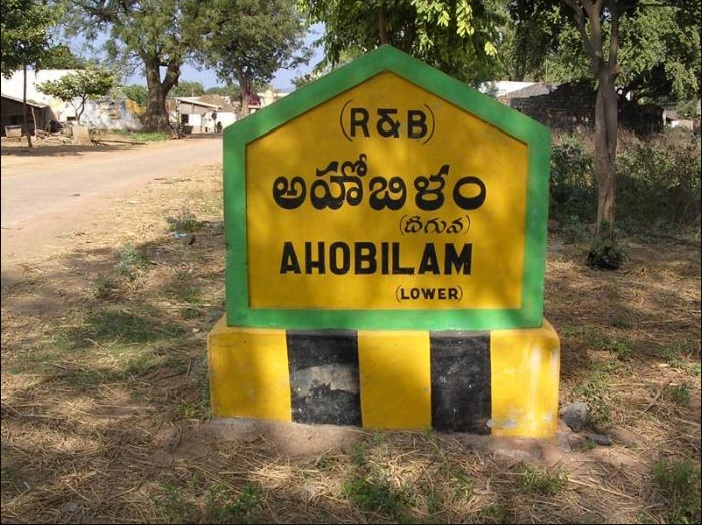
Sri Prahlada Varada
Narasimha is in Lower Ahobilam
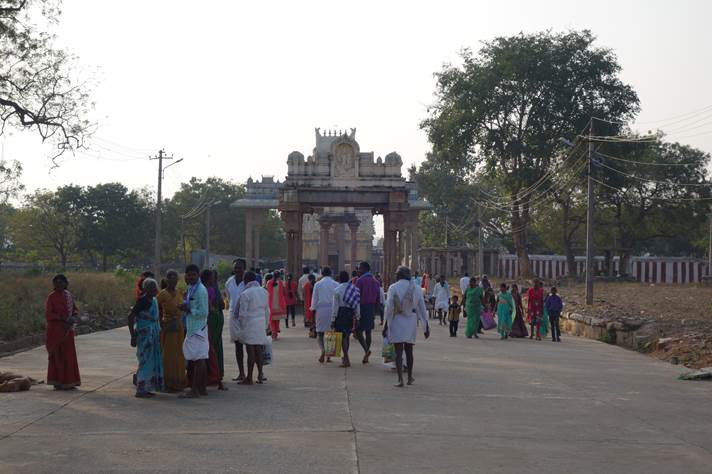
Sri Prahlada Varada
Narasimha temple
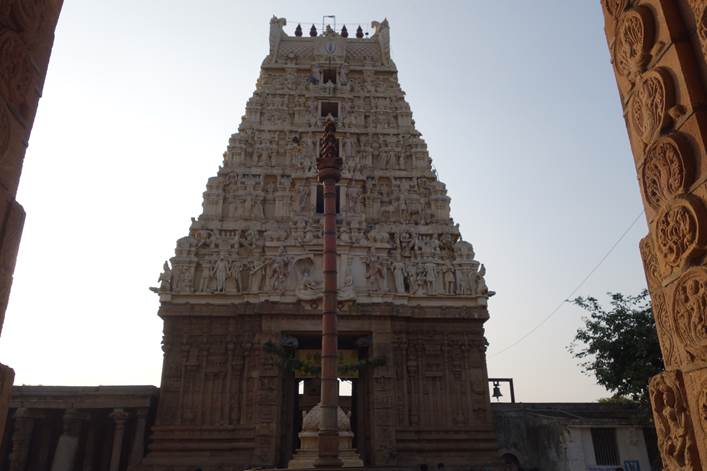
Sri Prahlada Varada
Narasimha temple
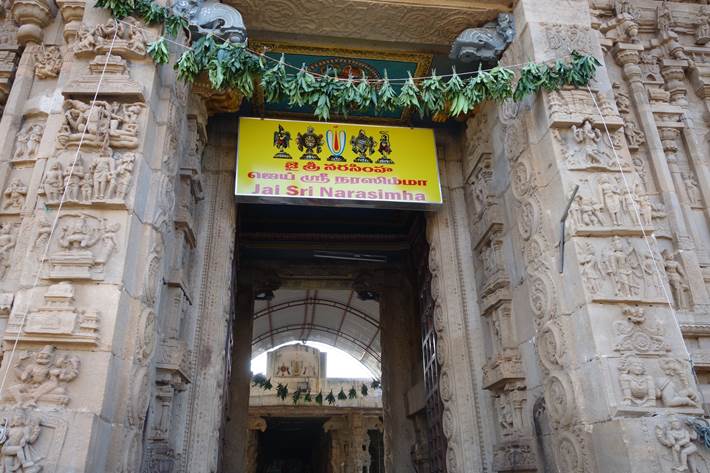
Sri Prahlada Varada
Narasimha temple
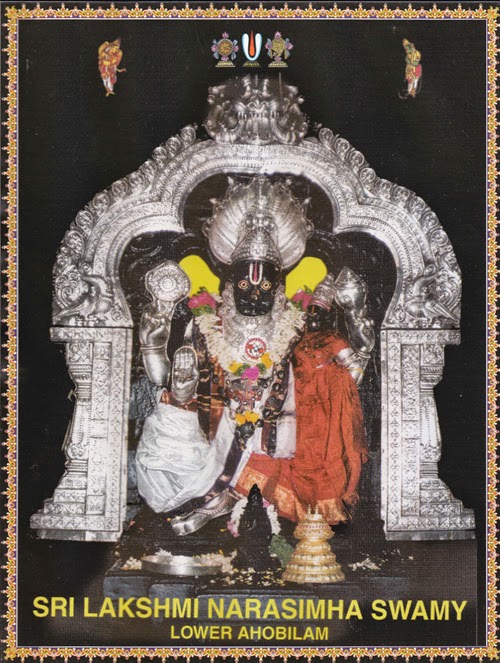
Lord Sri Lakshmi
Narasimha at Sri Prahlada Varada Narasimha temple
Here Lord Nrsimhadeva is
blessing Prahlada Maharaja. Sri Laxmi Narasimha Swamy is the presiding
deity at the temple.
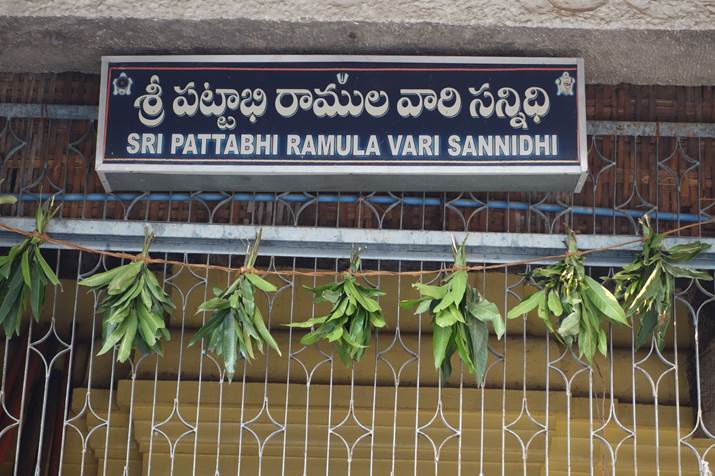
Sri Pattabhi Ramula
Vari Sannidhi
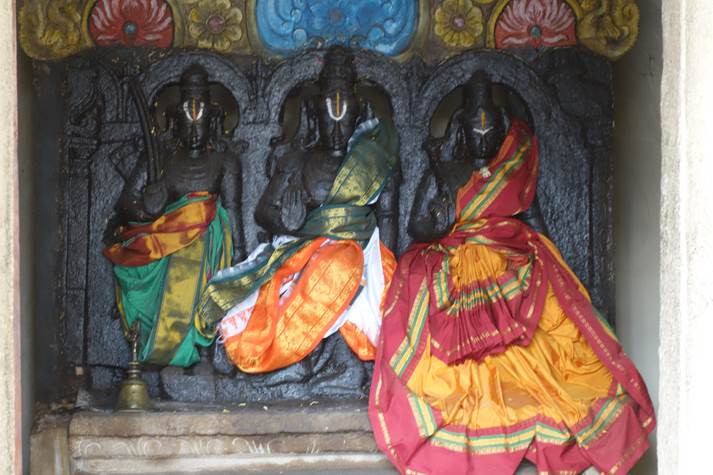
Sri Pattabhi Ramula
Vari Sannidhi
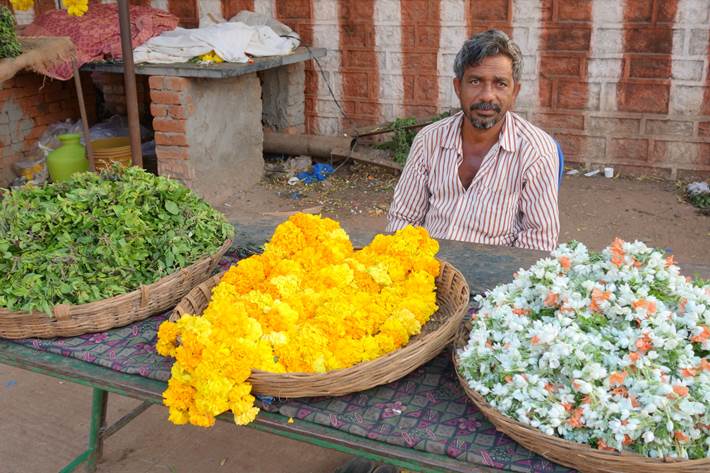
Flower vendor at Sri
Prahlada Varada Narasimha temple
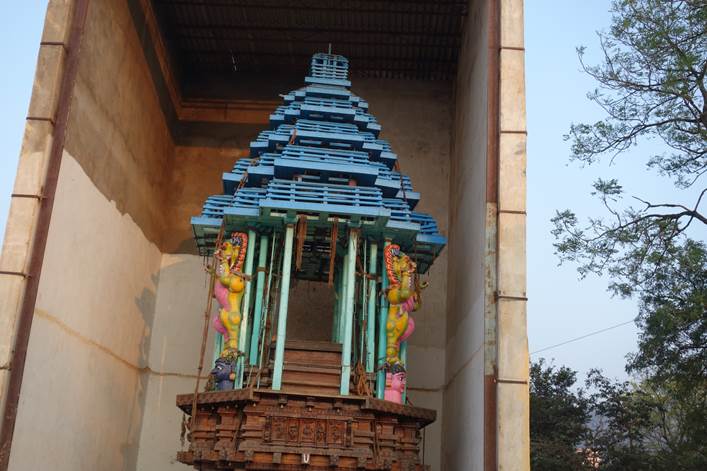
Chariot that is used
in service of Lord Nrsimhadeva during the Festival celebrations
Prahlada
Mettu - School where Prahlada studied
Prahlada Mettu, the school of Prahalda, situated in a cave on the hill, behind
the Malola Narasimha Temple in Upper Ahobilam. This is where Prahlada
had his school with teachers Sanda and Amarka. It is a 0.4 km walk from Malola
Narasimha temple through the forest and the narrow path of the cliff. There is
a cavern in this cave. When demons threw Prahlada from the cliff, Prahlada
Maharaja fell through this cavern of the rock and was held by Lord Sri Krishna.
Around this cave, Prahlada Maharaja wrote ‘om namo bhagavate vasudevaya’
on the rocks. Devotees can still those transcendental letters. One can also
have darshan of Sri Yoga Narasimha, Sri Sudarshana and Sri Narayana
deities in this cave.
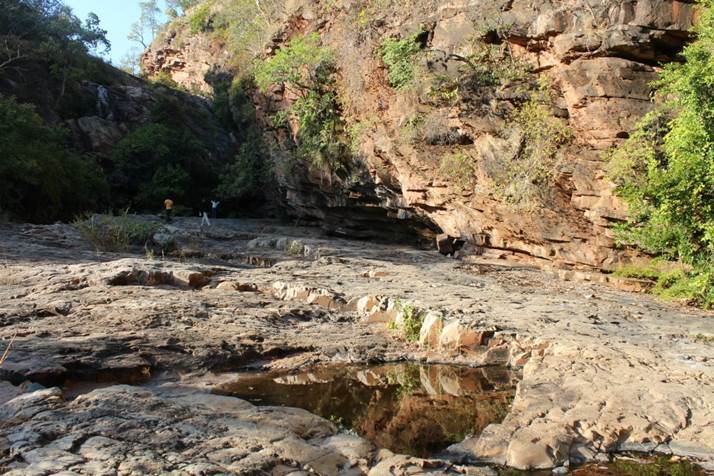
Prahlada Mettu, the
area of school of Prahlada
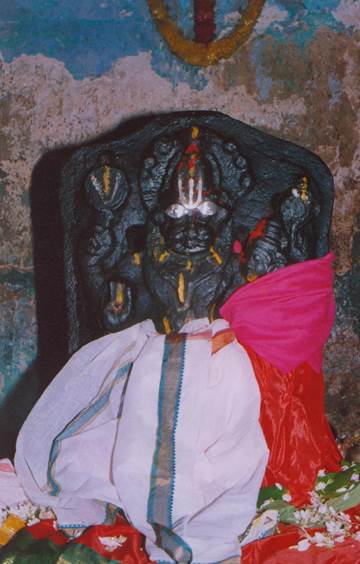
Lord Nrsimhadeva at
Prahlada Mettu
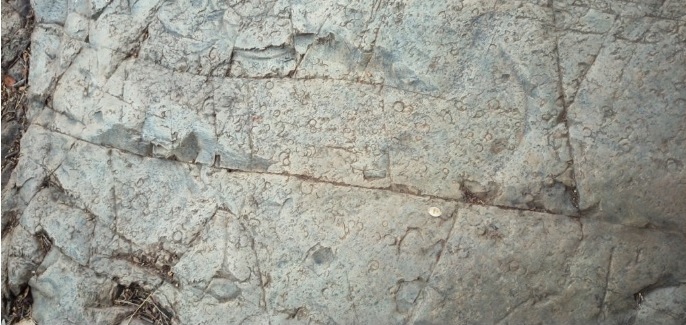
“Om Namo Bhagavate
Vasudevaya” sculpted by Prahlada on rocks at his school, Prahlada Mettu
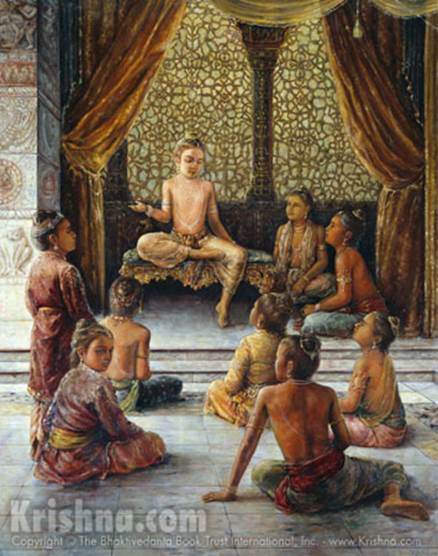
Prahlada Maharaja
Instructs His Friends at school
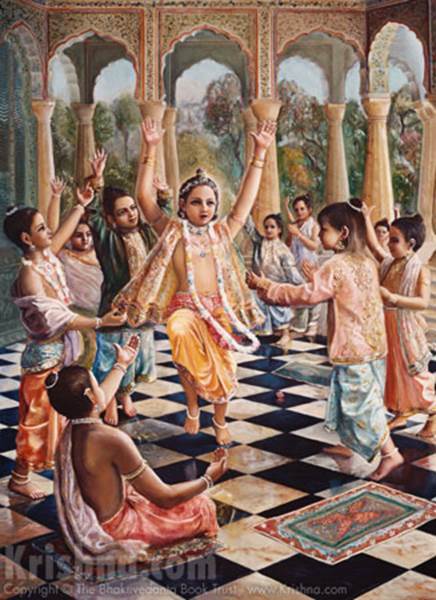
Prahlada Dances
Ecstatically Among His School Friends
When his demoniac teachers were
absent, Prahlada taught his classmates the science of Krishna consciousness,
beginning with the chanting of the holy names. All the boys took his
instructions very seriously and they became attached to the Supreme Personality
of Godhead, rejecting the materialistic instructions given by their teachers.
Ahobilam Matha Role in Developing Ahobilam:
Majority of
the development work in Ahobilam for the pleasure of Lord Nrsimhadeva has been
carried out by Ahobilam Matha, who are followers of Sri Vaisnavism of Sripada
Ramanujacarya. The 33rd Jeeyar (a member of their disciplic succession) is
especially said to have carried monumental work in developing this sacred
place.
Ahobilam
Matha was established 600 years ago at Ahobilam by Srimad Athivan Satakopan. He
was originally known as Kidambi Srinivasachar. One day, the Lord of Ahobilam,
Sri Lakshmi Narasimha, appeared in Srinivasachar's dream and instructed him to
come to the temple town of Ahobilam. After consulting with his acarya,
he proceeded to Ahobilam. At Ahobilam, the Lord Nrsimhadeva Himself initiated
Srinivasachar into sannyasa and gave him the title, "Satakopa
Jeeyar". Then, one of the nine Nrisimha’s of Ahobilam called Malolan
jumped into the hands of Athivan Satakopan and ordered him to travel the length
and breadth of the country. Thus began the institution called Sri Ahobila Matha
and the travels of Lord Malolan to village after village so that devotees get a
chance to undertake Panca Samskaram and perform Bhara Nyasam at
the lotus feet of the Lord Nrsimhadeva. The travels thus started 600 years ago
and the unique tradition of the Lord travelling to the houses of His devotees
continues till-date.

Sri Ahobila Mutha
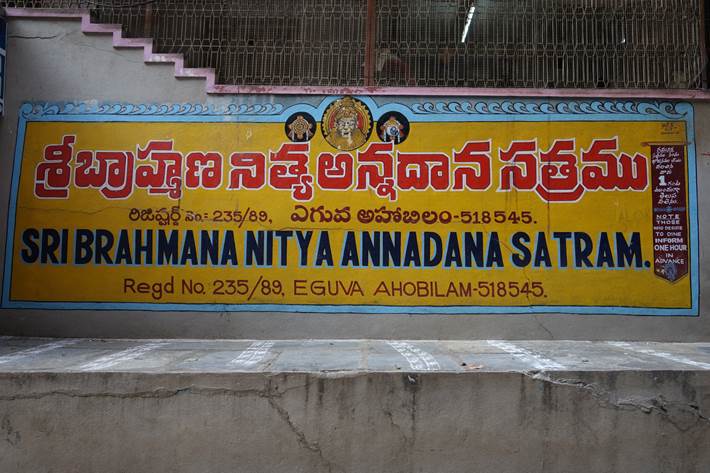
Sri Ahobila Mutta has
established a trust called Annamacharya Nitya Annadanam Trust which
provides free prasadam to the devotees.
Stories from Sthala Purana:
Sthala Purana of Ahobilam, which is part of 10 chapters of Brahmanda Purana
described the greatness of ksetra in the 1st chapter. The 2nd chapter of
the Purana narrates the performance of the penance of Garuda for the darshan
of the Lord. The 3rd chapter gives an account of the sacred ponds of the place.
The 4th chapter furnishes an account of the nine temples of Narasimha in His
nine forms and performances of the penances by Brahma, Bharadvaja, Gobhila and
Bhargava Rama. The 5th chapter relates the traditional story of Jaya and Vijaya
and their birth as Hiranyaksha and Hiranyakasipu respectively and the assurance
given by the Lord to the demigods for their protection. The 6th chapter
describes, at length, the childhood of Prahlada and the atrocities perpetrated
against him by his father. The 7th chapter narrates the devotion of Prahlada to
the Lord, appearance of Lord Nrsimhadeva and the killing of the demon,
Hiranyaksha. The 8th chapter mentions the Sarabhavatara and his
destruction by Lord Nrsimhadeva. The 9th chapter states the untiring efforts of
Bhairava for the river Bhavanasini and his becoming Kshetrapala of the place.
The last chapter clearly states that taking up the process of devotional
service to the Lord is the only means for crossing the cycle of birth and death
(samsara).
Laxmidevi as Chenchu Laxmi:
Once
upon a time Samudra raja (Ocean god) was cursed to be born in a tribe of name
Chenchu. Sri Mahalaxmi manifested herself as his daughter known as Chenchu
Laxmi. Being aware of this, Lord came down adorning role as a chenchu.
Samudra raja was not aware of this and felt that his aristocratic daughter had
fallen in love with an ordinary chenchu man. He decided to kill Him. At
that time, Lord Narahari appeared and told him the truth. The Lord’s marriage
with Chenchu Laxmi was celebrated and Samudra raja also got released
from his curse. Because Lord married a lady belonging to chenchu tribe
the Lord became their son in law. Even today during the utsavas the chenchu
tribes bring honey, sandal paste, clothes and other forest products and offer
them to lord, who is their son in law. They affectionately call him “Obulaesudu”
(short version of Ahobalesudu Lord of Ahobalam). A Sanskrit drama “Vasantika
Parinaya” written by the 7th Jeeyar of the Ahobala matha describes the
marriage of the Lord with Chenchu Laxmi.
33rd Jeeyar of Ahobilam Matha and the dacoits:
One day the Jeeyar was going through dense forest accompanied by his disciples,
journeying from Ahobilam to Mysore. On the way, the Jeeyar decided to halt at a
spot near a small rivulet to perform his evening puja to his Lord. As he was
settling down to offer prayers, there was a commotion and his disciples rushed
to him saying that dacoits had come to loot their property. The unperturbed
Jeeyar went to meet the leader of the dacoit gang, told him that they had
nothing which belonged to them, that everything they possessed belonged to Lord
and requested him to take it after he finished his puja to the Lord. The leader
agreed. The Jeeyar commenced his puja. He offered “Chakkarai Pongal, a sweet
prepared out of rice and jaggery” to the Lord. He did Mangala arati to
the deity 3 times and at the end of third round, all dacoits suddenly fell at
the feet of Jeeyar and asked him to protect them saying that a large number of
lions were attacking them. The Jeeyar could not see the lions but he realized
that his Lord Nrsimhadeva had come to rescue him. He requested the lions to
disappear. The dacoits who had come to rob fell at his feet begging forgiveness
and then escorted the Jeeyar safely out of the forest.
Lord Nrsimhadeva Prayers:
namas te narasimhaya
prahladahlada-dayine
hiranyakasipor vaksah-
sila-tanka-nakhalaye
ito nrsimhah parato nrsimho
yato yato yami tato nrsimhah
bahir nrsimho hrdaye nrsimho
nrsimham adim saranam prapadye
tava kara-kamala-vare nakham
adbhuta-srngam
dalita-hiranyakasipu-tanu-bhrngam
kesava dhrta-narahari-rupa jaya
jagadisa hare
jaya jagadisa hare jaya jagadisa
hare
Lord
Nrsimhadeva Pastimes
[ref. Srimad-Bhagavatam Canto 7,
chapters 2 to 10]
Hiranyakasipu,
King of the Demons
When the
Supreme Personality of Godhead Lord Sri Krishna appeared as the boar and killed
Hiranyakasipu’s brother Hiranyaksa, Hiranyakasipu was very much aggrieved. In
anger, he accused the Supreme Personality of Godhead of being partial to His
devotees and derided the Lord’s appearance as Varaha to kill his brother. He
began to agitate all the demons and Raksasas and disturb the ritualistic
ceremonies of the peaceful sages and other inhabitants of earth. For want of
the performance of yajna, sacrifice, the demigods began wandering unseen on
earth.
After
finishing the ritualistic funeral ceremonies of his brother, Hiranyakasipu
began speaking to his nephews, quoting from the sastras about the truth of
life. To pacify them, he spoke as follows: “My dear nephews, for heroes to die
before the enemy is glorious. According to their different fruitive activities,
living entities come together within this material world and are again
separated by the laws of nature. We should always know, however, that the
spirit soul, which is different from the body, is eternal, inadjustable, pure,
all-pervading and aware of everything. When bound by the material energy, the
soul takes birth in higher or lower species of life according to varying
association and in this way receives various types of bodies in which to suffer
or enjoy. One’s affliction by the conditions of material existence is the cause
of happiness and distress; there are no other causes, and one should not be
aggrieved upon seeing the superficial actions of karma.”
Hiranyakasipu
then related a historical incident concerning a King Suyajna who resided in the
country named Usinara. When the King was killed, his queens, overwhelmed with
grief, received instructions, which Hiranyakasipu quoted to his nephews.
Hiranyakasipu related an account of a kulinga bird pierced by the arrow of a
hunter while lamenting for his wife, who had also been shot by the same hunter.
By narrating these stories, Hiranyakasipu pacified his nephews and other
relatives and relieved them of lamentation. Thus having been pacified, Diti and
Rusabhanu, Hiranyakasipu’s mother and sister-in-law, engaged their minds in
spiritual understanding.
Hiranyakasipu’s
Plan to Become Immortal
Hiranyakasipu
wanted to become immortal. He wanted not to be conquered by anyone, not to be
attacked by old age and disease, and not to be harassed by any opponent. Thus
he wanted to become the absolute ruler of the entire universe. With this
desire, he entered the valley of Mandara Mountain and began practicing a severe
type of austerity and meditation. Seeing Hiranyakasipu engaged in this
austerity, the demigods returned to their respective homes, but while
Hiranyakasipu was thus engaged, a kind of fire began blazing from his head,
disturbing the entire universe and its inhabitants, including the birds, beasts
and demigods. When all the higher and lower planets became too hot to live on,
the demigods, being disturbed, left their abodes in the higher planets and went
to see Lord Brahma, praying to him that he curtail this unnecessary heat. The
demigods disclosed to Lord Brahma Hiranyakasipu’s ambition to become immortal,
overcoming his short duration of life, and to be the master of all the
planetary systems, even Dhruvaloka.
Upon
hearing about the purpose of Hiranyakasipu’s austere meditation, Lord Brahma,
accompanied by the great sage Bhrgu and great personalities like Daksa, went to
see Hiranyakasipu. He then sprinkled water from his kamandalu, a type of
waterpot, upon Hiranyakasipu’s head. Hiranyakasipu, the King of the Daityas,
bowed down before Lord Brahma, the creator of this universe, offering
respectful obeisances again and again and offering prayers. When Lord Brahma
agreed to give him benedictions, he prayed not be killed by any living entity,
not to be killed in any place, covered or uncovered, not to die in the daytime
or at night, not to be killed by any weapon, on land or in the air, and not to
be killed by any human being, animal, demigod or any other entity, living or
nonliving. He further prayed for supremacy over the entire universe and
requested the eight yogic perfections, such as anima and laghima.
Hiranyakasipu
Terrorizes the Universe
By severe
austerities, Hiranyakasipu satisfied Lord Brahma and obtained the benedictions
he desired. After he received these benedictions, his body, which had been
almost entirely consumed, was revived with full beauty and a luster like gold.
Nonetheless, he continued to be envious of Lord Visnu, unable to forget Lord
Visnu’s having killed his brother. Hiranyakasipu conquered everyone in the ten
directions and the three worlds and brought all living entities, both demigods
and asuras, under his control.
Becoming the master of all places, including the residence of Indra, whom he
had driven out, he began enjoying life in great luxury and thus became mad. All
the demigods but Lord Visnu, Lord Brahma and Lord Siva came under his control
and began serving him, but despite all his material power he was dissatisfied
because he was always puffed up, proud of transgressing the Vedic regulations.
All the brahmanas were dissatisfied
with him, and they cursed him with determination. Eventually, all the living
entities within the universe, represented by the demigods and sages, prayed to
the Supreme Lord for relief from Hiranyakasipu’s rule.
Lord Visnu informed the demigods
that they and the other living entities would be saved from the fearful
conditions created by Hiranyakasipu. Since Hiranyakasipu was the oppressor of
all the demigods, the followers of the Vedas, the cows, the brahmanas and the religious, saintly
persons, and since he was envious of the Supreme Lord, he would naturally be
killed very soon. Hiranyakasipu’s last exploit would be to torment his own son
Prahlada, who was a maha-bhagavata, an exalted Vaisnava. Then his life would
end. When the demigods were thus reassured by the Supreme Personality of
Godhead, everyone was satisfied, knowing that the miseries inflicted upon them
by Hiranyakasipu would come to an end.
Prahlada
Maharaja, the Saintly Son of Hiranyakasipu
Hiranyakasipu’s
spiritual master, Sukracarya, had two sons named Sanda and Amarka, to whom
Prahlada Maharaja was entrusted for education. Although the teachers tried to
educate the boy Prahlada in politics, economics and other material activities,
he did not care for their instructions. Instead, he continued to be a pure
devotee. Prahlada Maharaja never liked the idea of discriminating between one’s
friends and enemies. Because he was spiritually inclined, he was equal toward
everyone.
Once upon a
time, Hiranyakasipu inquired from his son what the best thing was that he had
learned from his teachers. Prahlada Maharaja replied that a man engrossed in
the material consciousness of duality, thinking, “This is mine, and that
belongs to my enemy,” should give up his householder life and go to the forest
to worship the Supreme Lord.
When
Hiranyakasipu heard from his son about devotional service, he decided that this
small boy had been polluted by some friend in school. Thus he advised the
teachers to take care of the boy so that he would not become a Krishna
conscious devotee. However, when the teachers inquired from Prahlada Maharaja
why he was going against their teachings, Prahlada Maharaja taught the teachers
that the mentality of ownership is false and that he was therefore trying to
become an unalloyed devotee of Lord Visnu. The teachers, being very angry at
this answer, chastised and threatened the boy with many fearful conditions.
They taught him to the best of their ability and then brought him before his
father.
Hiranyakasipu
affectionately took his son Prahlada on his lap and then inquired from him what
the best thing was that he had learned from his teachers. As usual, Prahlada
Maharaja began praising the nine processes of devotional service, such as
sravanam and kirtanam. Thus the King of the demons, Hiranyakasipu, being
extremely angry, chastised the teachers, Sanda and Amarka, for having wrongly
trained Prahlada Maharaja. The so-called teachers informed the King that
Prahlada Maharaja was automatically a devotee and did not listen to their
instructions. When they proved themselves innocent, Hiranyakasipu inquired from
Prahlada where he had learned visnu-bhakti. Prahlada Maharaja replied
that those who are attached to family life do not develop Krishna
consciousness, either personally or collectively. Instead, they suffer repeated
birth and death in this material world and continue simply chewing the chewed.
Prahlada explained that the duty of every man is to take shelter of a pure
devotee and thus become eligible to understand Krishna consciousness.
Enraged at
this answer, Hiranyakasipu threw Prahlada Maharaja from his lap. Since Prahlada
was so treacherous that he had become a devotee of Visnu, who had killed his
uncle Hiranyaksa, Hiranyakasipu asked his assistants to kill him. The
assistants of Hiranyakasipu struck Prahlada with sharp weapons, threw him under
the feet of elephants, subjected him to hellish conditions, threw him from the
peak of a mountain and tried to kill him in thousands of other ways, but they
were unsuccessful. Hiranyakasipu therefore became increasingly afraid of his
son Prahlada Maharaja and arrested him. The sons of Hiranyakasipu’s spiritual
master, Sukracarya, began teaching Prahlada in their own way, but Prahlada
Maharaja did not accept their instructions. While the teachers were absent from
the classroom, Prahlada Maharaja began to preach Krishna consciousness in the
school, and by his instructions all his class friends, the sons of the demons,
became devotees like him.
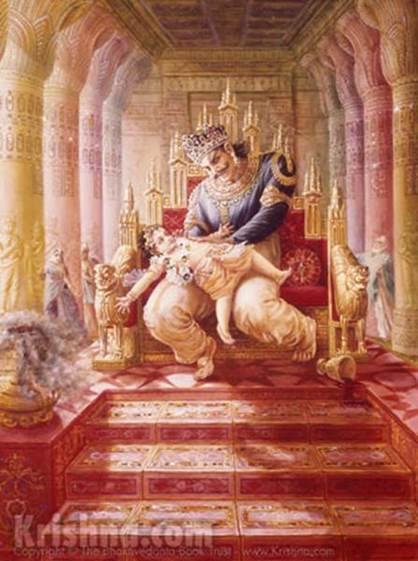
Hiranyakasipu Throws
Prahlada Off His Lap
Prahlada, although born in a family
of demons, was devoted to the service of Lord Vishnu. When Prahlada was a young
boy, his father, the great demon Hiranyakasipu, took Prahlada on his lap and
affectionately asked him what was the best subject that he had learned from his
teachers. Prahlada replied that this material existence only provides suffering
and one should take shelter of the Supreme Personality of Godhead.
Hiranyakasipu laughed, and thought that his son's intelligence must have been
spoiled by the words of the enemy. Demons like Hiranyakasipu consider Lord
Vishnu and His devotees to be the enemy. He called Prahlada's teachers and told
them to make sure he learned properly. The two teachers chastised and
threatened Prahlada out of fear of losing their good name, and taught him of
economic development and sense gratification. After some time, they brought him
before his father again, thinking that he had been sufficiently educated. At
that time, Hiranyakasipu took Prahlada on his lap and again asked him, "My
dear Prahlada, my dear son, O long-lived one, for so much time you have heard
many things from your teachers. Now please repeat to me whatever you think is
the best of that knowledge." Prahlada told his father that one who has
dedicated his life to the service of Lord Krishna through the nine processes of
devotional service, dedicating his body, mind and words to Him, has complete
knowledge. Hiranyakasipu was infuriated, and he threw Prahlada off his lap,
onto the ground. [Srimad-Bhagavatam, Canto 7, Chapter 5, Excerpt from 7.5.22]
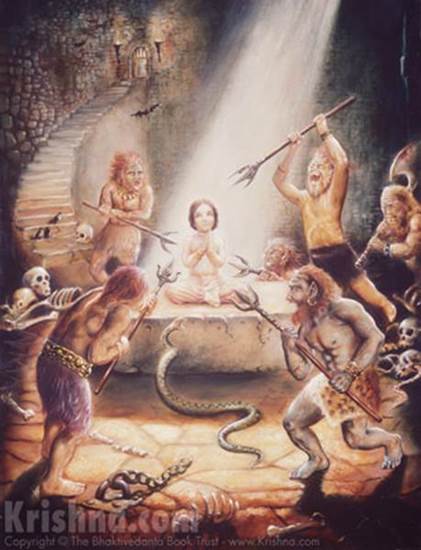
Prahlada silently
meditates as Rakshashas try to pierce him
Prahlada, although born in a family of
demons, was devoted to the service of Lord Vishnu. Demons like his father,
Hiranyakasipu, consider Lord Vishnu and His devotees to be the enemy. When
Hiranyakasipu understood that Prahlada would not give up the worship of Lord
Vishnu, Hiranyakasipu told the rakshashas (his demon servants) that Prahlada
must be killed, by all means. The rakshashas began striking Prahlada with
tridents and shouting, "Chop him up! Pierce him!" Prahlada, due to
his complete faith in the Supreme Personality of Godhead, was fearless, and he
sat silently, meditating on the Lord.
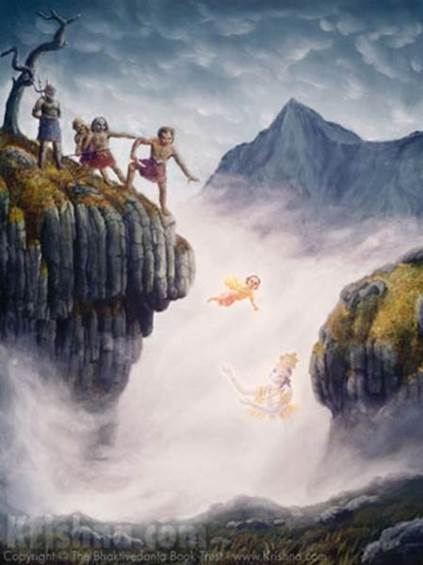
Hiranyakasipu has
Prahlada thrown from a cliff
The great demon Hiranyakasipu tried
to have his son, Prahlada, killed in many ways. Prahlada was thrown beneath the
feet of big elephants, he was thrown among snakes, fed poison, exposed to
severe cold, winds, and fire, and forced to sit in boiling oil. Nothing could
harm Prahlada, who was completely sinless. Prahlada was even thrown from a
cliff, but he was completely protected by the Supreme Personality of Godhead.
When Hiranyakasipu saw that he could not hurt Prahlada in any way, he felt
great anxiety about what to do next.
Prahlada
Instructs His Demoniac Schoolmates
In speaking
to his friends, who were all sons of demons, Prahlada Maharaja stressed that
every living entity, especially in human society, must be interested in
spiritual realization from the very beginning of life. When human beings are
children, they should be taught that the Supreme Personality of Godhead is the
worshipable Deity for everyone. One should not be very much interested in
material enjoyment; instead, one should be satisfied with whatever material
profits are easily obtainable, and because the duration of one’s life is very
short, one should utilize every moment for spiritual advancement. One may
wrongly think, “In the beginning of our lives let us enjoy material facilities,
and in old age we may become Krishna conscious.” Such materialistic thoughts are
always useless because in old age one cannot be trained in the spiritual way of
life. Therefore, from the very beginning of life, one should engage in
devotional service (sravanam kirtanam visnoh). This is the duty of all
living entities. Material education is infected by the three modes of nature,
but spiritual education, for which there is a great need in human society, is
transcendental. Prahlada Maharaja disclosed the secret of how he had received
instructions from Narada Muni. By accepting the lotus feet of Prahlada
Maharaja, who is in the parampara succession, one will be able to
understand the mode of spiritual life. In accepting this mode of activity,
there is no need for material qualifications. After Prahlada Maharaja’s class
friends had listened to Prahlada Maharaja, they inquired how he had become so
learned and advanced.
What
Prahlada Learned in the Womb
When
Hiranyakasipu left his kingdom and went to the mountain known as Mandaracala to
execute severe austerities, all the demons scattered. Hiranyakasipu’s wife,
Kayadhu, was pregnant at that time, and the demigods, mistakenly thinking that
she carried another demon in her womb, arrested her. Their plan was that as
soon as the child took birth they would kill him. While they were taking
Kayadhu to the heavenly planets, they met Narada Muni, who stopped them from
taking her away and took her to his asrama until Hiranyakasipu’s return. In
Narada Muni’s asrama, Kayadhu prayed for the protection of the baby in her
womb, and Narada Muni reassured her and gave her instructions on spiritual
knowledge. Taking advantage of those instructions, Prahlada Maharaja, although
a small baby within the womb, listened very carefully. The spirit soul is
always apart from the material body. There is no change in the spiritual form
of the living entity. Any person above the bodily conception of life is pure
and can receive transcendental knowledge. This transcendental knowledge is
devotional service, and Prahlada Maharaja, while living in the womb of his
mother, received instructions in devotional service from Narada Muni. Any
person engaged in the service of the Lord through the instructions of a bona
fide spiritual master is immediately liberated, and being free from the
clutches of maya, he is relieved of all ignorance and material desires. The
duty of everyone is to take shelter of the Supreme Lord and thus become free
from all material desires. Regardless of the material condition in which one is
situated, one can achieve this perfection. Devotional service is not dependent
on the material activities of austerity, penance, mystic yoga or piety. Even
without such assets, one can achieve devotional service through the mercy of a
pure devotee.
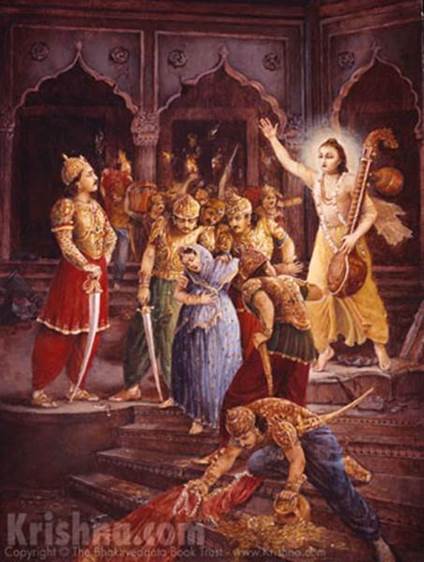
Narada Muni instructs
the demigods to release Hiranyakasipu's pregnant wife
"Narada Muni said: O Indra,
King of the demigods, this woman is certainly sinless. You should not drag her
off in this merciless way. O greatly fortunate one, this chaste woman is the
wife of another. You must immediately release her. King Indra said: In the womb
of this woman, the wife of the demon Hiranyakasipu, is the seed of that great
demon. Therefore, let her remain in out custody until her child is delivered,
and then we shall release her. Narada Muni replied: The child within this
woman's womb is faultless and sinless. Indeed, he is a great devotee, a
powerful servant of the Supreme Personality of Godhead. Therefore you will not
be able to kill him." [Srimad-Bhagavatam 7.7.8-10]
Lord
Nrsimhadeva Slays the King of the Demons
Following
the instructions of Prahlada Maharaja, all the sons of the demons became
attached to Lord Visnu, the Supreme Personality of Godhead. When this
attachment became pronounced, their teachers, Sanda and Amarka, were very much
afraid that the boys would become more and more devoted to the Lord. In a
helpless condition, they approached Hiranyakasipu and described in detail the
effect of Prahlada’s preaching. After hearing of this, Hiranyakasipu decided to
kill his son Prahlada. Hiranyakasipu was so angry that Prahlada Maharaja fell
down at his feet and said many things just to pacify him, but he was
unsuccessful in satisfying his demoniac father. Hiranyakasipu, as a typical
demon, began to advertise himself as being greater than the Supreme Personality
of Godhead, but Prahlada Maharaja challenged him, saying that Hiranyakasipu was
not God, and began to glorify the Supreme Personality of Godhead, declaring
that the Lord is all-pervading, that everything is under Him, and that no one
is equal to or greater than Him. Thus he requested his father to be submissive
to the omnipotent Supreme Lord.
The more
Prahlada Maharaja glorified the Supreme Personality of Godhead, the more angry
and agitated the demon became. Hiranyakasipu asked his Vaisnava son whether his
God existed within the columns of the palace, and Prahlada Maharaja immediately
accepted that since the Lord is present everywhere, He was also present within
the columns. When Hiranyakasipu heard this philosophy from his young son, he
derided the boy’s statement as just the talk of a child and forcefully struck
the pillar with his fist.
As soon as
Hiranyakasipu struck the column, there issued forth a tumultuous sound. At
first Hiranyakasipu, the King of the demons, could not see anything but the
pillar, but to substantiate Prahlada’s statements, the Lord came out of the
pillar in His wonderful incarnation as Narasimha, half lion and half man.
Hiranyakasipu could immediately understand that the extraordinarily wonderful
form of the Lord was surely meant for his death, and thus he prepared to fight
with the form of half lion and half man. The Lord performed His pastimes by
fighting with the demon for some time, and in the evening, on the border
between day and night, the Lord captured the demon, threw him on His lap, and
killed him by piercing his abdomen with His nails. The Lord not only killed
Hiranyakasipu, the King of the demons, but also killed many of his followers.
When there was no one else to fight, the Lord, roaring with anger, sat down on
Hiranyakasipu’s throne.
The entire
universe was thus relieved of the rule of Hiranyakasipu, and everyone was
jubilant in transcendental bliss. Then all the demigods, headed by Lord Brahma,
approached the Lord. These included the great saintly persons, the Pitas, the
Siddhas, the Vidyadharas, the Nagas, the Manus, the prajapatis, the Gandharvas, the Caranas, the Yaksas, the
Kimpurusas, the Vaitalikas, the Kinnaras and also many other varieties of
beings in human form. All of them stood not far from the Supreme Personality of
Godhead and began offering their prayers unto the Lord, whose spiritual
effulgence was brilliant as He sat on the throne.
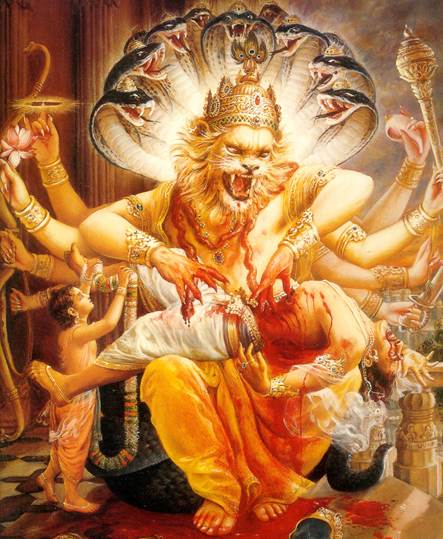
Lord Nrsimhadeva
Half-lion, Half-man
incarnation of Supreme Personality of Godhead
Prahlada
Pacifies Lord Nrsimhadeva with Prayers
After
Hiranyakasipu was killed, the Lord continued to be very angry, and the
demigods, headed by Lord Brahma, could not pacify Him. Even mother Laksmi, the
goddess of fortune, the constant companion of Narayana, could not dare come
before Lord Nrsimhadeva. Then Lord Brahma asked Prahlada Maharaja to go forward
and pacify the Lord’s anger. Prahlada Maharaja, being confident of the
affection of his master, Lord Nrsimhadeva, was not afraid at all. He very
gravely appeared before the Lord’s lotus feet and offered Him respectful
obeisances. Lord Nrsimhadeva, being very much affectionate toward Prahlada
Maharaja, put His hand on Prahlada’s head, and because of being personally
touched by the Lord, Prahlada Maharaja immediately achieved brahma-jnana,
spiritual knowledge. Thus he offered his prayers to the Lord in full spiritual
knowledge and full devotional ecstasy. The instructions given by Prahlada
Maharaja in the form of his prayers are as follows.
Prahlada
said, “I am not proud of being able to offer prayers to the Supreme Personality
of Godhead. I simply take shelter of the mercy of the Lord, for without
devotion one cannot appease Him. One cannot please the Supreme Personality of
Godhead simply by dint of high parentage or great opulence, learning,
austerity, penance or mystic power. Indeed, these are never pleasing to the
Supreme Lord, for nothing can please Him but pure devotional service. Even if a
non-devotee is a brahmana qualified with the twelve brahminical
symptoms, he cannot be very dear to the Lord, whereas if a person born in a
family of dog-eaters is a devotee, the Lord can accept his prayers. The Lord
does not need anyone’s prayers, but if a devotee offers his prayers to the
Lord, the devotee benefits greatly. Ignorant persons born in low families,
therefore, can sincerely offer heartfelt prayers to the Lord, and the Lord will
accept them. As soon as one offers his prayers to the Lord, he is immediately
situated on the Brahman platform.”
Lord
Nrsimhadeva appeared for the benefit of all human society, not only for
Prahlada’s personal benefit. The fierce form of Lord Nrsimhadeva may appear
most awful to a nondevotee, but to the devotee the Lord is always affectionate
as He is in other forms. Conditioned life in the material world is actually
extremely fearful; indeed, a devotee is not afraid of anything else. Fear of
material existence is due to false ego. Therefore the ultimate goal of life for
every living entity is to attain the position of being servant of the servant
of the Lord. The miserable condition of the living entities in the material
world can be remedied only by the mercy of the Lord. Although there are so-called
material protectors like Lord Brahma and the other demigods, or even one’s own
father, they are unable to do anything if one is neglected by the Supreme
Personality of Godhead. However, one who has fully taken shelter of the Lord’s
lotus feet can be saved from the onslaught of material nature. Therefore every
living entity should be unattracted by material so-called happiness and should
take shelter of the Lord by all means. That is the mission of human life. To be
attracted by sense gratification is simply foolish. Whether one is a devotee of
the Lord or is a nondevotee does not depend upon one’s birth in a high or low
family. Even Lord Brahma and the goddess of fortune cannot achieve the full
favour of the Lord, whereas a devotee can very easily attain such devotional
service. The Lord’s mercy is bestowed equally upon everyone, regardless of
whether one is high or low. Because Prahlada Maharaja was blessed by Narada
Muni, Prahlada became a great devotee. The Lord always saves the devotee from
impersonalists and voidists. The Lord is present in everyone’s heart as the
Supersoul to give the living being protection and all benefits. Thus the Lord
acts sometimes as the killer and sometimes as the protector. One should not
accuse the Lord for any discrepancies. It is His plan that we see varieties of
life within this material world. All of them are ultimately His mercy.
Although
the entire cosmic manifestation is non-different, the material world is
nonetheless different from the spiritual world. Only by the mercy of the
Supreme Lord can one understand how the wonderful material nature acts. For
example, although Lord Brahma appeared from the lotus seat that had grown from
the abdomen of Garbhodakasayi Visnu, he could not understand what to do after
his appearance. He was attacked by two demons, Madhu and Kaitabha, who took
away Vedic knowledge, but the Lord killed them and entrusted to Lord Brahma the
Vedic knowledge. Thus the Lord appears in every millennium in the societies of
demigods, human beings, animals, saints and aquatics. All such incarnations are
meant to protect the devotees and kill the demons, but this killing and
protecting does not reflect any sense of partiality on the part of the Supreme
Lord. The conditioned soul is always attracted by the external energy.
Therefore he is subjected to lust and greed, and he suffers under the
conditions of material nature. The Lord’s causeless mercy toward His devotee is
the only means by which to get out of material existence. Anyone engaged in
glorifying the Lord’s activities is always unafraid of this material world,
whereas one who cannot glorify the Lord in that way is subjected to all
lamentation.
Those
interested in silently worshiping the Lord in solitary places may be eligible
for liberation themselves, but a pure devotee is always aggrieved to see others
suffering. Therefore, not caring for his own liberation, he always engages in
preaching by glorifying the Lord. Prahlada Maharaja, therefore, had tried to
deliver his class friends by preaching and had never remained silent. Although
being silent, observing austerities and penances, learning the Vedic
literature, undergoing ritualistic ceremonies, living in a solitary place and
performing japa and transcendental meditation are approved means of liberation,
they are meant for non-devotees or for cheaters who want to live at the expense
of others. A pure devotee, however, being freed from all such deceptive
activities, is able to see the Lord face to face.
The atomic
theory of the composition of the cosmic manifestation is not factual. The Lord
is the cause of everything, and therefore He is the cause of this creation. One
should therefore always engage in devotional service by offering respectful
obeisances to the Lord, offering prayers, working for the Lord, worshiping the
Lord in the temple, always remembering the Lord and always hearing about His
transcendental activities. Without these six kinds of activity, one cannot
attain to devotional service.
Prahlada
Maharaja thus offered his prayers to the Supreme Lord, begging His mercy at
every step. Lord Nrsimhadeva was pacified by Prahlada Maharaja’s prayers and
wanted to give him benedictions by which Prahlada could procure all kinds of
material facilities. Prahlada Maharaja, however, was not misled by material
facilities. Rather, he wanted to remain always a servant of the servant of the
Lord.
Prahlada,
the Best Among Exalted Devotees
Lord
Nrsimhadeva wanted to bestow benedictions upon Prahlada Maharaja, one after
another, but Prahlada Maharaja, thinking them impediments on the path of
spiritual progress, did not accept any of them. Instead, he fully surrendered
at the Lord’s lotus feet. He said: “If anyone engaged in the devotional service
of the Lord prays for personal sense gratification, he cannot be called a pure
devotee or even a devotee. He may be called only a merchant engaged in the
business of give and take. Similarly, a master who wants to please his servant
after taking service from him is also not a real master.” Prahlada Maharaja,
therefore, did not ask anything from the Supreme Personality of Godhead.
Rather, he said that if the Lord wanted to give him a benediction, he wanted
the Lord to assure him that he would never be induced to take any benedictions
for the sake of material desires. Exchanges of devotional service for lusty
desires are always very prominent. As soon as lusty desires awaken, one’s
senses, mind, life, soul, religious principles, patience, intelligence,
shyness, beauty, strength, memory and truthfulness are all vanquished. One can
render unalloyed devotional service only when there are no material desires in
one’s mind.
The Supreme
Personality of Godhead was greatly pleased with Prahlada Maharaja for his
unalloyed devotion, yet the Lord provided him one material benediction - that
he would be perfectly happy in this world and live his next life in Vaikuntha.
The Lord gave him the benediction that he would be the king of this material
world until the end of the manvantara millennium and that although in this
material world, he would have the facility to hear the glories of the Lord and
depend fully on the Lord, performing service to Him in uncontaminated
bhakti-yoga. The Lord advised Prahlada to perform sacrifices through
bhakti-yoga, for this is the duty of a king.
Prahlada
Maharaja accepted whatever the Lord had offered him, and he prayed for the Lord
to deliver his father. In response to this prayer, the Lord assured him that in
the family of such a pure devotee as he, not only the devotee’s father but his
forefathers for 21 generations are liberated. The Lord also asked Prahlada to
perform the ritualistic ceremonies appropriate after his father’s death.
Then Lord
Brahma, who was also present, offered many prayers to the Lord, expressing his
obligation to the Lord for having offered benedictions to Prahlada Maharaja.
The Lord advised Lord Brahma not to offer benedictions to asuras as he had to Hiranyakasipu, for such benedictions indulge
them. Then Lord Nrsimhadeva disappeared. On that day, Prahlada Maharaja was
installed on the throne of the world by Lord Brahma and Sukracarya.
Directions to reach Ahobilam:
Ahobilam
is located in Kurnool district of Andhra Pradesh amidst the majestic hills of
the Eastern Ghats range. It is 256 km from Tirupati, 110 km from Cuddapah, 68 km
from Nandyal and 24 km from Allagadda. To visit Ahobilam, the best is to
travel from Tirupati. It is approximately 5 hours drive from Tirupati to
Ahobilam (256 km).
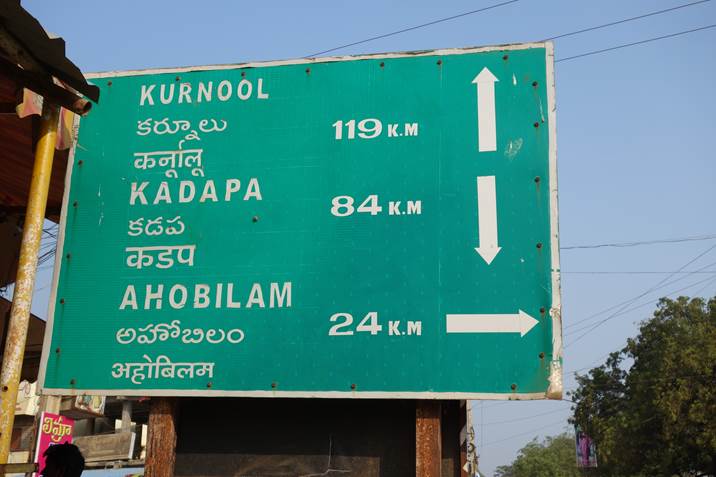
Ahobilam Yatra lectures:
His Holiness Radhanath Swami
lectures at Ahobilam South India Yatra 1999:
Pilgrimage to Ahobilam: https://www.youtube.com/watch?v=WuCzk6Ad44Q (video)
Pilgrimage
to Ahobilam: https://touchstonemedia.com/products/pilgrimage-to-ahobilam (DVD)
Lord Nrsimhadeva Pastimes (Srimad-Bhagavatam Canto 7):
www.vedabase.com/sb/7
Mayapur TV: http://Mayapur.tv
/ Vrindavana TV: http://Vrindavana.tv
Holy
Pilgrimages: www.Holy-Pilgrimages.com
Holy
Dham: www.HolyDham.com
HARE KRISHNA HARE
KRISHNA KRISHNA KRISHNA HARE HARE |
HARE RAMA HARE RAMA
RAMA RAMA HARE HARE ||