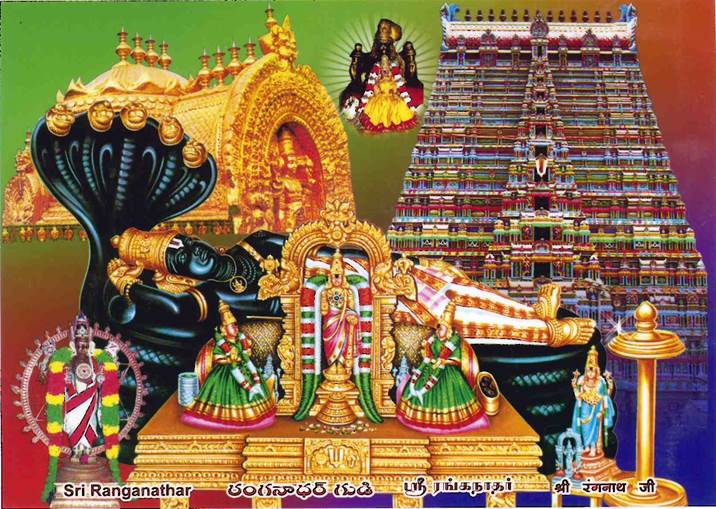
Sri
Ranganatha Swamy Temple
Srirangam
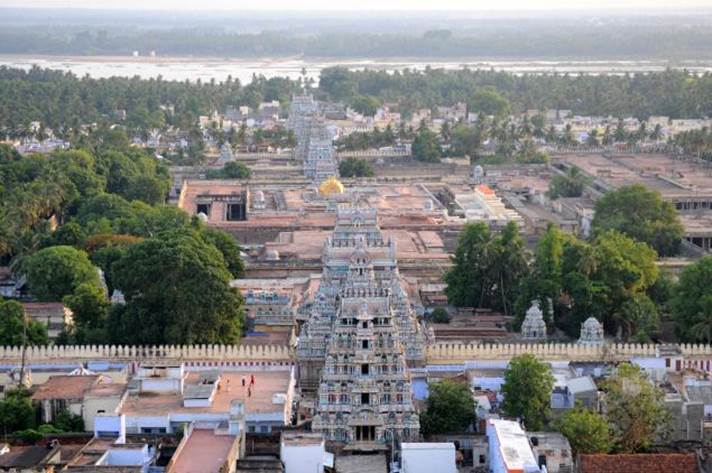
This article covers:
I. Sri Ranganatha Swamy Temple at Srirangam
II. Vaishnava temples around Srirangam:
1. House of Srila Gopala Bhatta
Goswami and Jagannatha Math
2. Sri Adi Narayana Perumal Kovil at
Gopurapatti
3. Sri Pundarikaksha Perumal Temple
at Thiruvellarai
4. Uthamar Kovil (Thirukkarambanoor)
5. Anbil Sundararaja Perumal Temple
6. Azhagiya Manavala Perumal Temple
at Uraiyur
7. Appakkudathaan Perumal Temple
8. Gunaseelam
9. Kattu Narasimha Perumal Temple
(Azhagiya Singar - handsome jungle God)
III.
Life and Teachings of Sripad Ramanujacarya
Sri
Ranganatha Swamy Temple at Srirangam
Srirangam or Sri Rangaksetra is the
largest temple in world in which worship is still being performed. According to
the great acaryas of Sri Sampradaya, Srirangam is the supreme holy
place, it is Vaikuntha manifested in this world. Its history and its glories
are spoken of in many of the Vedic literatures and Puranas. Srirangam,
the premier Vaishnava temple in South India is the first and foremost among the
108 Vaishnava divyadesas. In the year 1511 A.D.,
Lord Caitanya Mahaprabhu visited Srirangam when He was
touring South India. Lord Caitanya spent four months of Caturmasya Vrata (rainy
season) in Srirangam, the longest time He spent in one place during His
travels. Lord
stayed at the house of a Sri Vaishnava brahmana named Venkata Bhatta,
who then got the opportunity to serve the Lord to his heart’s content. Sri
Gopala Bhatta Gosvami,
who is one of the Six Gosvami’s of Vrindavana,
was the son of Venkata Bhatta.
Srirangam
(formerly Vellithirumutha gramam) and Thiruvarangam in Tamil is an island and a part of the city of Tiruchirappalli in
south India, surrounded by holy Kaveri River and Kollidam. Srirangam is the
main centre of worship and culture for the Sri Vaishnavas, the disciplic line
of devotees of Lord Vishnu (Krishna) that begins with Lakshmi Devi (Sri, Lord
Vishnu’s consort). Historically, their main acarya, or spiritual
teacher, was Sripad Ramanujacarya.
Sri
Caitanya Caritamrta Madha-lila
chapter 9 verse 79 describes:
Sri Ranga-ksetra
(Srirangam) is a very famous place. It lies in the
district of Tiruchchirapalli, about ten miles west of
Kumbhakonam and near the city of Tiruchchirapalli, on
an island in the Kaveri River. The
Srirangam
temple is the largest in India, and there are seven walls and seven roads
surrounding it. The ancient names of these roads are the road of Dharma, the
road of Rajamahendra, the road of Kulasekhara,
the road of Alinadana, the
road of Tiruvikrama, the Tirubidi road of Madamadi-gaisa,
and the road of Ada-iyavala-indana.
The temple was founded before the reign of Dharmavarma, who reigned before Rajamahendra.
Many celebrated kings like Kulasekhara and
Yamunacarya
(Alabandaru) resided
in the temple of Srirangam. Yamunacarya,
Sri
Ramanuja, Sudarsanacarya
and others also supervised this temple.
The
incarnation of the goddess of fortune known as Godadevi
or Sri Andal
was one of the twelve Alvars,
liberated persons known as divya-suris. She
was married to the Deity of Lord Sri
Ranganatha, and
later she entered into the body of the Lord. An incarnation of Karmuka
named Tirumanga (also one of the Alvars)
acquired some money by stealing and built the fourth boundary wall of Srirangam.
It is said that in the year 289 of the Age of Kali, the Alvar
of the name Tondaradippadi
was born. While engaged in devotional service he fell
victim to a prostitute, and Sri
Ranganatha, seeing
His devotee so degraded, sent one of His servants with a golden plate to that
prostitute. When the golden plate was discovered missing from the temple, there
was a search, and it was found in the prostitute’s house. When the devotee saw
Ranganatha’s mercy
upon this prostitute, his mistake was rectified. He then prepared the third
boundary wall of the Ranganatha temple
and cultivated a tulasi garden there.
There
was also a celebrated disciple of Ramanujacarya’s
known as Kuresa. Sri Ramapillai
was the son of Kuresa, and his
son was Vagvijaya Bhatta,
whose son was Vedavyasa Bhatta, or Sri
Sudarsanacarya.
When Sudarsanacarya
was an old man, the Muslims attacked the temple of Ranganatha
and killed about twelve hundred Sri
Vaisnavas. At that time the Deity of Ranganatha
was transferred to the temple of Tirupati, in the kingdom of Vijaya-nagara. The
governor of Gingee, Goppanarya, brought Sri
Ranganatha from
the temple of Tirupati to a place known as Simha-brahma,
where the Lord was situated for three years. In the year 1293 Saka
(A.D. 1371) the Deity was reinstalled in the Ranganatha
temple. On the eastern wall of the Ranganatha
temple is an inscription written by Vedanta-desika
relating how Ranganatha was
returned to the temple.
Srirangam
temple compound covers about 3 square miles. The main temple is surrounded by seven walls, which
represent the seven planetary systems described in Vedic cosmology. The seven
walls have twenty-one towered entrances (gopurams), the highest of which is called the Rajagopuram and is 236 feet tall, biggest in
Asia, and can be seen from at least ten miles away. Much of the town of
Srirangam is within the three outer walls of the temple compound. After
Tirupati, this is the second most visited Vaishnava temple in South India.
The Deity in the main temple is Sri Ranganatha Swamy, a
two-armed form of Lord Vishnu reclining on the divine serpent Ananta Sesa. Near
His feet are seated His two consorts, Sri Bhu and Sri Neela. In front of Lord
Ranganatha is the utsava-murti of Lord Vishnu, called Sri Manavala Perumal.
This deity is taken out of the temple for processions. Alongside Lord
Ranganatha is Deity Tiruvaranga, who was worshiped as a substitute during the
Muslim period, when the original could not be found. At the feet of the Lord is
Vibhisana, the brother of Ravana. Above the main altar is the Sriranga-vimana
(golden tower) fully made of gold. On the four sides
of the Sriranga vimana are carvings of four forms of Lord Vishnu. On the south
side is Para-Vasudeva, on the west is Acyuta, on the
north Ananda and on the east Govinda.
The
priests of Srirangam have worshiped Sri Ranganatha in much the same way since
the 18th century, when Sri Ramanuja set up strict standards of worship, with a
meticulous schedule of songs, prayers, rituals, and offerings. Each morning at
6:45 am, a cow with her head facing away from Lord Ranganatha and an elephant
facing the cow are brought before the altar. Thus when the deity’s doors are
opened the first thing that Lord Ranganatha sees is the rear end of a cow and
the head of an elephant, which are both considered very auspicious. Instead of
a conch-shell being blown, the elephant blows his trunk. This is the most
auspicious time to see Lord Ranganatha.
Since
the time Sri Ranganatha decided to stay at Srirangam countless kings, queens,
saints, sages, devotees, demigods, and goddesses have eagerly stood before the
doors of His chamber awaiting His merciful glance. Millions of souls since
ancient times have had that fortune, and many more will have it for many years
to come. Vaikuntha Ekadasi is one of the main festival
at the Srirangam temple.
History of Sri Ranganatha Swamy:
History
of Srirangam as revealed in various Puranas traces back to the beginning
of creation. At the beginning of this creation, Lord Brahma was born from the
lotus sprouting from the navel of Lord Vishnu. There was darkness all around
and Lord Brahma was initiated with a mantra, he chanted this mantra and
was given the power to create. Brahma wanted a deity to worship. Pleased by the
penance of Brahma, Lord Vishnu manifested Himself in the form of Lord
Ranganatha lying on the Ananta Sesa for Brahma to worship. Lord Ranganatha
appeared with His Deity chamber or vimana.
The
Lord informed Brahma that he had come as a Svayamvyakta - on his own
volition - as a deity. He would appear likewise in eight places on earth - Srirangam,
Sri Mushnam, Venkatadri, Saligram, Naimisaranya, Totadri, Pushkara and
Badrinath. Sri Ranga Vimana is the first and the earliest of all these. The
Lord directed Brahma to worship him strictly according to the procedure for
worship laid down in the Agamas.
Brahma
carried the deity to Satyaloka and installed it on the banks of the
river, Viraja. Brahma worshiped that deity for a long time. After
him, Vaivasvata Manu, performed the worship. When his son Ikshvaku,
became the King of Ayodhya, he wanted to have it installed at Ayodhya. Ikshvaku
performed penance which lasted for many 100 years at the end of which he was
permitted by Brahma to take it to Ayodhya. It was this dynasty in which Lord
was later to appear in His avatar as Lord Ramacandra. Sri Ranganatha
Swamy was their ancestral Deity.
After
the coronation of Lord Ramacandra in Ayodhya, the celebration went on for one
month. Nobody could leave the association of dear-most Lord Rama in Ayodhya.
Seeing Vibhisana’s deep attachment, Rama wanted to give him the best thing He
had. Vibhisana is the symbol of sarnagati. He surrendered everything to
Lord Ramacandra. He took such risk in his loving service to Sri Rama. Lord Rama
gave him His own personal murti, which was the ishtadev of Raghu
dynasty for many ages.
Along
with vimana, Vibhisana was carrying the deity to Lanka. On an island on
the banks of Kaveri river, there was a king named
Dharma Varma. Vibhisana stopped on this island of Sri Ranga. King Dharma Varma
had earlier been to Ayodhya and saw the puja of Ranganath Swamy and in the
heart of his heart he prayed that the Lord come here in his kingdom so that he
could worship Him. Dharma Varma performed the worship of Sri Ranganatha Swamy
and when it was time to go to Lanka, the murti would not move. The Lord
spoke to Vibhisana, “I wish to remain here. This Ranga kshetra is Vaikuntha,
it is My abode. I will remain here. I must fulfil the
prayers of Dharma Varma. You go back to Sri Lanka and I will protect you.”
Generally
deities face the eastern direction. But Ranganath Swami is facing the southern
direction. His eyes are facing towards Sri Lanka. And by that glance He is
protecting and fulfilling all of Vibhisana’s desires.
According
to one commentary by a Vaishnava acarya of Sri Sampradaya, in Ayodhya,
Sita asked Lord Rama the following. “When Vibhisana was telling Ravana that I should
be sent back, he told that ever since I came in Sri Lanka there were
inauspicious moments. I am goddess of fortune. I am supposed to make everything
auspicious, then how come as soon as I came to Lanka there was
inauspiciousness.” Then Lord Rama said, it was not
because of you but Ravana’s nefarious activities. Sita said but still I am the
source of auspiciousness then why everything became inauspicious. So Rama said
that, “In the form of Ranganath I will always look towards Sri Lanka to show
how supremely auspicious you have made it.”
Dharma
Varma built a very beautiful temple but over the years the temple got covered
over by sandstorms and floods. As generations went by it was forgotten. Then
one day, temple histories say, a king of the Chola dynasty was resting under a
tree in the area when a parrot told him that Lord Ranganath was buried under
the sand. The parrot was again and again repeating a sloka:
kaveree viraja seyam
vaikuntam rangamandiram sa vasudevo pangeshah pratyaksham paramam padam
vimanam pranavakaram
vedasrungam mahadhbhutham srirangasayee bhagavan pranavarthaprakasakah
“The
river Kaveri is the very same river Viraja that eternally flows in Vaikuntha, Srirangam Temple is verily Vaikuntam itself, the
Abode of Lord Vishnu where he sits in all splendour and majesty in the company
of Nityasuris Eternal associates. The Lord of Arangam,
is none but Vasudeva, the primeval Lord Himself. The vimana is verily the
external Paramapada itself. The vimana
is in the form of the Pranava (OM).
The four towers are marvellously akin to the four Vedas and the Lord, Sri
Rangasayee is expounding the import of the Pranava.”
The
king then excavated the temple and restored all parts of the huge complex. Over
the years to follow, numerous Chola and Pandya kings, including King
Kulasekhara, expanded and renovated the temple. Great Vaishnava leaders
Yamunacarya, Ramanujacarya and Sudarsanacarya all had important roles in the
further development of Srirangam. Natha Muni worshipped this place. Sripad
Yamunacarya made his headquarter and then his disciple Ramanujacarya came to
establish the worship as it is seen today and from that time the worship is
going on by his descendants.
In
1334, Ulugh khan, a Moghul king attacked Srirangam. During this period, lasting
close to 50 years some of the residents fled the place but many others stayed
on to fight the invaders. And at that time, there were 12,000 Vaishnavas in
Srirangam. Amongst those 11,250 were massacred. The remaining 750 Vaishnavas
somehow or other escaped to the village Gopurapatti. According to Koyilozhugu,
an authentic record of events relating to Srirangam, Sri Vaishnavites were
scattered during the invasion. Divided into various teams, each team took upon
various responsibilities for protection of the temple. Then in the 15th and 16th centuries
the Vijayanagar and Nayak rulers slowly began to revive the glories of
Srirangam. In the 17th and 18th centuries Muslims, the French, and finally the
British used the fort-like temple of Srirangam during their conquests.
Eventually, when India gained independence in 1947, the Indian government and
the Sri Vaishnavas took over the management of the temple.
Lord Caitanya’s Visit
to Srirangam
Sri Caitanya Caritamrta Madha-lila chapter 9 verses 79-165 describe
visit of Lord Caitanya to Srirangam. Lord Krishna appeared 500 years ago in
Bengal as Sri Caitanya Mahaprabhu, who accepted the mood of a devotee of
Krishna. After taking sannyasa, the renounced order of life, Lord
Caitanya travelled throughout India for 6 years, visiting holy places and
spreading the chanting of the holy names of the Lord. In
the year 1433 Sakabda (A.D.
1511), when Lord Caitanya Mahaprabhu was
touring South India, He visited Srirangam. Lord Caitanya observed the practice that a sannyasi
ceases travel during the 4 months of the rainy season (Caturmasya). During that period, the longest
time He spent in one place was at Srirangam at
the house of a Sri
Vaishnava brahmana named Venkata
Bhatta, who then got the opportunity to
serve the Lord to his heart’s content. Sri
Gopala Bhatta Gosvami,
who is one of the Six Gosvami’s of Vrindavana,
was the son of Venkata Bhatta.
Because Venkata Bhatta was a devotee with whom Lord
Caitanya could discuss the transcendental pastimes of Lord Krishna, Lord
Caitanya passed His days at Srirangam in great happiness.
While there, Sri
Caitanya Mahaprabhu took His bath in the river Kaveri
and visited the temple of
Sri Ranganatha Swami. Every day the Lord also danced in ecstasy.
The beauty of Lord Caitanya’s body and His ecstatic love of God were witnessed
by everyone. Many people used to come see Him, and as soon as they saw Him, all
their unhappiness and distress vanished.
Every day, local Vaishnava brahmanas would invite Caitanya Mahaprabhu to
their homes for prasadam.
Venkata
Bhatta and Caitanya Mahaprabhu developed a friendly relationship, and they
would happily laugh and joke together. Since Venkata Bhatta belonged to the Sri
Sampradaya and worshiped the Supreme Lord in His majestic aspect as
Laxmi-Narayana, Caitanya Mahaprabhu would have lengthy spiritual discussions
with him about worshiping Laxmi-Narayana and worshiping the Lord in His most
sweet form as Radha-Krishna. Lord Caitanya (all the while in a pleasant mood)
cited a scriptural reference that tells how Laxmi, the consort of Narayana,
wanted to join the most confidential pastimes of Krishna but was not allowed to
do so.
Unable
to defeat Lord Caitanya’s arguments, Venkata Bhatta said, “You are the
Supreme Personality of Godhead Krishna Himself. You know the purpose of Your activities, and the person whom You enlighten can also
understand Your pastimes.” Caitanya Mahaprabhu enlightened Venkata Bhatta
in all the subtle details of Lord Krishna's most intimate pastimes. Lord
Caitanya then said, “There is no difference between the transcendental forms
of the Lord. Different forms are manifested due to different attachments of
different devotees. Actually the Lord is one, but He appears in different forms
just to satisfy His devotees.”
When
the four-month period ended, Sri Caitanya Mahaprabhu took permission from
Venkata Bhatta to continue on with His travels. When Caitanya Mahaprabhu bade
farewell, Venkata Bhatta fell down unconscious in the ecstasy of spiritual
love. Pilgrims to Srirangam can still visit the house of Venkata Bhatta. During
His stay Lord Caitanya carved with His own hands deities of Jagannatha,
Baladeva and Subhadra and worshipped Them. This deities are worshipped even today in a small temple
called Jagannatha Math across the road from Venkata Bhatta’s house.
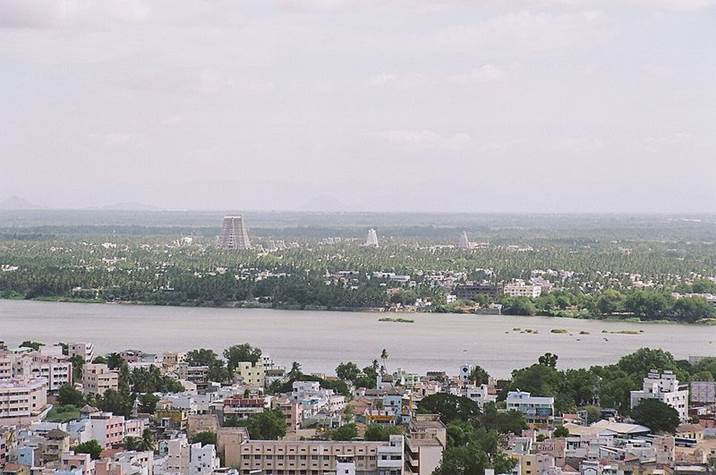
Sri Ranganatha Swamy
Temple at the Srirangam island and sacred Kaveri river
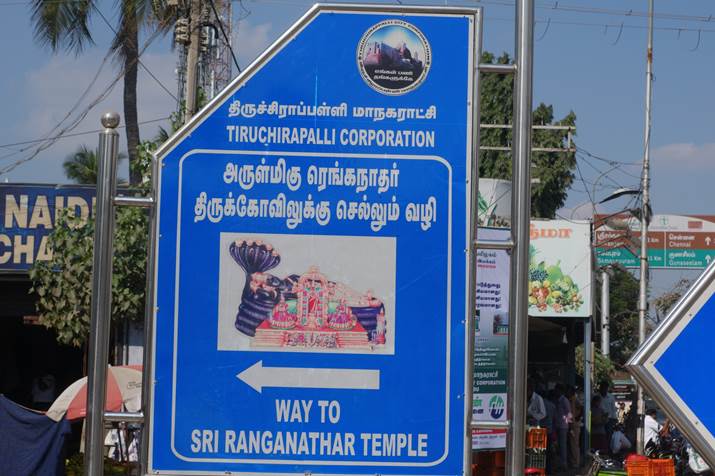
Way to Sri Ranganatha
Swamy Temple
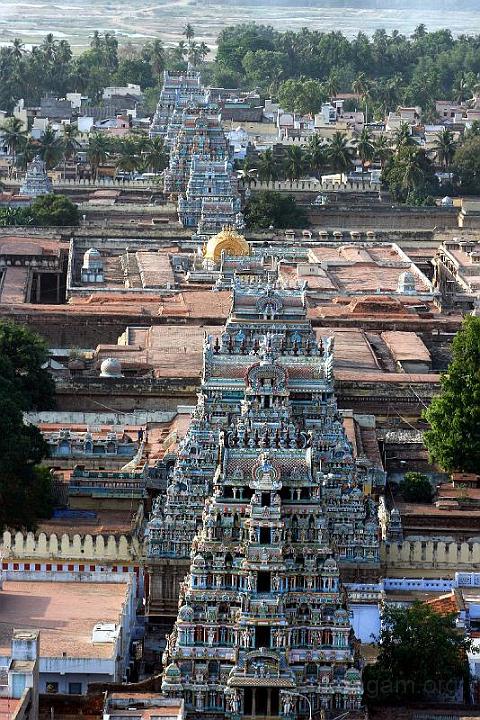
Sri Ranganatha Swamy
Temple at Srirangam
Srirangam
temple compound covers about 3 square miles. The main temple is surrounded by
seven walls, which represent the seven planetary systems described in Vedic
cosmology. The seven walls have twenty-one towered entrances (gopurams), the
highest of which is called the Rajagopuram and is 236
feet tall, biggest in Asia, and can be seen from at least ten miles away. Much
of the town of Srirangam is within the three outer walls of the temple
compound. After Tirupati, this is the second most visited Vaishnava temple in
South India.
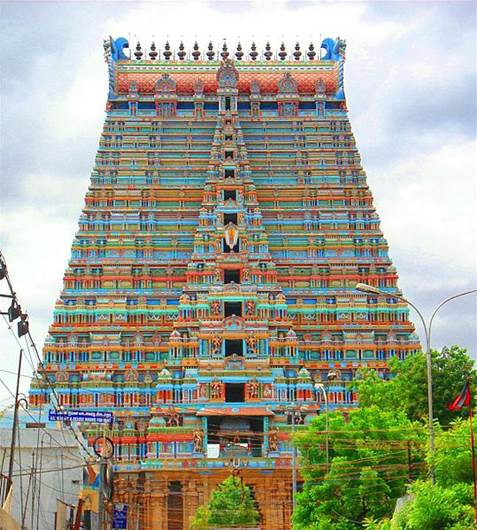
Rajagopuram of
Srirangam Temple
Rajagopuram is 236 feet tall,
biggest in Asia, and can be seen from at least ten miles away.
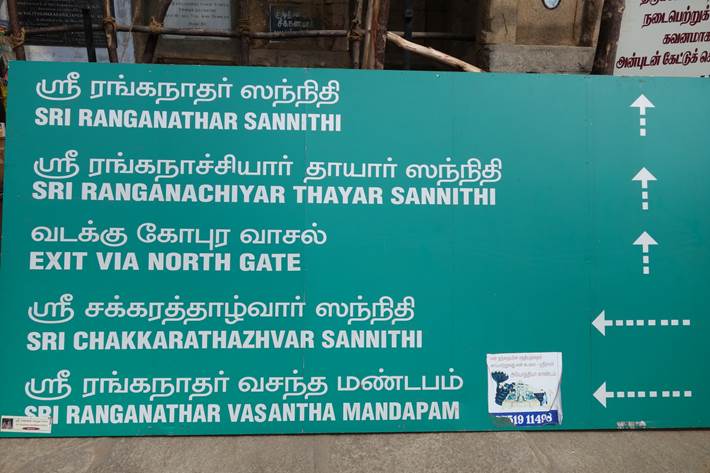
Sri Ranganatha Swamy
Temple at Srirangam
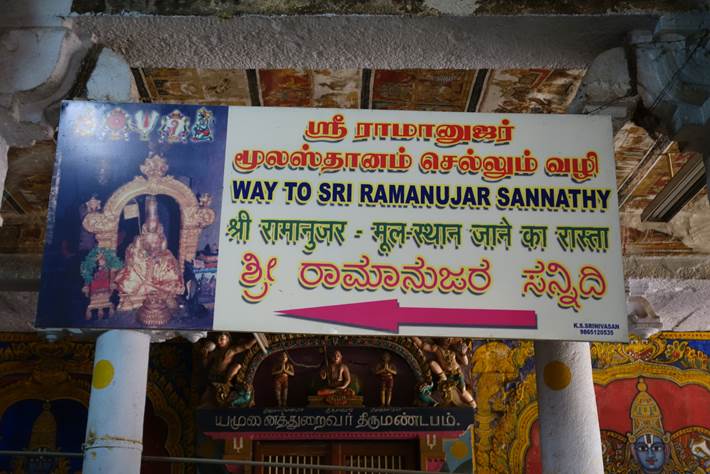
Way to Sripad Ramanujacarya
Samadhi at Srirangam
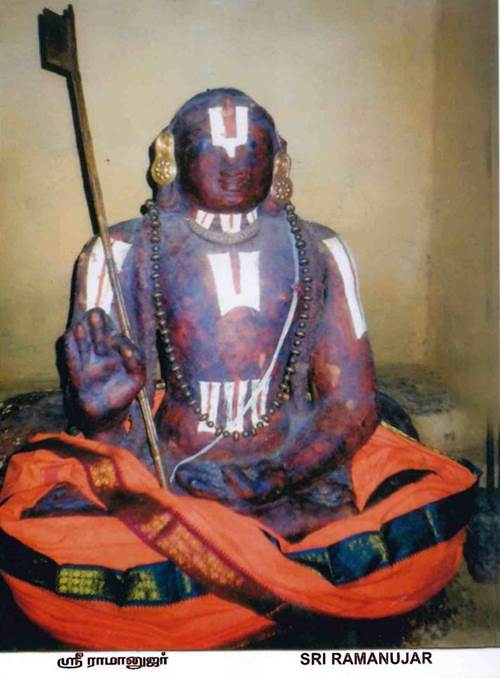
Sripad Ramanujacarya
at his Samadhi at Srirangam
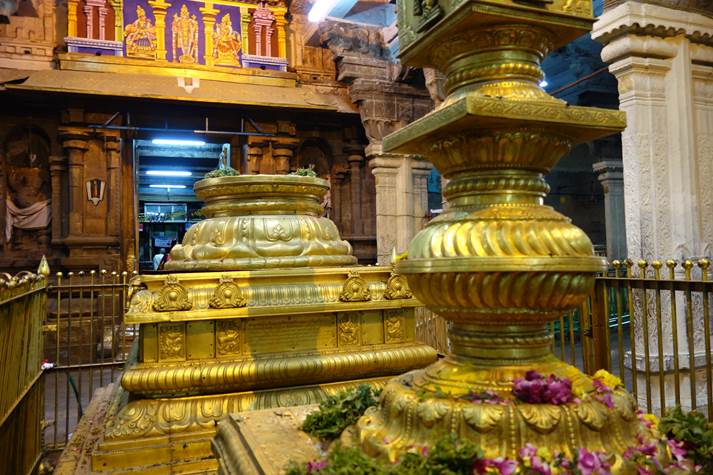
Sri Ranganatha Swamy
Temple (inside)
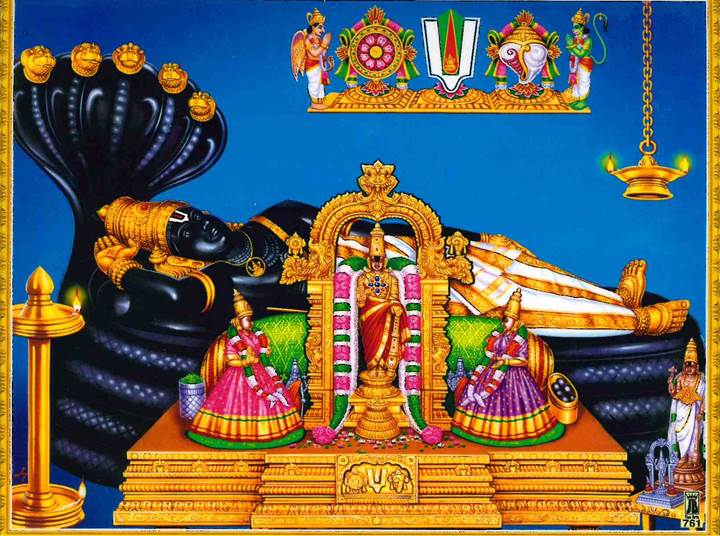
Lord Sri Ranganatha
Swamy Temple at Srirangam
The Deity in the main
temple is Sri Ranganatha Swamy, a two-armed form of Lord Vishnu reclining on
the divine serpent Ananta Sesa. Near His feet are seated His two consorts, Sri
Bhu and Sri Neela. In front of Lord Ranganatha is the utsava-murti of Lord
Vishnu, called Sri Manavala Perumal.
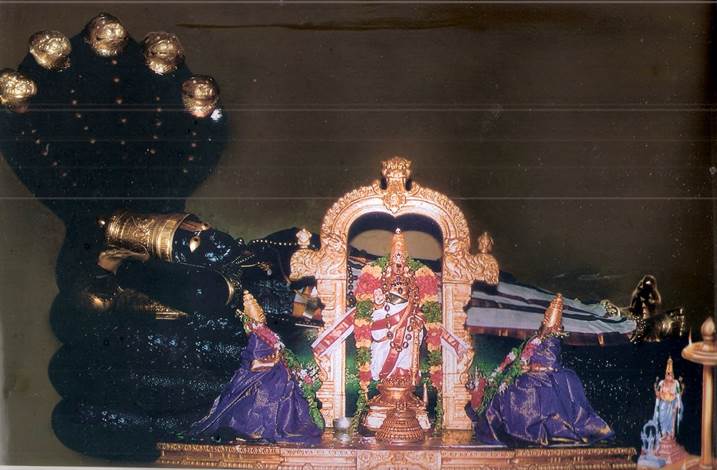
Lord Sri Ranganatha
Swamy Temple
Utsava-murti is taken
out of the temple for processions. Alongside Lord Ranganatha is Deity
Tiruvaranga, who was worshiped as a substitute during the Muslim period, when
the original could not be found. At the feet of the Lord is Vibhisana, the
brother of Ravana.
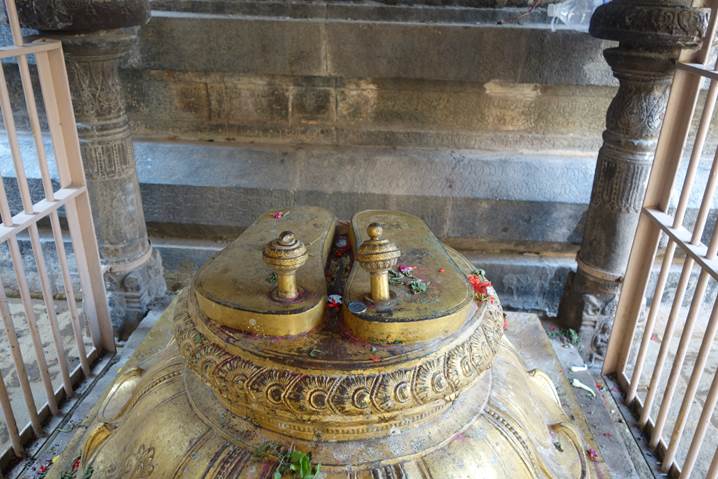
Lotus Feet of Lord Sri
Ranganatha Swamy
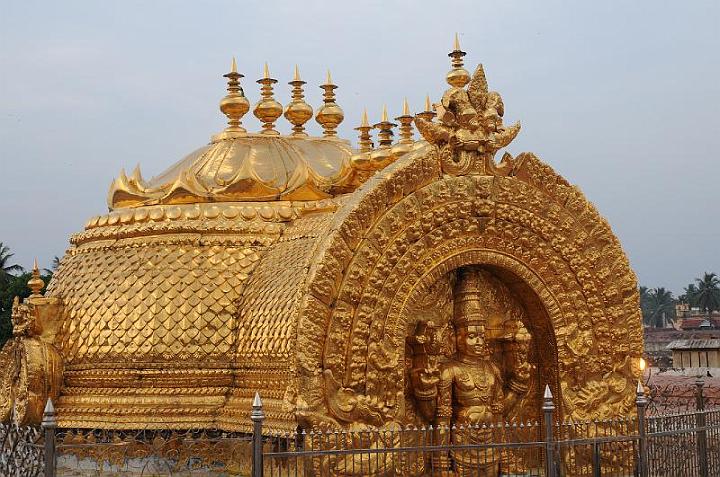
Vimana of Lord Sri
Ranganatha Swamy
Above the main altar
is the Sriranga-vimana (golden tower) fully made of gold.
On the four sides of the Sriranga vimana are carvings of four forms of Lord
Vishnu. On the south side is Para-Vasudeva, on the
west is Acyuta, on the north Ananda and on the east Govinda.
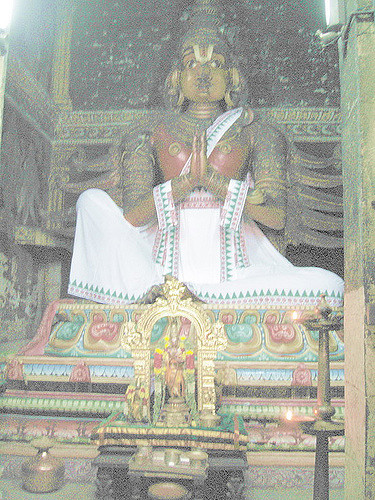
Garuda Shrine at Sri
Ranganatha Swamy Temple
In the 4th enclosure
of the temple is the biggest mantapa for Garuda. 25 feet tall Deity of Garuda
is seen graciously joining his palms and sitting opposite the temple of Lord
Ranganatha. Garuda appears in such a majestic form ready to take off with the
Lord. The dhoti of Sri Garuda is 30 meter long. He is adorned with Ashta Nagabaranam
(a jewel of 8 serpents). Abhisheka or Thirumanjana is not performed to Sri
Garuda. Kozhukkattai – the sweet pudding balls are offered as naivedyam on
every Thursday. Sugriva and Angada are the Dwarapalakas of the sanctum –
sanctorum of this temple. On the Margazhi Tiruvadirai star day, a festival for
Sri Garuda is celebrated.
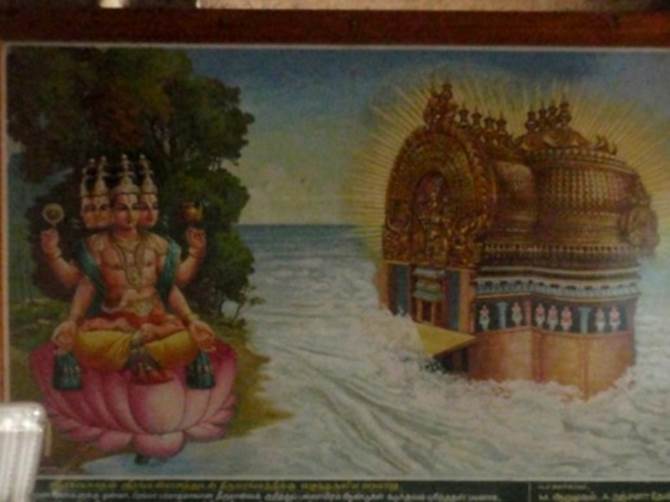
History of Srirangam
as revealed in Puranas traces back to the beginning of creation
At the beginning of
creation Lord Brahma wanted a deity to worship. Pleased by the penance of
Brahma, Lord Vishnu manifested Himself in the form of Lord Ranganatha lying on
the Ananta Sesa for Brahma to worship. Lord Ranganatha appeared with His Deity vimana.
Brahma carried the deity to Satyaloka and worshiped for a long time. After him, Vaivasvata Manu, performed the worship. When his
son Ikshvaku, became the King of Ayodhya, he wanted to have it installed at
Ayodhya. He performed penance which lasted for many 100 years at the end of
which he was permitted by Brahma to take it to Ayodhya.
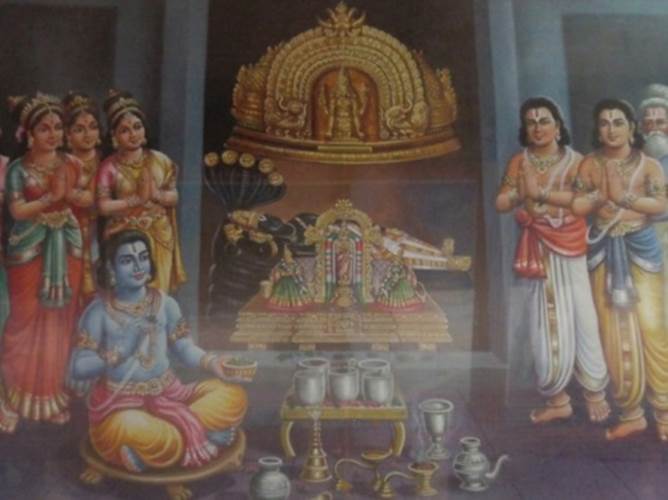
Lord Ramacandra
worshipping Sri Ranganatha Swamy at Ayodhya
Lord Ramacandra
appeared in this dynasty in Treta-yuga. Sri Ranganatha Swamy was there
ancestral Deity.
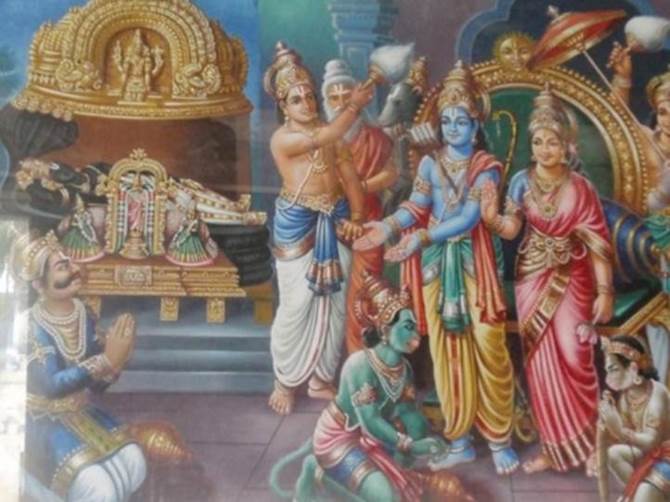
After the coronation
of Lord Ramacandra in Ayodhya, Lord Rama wanted to give to Vibhisana the best
thing He had. He gave him His own personal murti, Sri Ranganatha Swamy,
which was the ishtadev of Raghu dynasty.
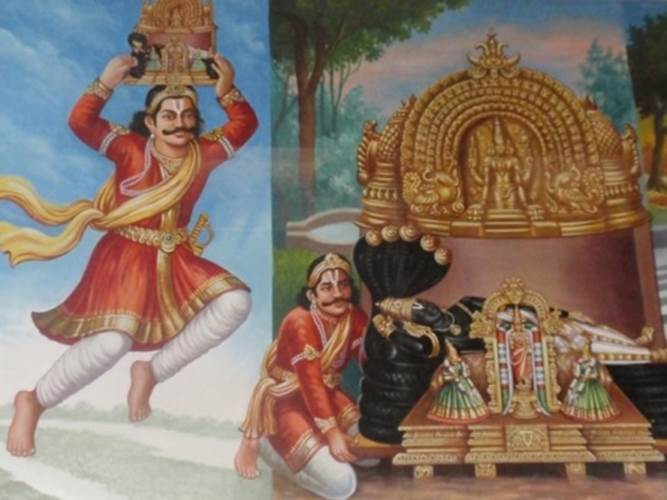
Along with vimana,
Vibhisana was carrying the deity to Lanka. On an island on the banks of Kaveri river, there was a king named, Dharma Varma. Vibhisana
stopped on this island of Sri Ranga.
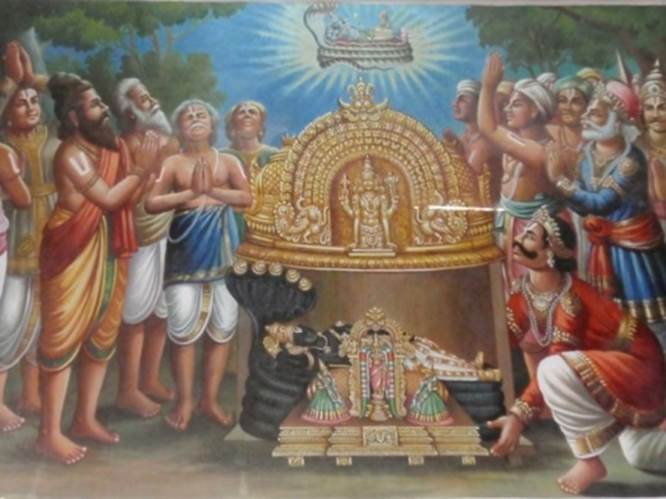
King Dharma Varma had
earlier been to Ayodhya and saw the puja of Ranganath Swamy and in the heart of
his heart he prayed that the Lord come here in his kingdom so that he could
worship Him. He performed the worship of Ranganath Swamy and when it was time
to go to Lanka, the murti would not move.
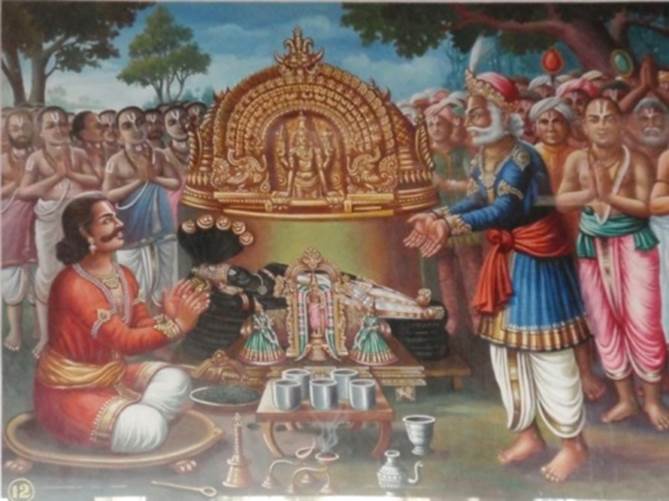
The Lord spoke to
Vibhisana, “I wish to remain here. This Ranga kshetra is Vaikuntha, it is My abode. I will remain here. I must fulfil the prayers of
Dharma Varma. You go back to Lanka and I will protect you.” Generally deities
face the eastern direction. But Ranganath Swami is facing the southern
direction. His eyes are facing towards Sri Lanka. And by that glance He is
protecting and fulfilling all of Vibhisana’s desires.
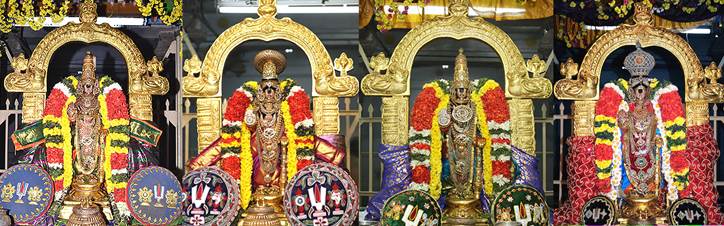
Utsava Deities at
Srirangam Temple
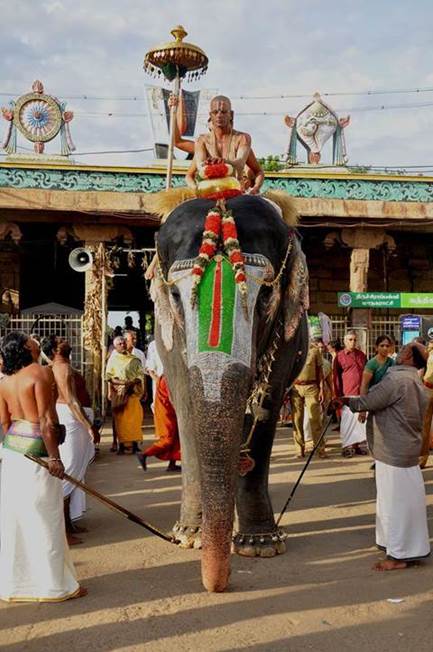
Festival Deities taken
out at Srirangam temple
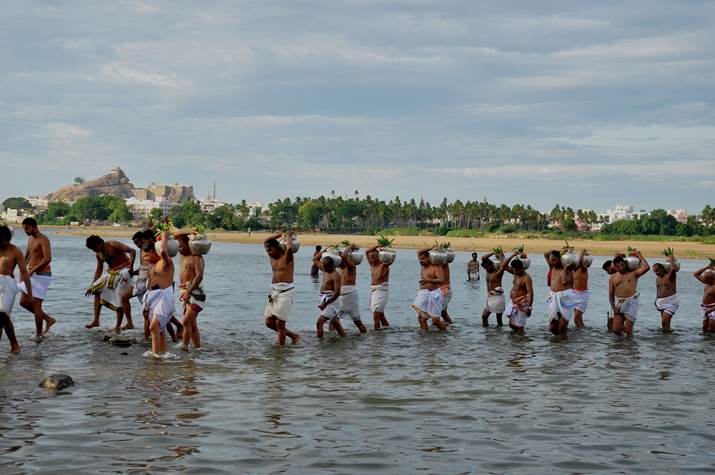
Devotees taking
tirtham from holy Kaveri river at Srirangam in
preparation for the festival
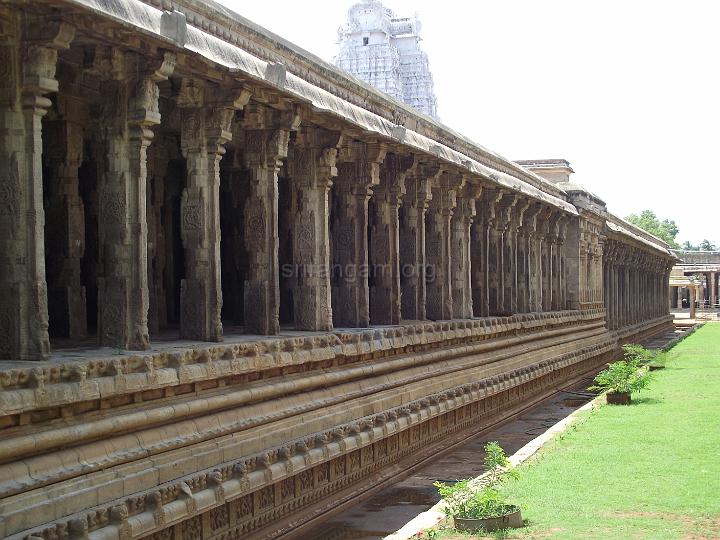
1000 pillar hall at
Srirangam temple
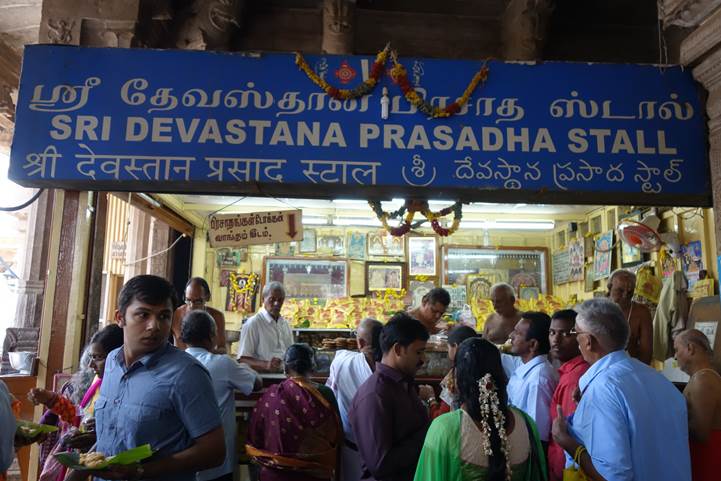
Maha-prasadam stall at Sri Ranganatha Swamy Temple
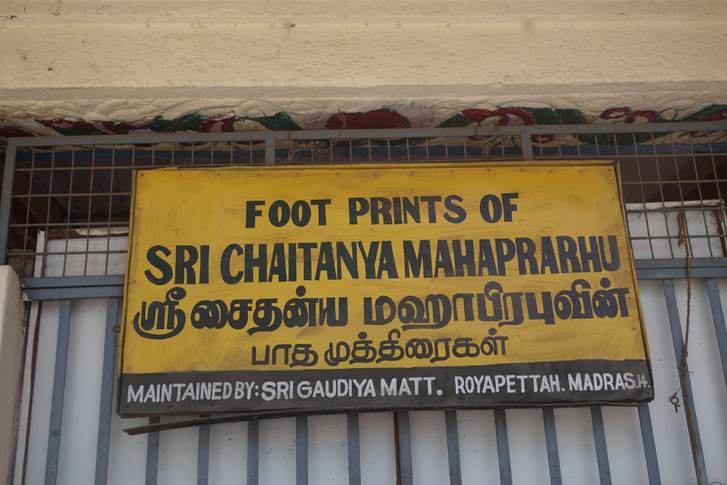
Foot Prints temple of
Sri Caitanya Mahaprabhu at Srirangam
This temple is at the centre on the
main road going towards Srirangam temple
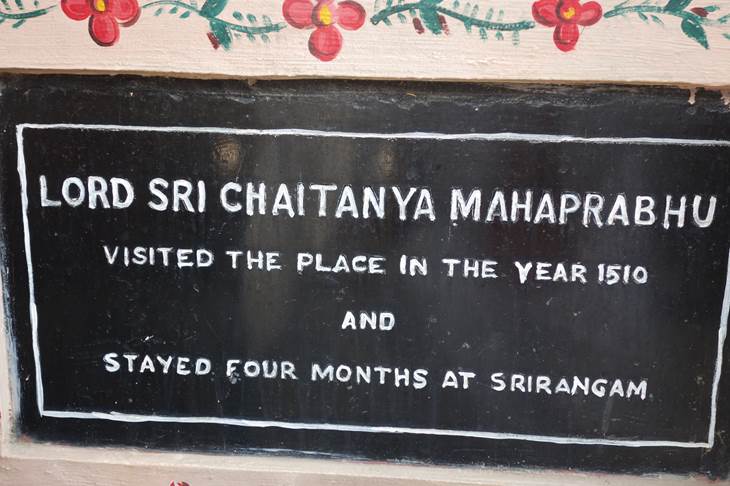
In the year 1511 Sri Caitanya Mahaprabhu
visited Srirangam during His South India tour. Lord Caitanya observed
the practice that a sannyasi ceases travel during the 4 months of the
rainy season (Caturmasya). During that period,
the longest time He spent in one place was at Srirangam at the house of a Sri Vaishnava brahmana named Venkata Bhatta,
who then got the opportunity to serve the Lord to his heart’s content. Sri
Gopala Bhatta Gosvami,
who is one of the Six Gosvami’s of Vrindavana,
was the son of Venkata Bhatta.
Because
Venkata
Bhatta
was a devotee with whom Lord Caitanya could discuss the transcendental pastimes
of Lord Krishna, Lord Caitanya passed His days at Srirangam in great happiness.
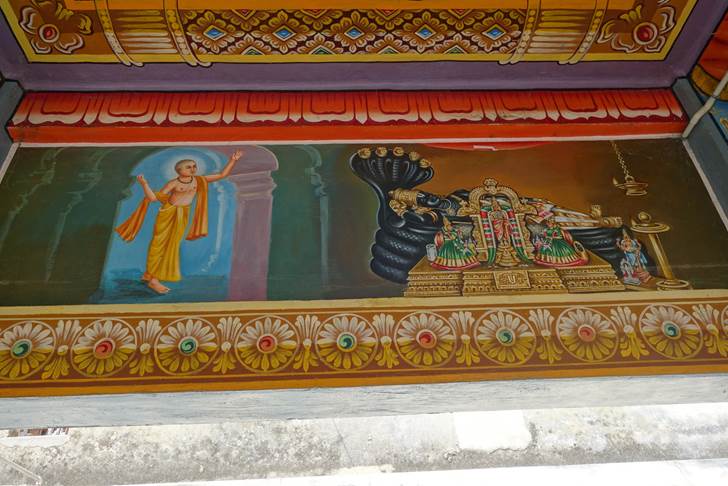
While at Srirangam, Sri Caitanya
Mahaprabhu took His bath in the river Kaveri
and visited the temple of Sri Ranganatha Swami. Every
day the Lord also danced in ecstasy. The beauty of Lord Caitanya’s body and His
ecstatic love of God were witnessed by everyone. Many people used to come see
Him, and as soon as they saw Him, all their unhappiness and distress vanished. Every day, local Vaishnava
brahmanas would invite Caitanya Mahaprabhu to their homes for prasadam.
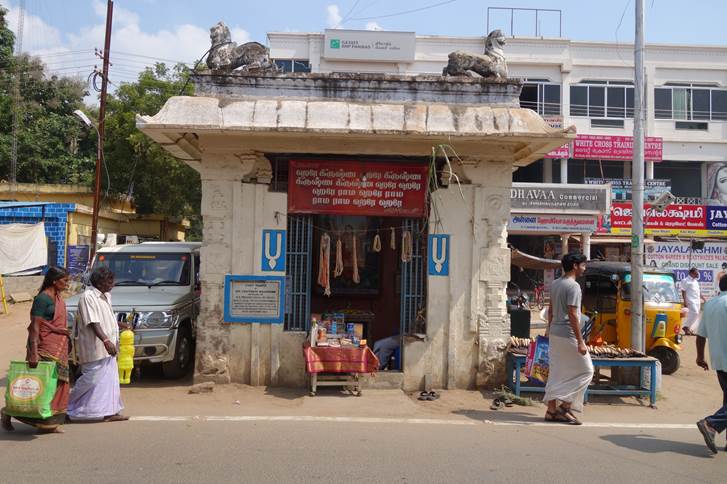
Foot Prints temple of
Sri Caitanya Mahaprabhu at Srirangam
While at Srirangam, Sri Caitanya
Mahaprabhu took His bath in the river Kaveri
and visited the temple of Sri Ranganatha Swami. Every
day the Lord also danced in ecstasy. The beauty of Lord Caitanya’s body and His
ecstatic love of God were witnessed by everyone. Many people used to come see
Him, and as soon as they saw Him, all their unhappiness and distress vanished. Every day, local
Vaishnava brahmanas would invite Caitanya Mahaprabhu to their homes for
prasadam.
Venkata Bhatta and
Caitanya Mahaprabhu developed a friendly relationship,
and they would happily laugh and joke together. Since Venkata Bhatta belonged
to the Sri Sampradaya and worshiped the Supreme Lord in His majestic
aspect as Laxmi-Narayana, Caitanya Mahaprabhu would have lengthy spiritual
discussions with him about worshiping Laxmi-Narayana and worshiping the Lord in
His most sweet form as Radha-Krishna. Lord Caitanya (all the while in a
pleasant mood) cited a scriptural reference that tells how Laxmi, the consort
of Narayana, wanted to join the most confidential pastimes of Krishna but was
not allowed to do so.
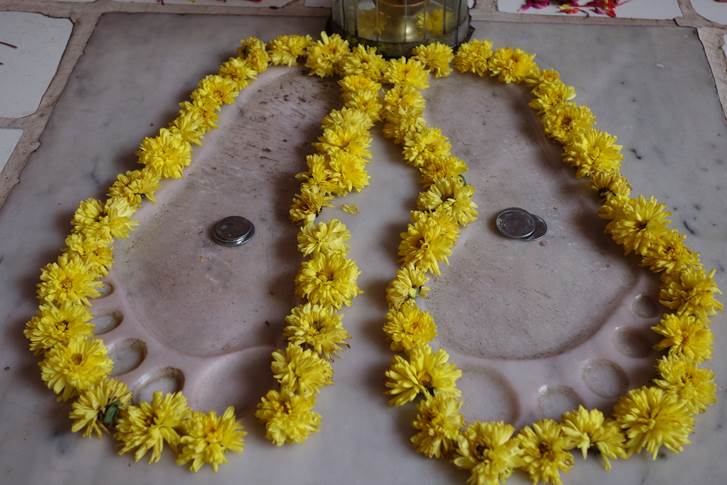
Foot prints of Lord
Sri Caitanya Mahaprabhu at Srirangam
Unable to defeat Lord
Caitanya’s arguments, Venkata Bhatta said, “You are the Supreme Personality of
Godhead Krishna Himself. You know the purpose of Your
activities, and the person whom You enlighten can also understand Your
pastimes.” Caitanya Mahaprabhu enlightened Venkata Bhatta in all the subtle
details of Lord Krishna's most intimate pastimes. Lord Caitanya then said,
“There is no difference between the transcendental forms of the Lord. Different
forms are manifested due to different attachments of different devotees.
Actually the Lord is one, but He appears in different forms just to satisfy His
devotees.” When the four-month period ended, Sri Caitanya took permission from
Venkata Bhatta to continue on with His travels. When Caitanya Mahaprabhu bade
farewell, Venkata Bhatta fell down unconscious in the ecstasy of spiritual
love. Pilgrims to Srirangam can still visit the house of Venkata Bhatta.
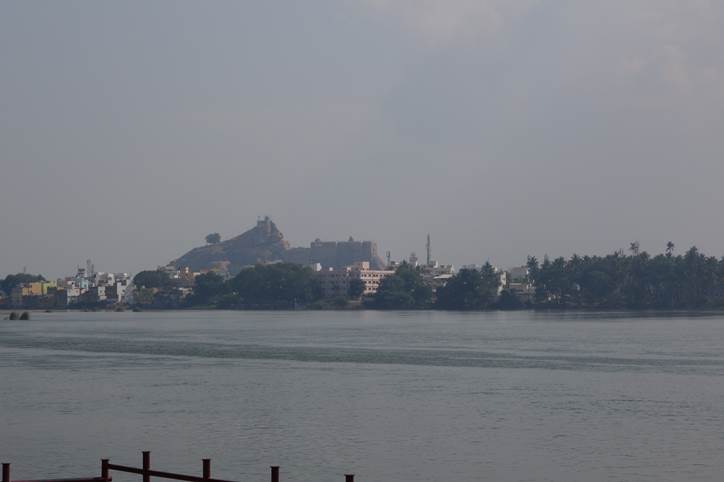
Sacred Kaveri river. Kaveri is one of the 7 holy rivers on earth. Across
the river is famous Rock Fort temple of Tiruchirappalli.
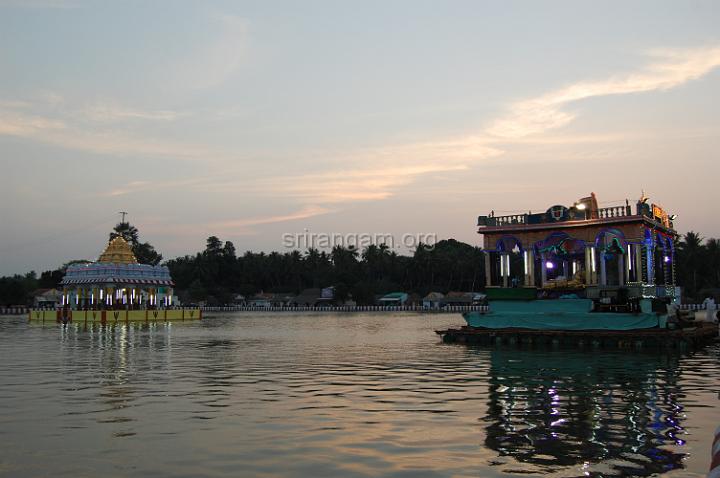
Pushkarini - Festival
time at Sri Ranganatha Swamy Temple at Srirangam
Once
Sripad Ramanujacarya washed his hands here. Immediately all the
aquatics in the pond manifested four-handed form and returned back to Godhead.
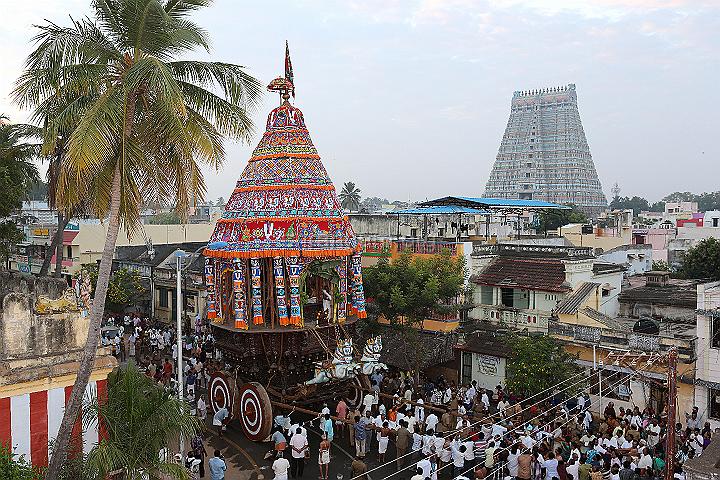
Thai Ther festival at
Sri Ranganatha Swamy Temple
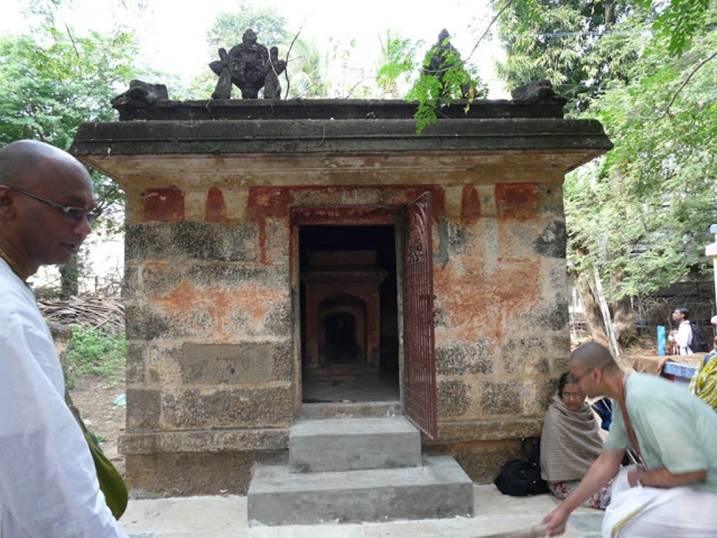
Samadhi of Yamunacharya
Just around when Ramanuja abandoned the life of a householder and became
a Sannyasi, about that time, Yamunacharya being very old was on the look-out
for a young person of good ability and character to take his place as head of
the Mutt at Srirangam. He had already heard of Ramanuja through his disciples
and made up his mind to instal Ramanuja in his place. He now sent for Ramanuja.
By the time Ramanuja reached Srirangam, Yamunacharya had left this world; and
Ramanuja saw his body being taken by his followers to the cremation ground
outside the village. Ramanuja followed them to the cremation ground. Ramanuja
saw Yamunacharya body fingers were uniquely curled. Three of Yamunacharyas
fingers were curled.
Taking this as Yamunacharya’s last 3 wishes for him, Ramanaujacharya
proclaimed to fulfil first wish that a Visishtadvaita Bhashya should be written
for the Brahma Sutras of Vyasa. At this the 1st finger of Yamunacharya
uncurled. Secondly Ramanujacharya proclaimed that the names of Parasara and
Veda Vyasa, should be commemorated on the earth by
giving it to a person worthy to bear it. Yamunacharya’s 2nd finger got
uncurled. Thirdly Ramaunja would compose a commentary on Tiruvaymozhi of
Nammalwar, the most prolific of Alwars. Thereupon the 3rd finger also got
straightened. Ramanuja lived for 120 years, and in the course of his long life,
fully redeemed his promise by fulfilling all the 3 wishes of Yamunacharya.
Yamunacharya was then given Samadhi (entombed) on the banks of river Kollidon
in Srirangam. This is around 10 min walk from back gate of Rangnatha Swamy
temple via Rangnayaki Nachiar Kovil to river banks. Samadhi is a little towards
right side of the bathing gaths of the river. Many acharyas samadhis are
also present there.
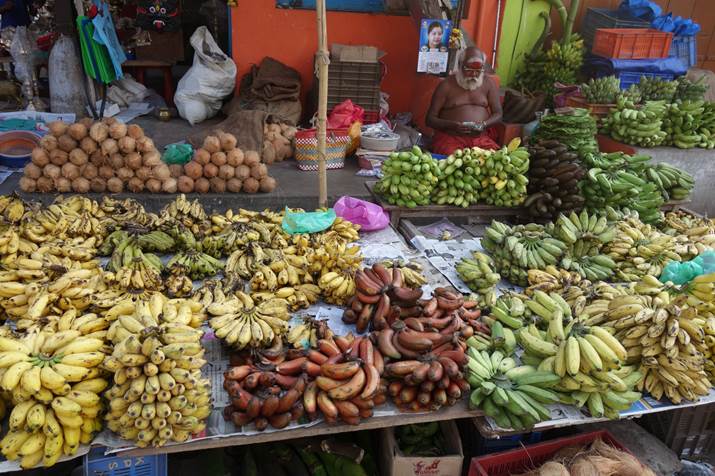
Local banana stall
near Srirangam temple
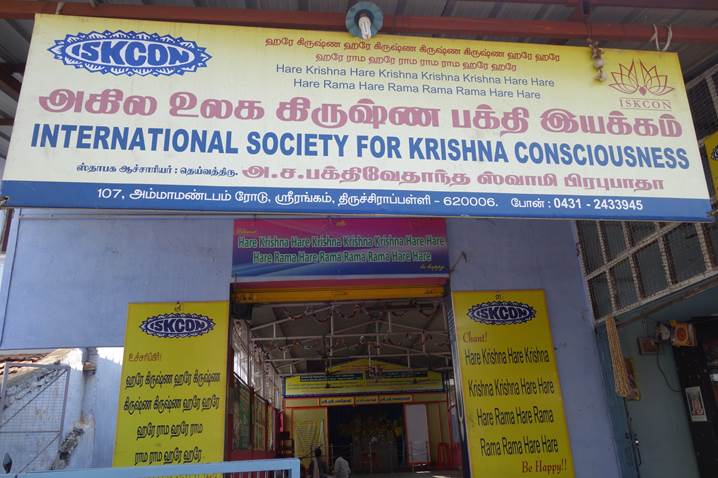
Hare Krishna -
International Society for Krishna Consciousness (ISKCON) Temple at Srirangam
ISKCON temple is about
2 km from Sri Ranganatha Swamy Temple on the main road towards Kaveri river.
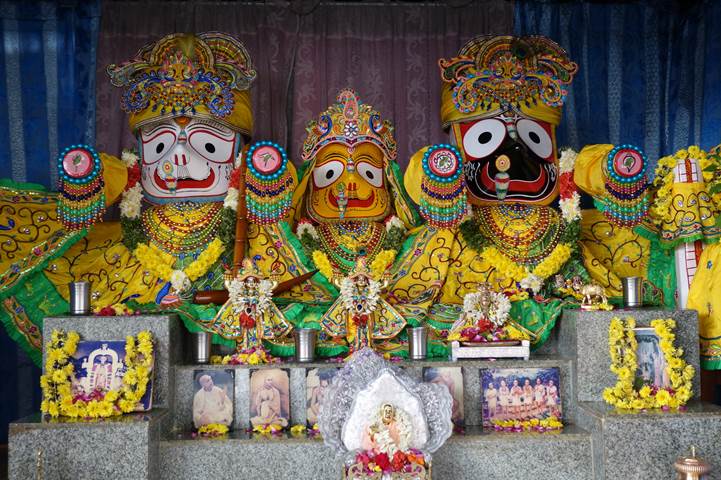
Their Lordships Sri
Sri Jagannatha, Baladeva, Subhadra at ISKCON Srirangam temple
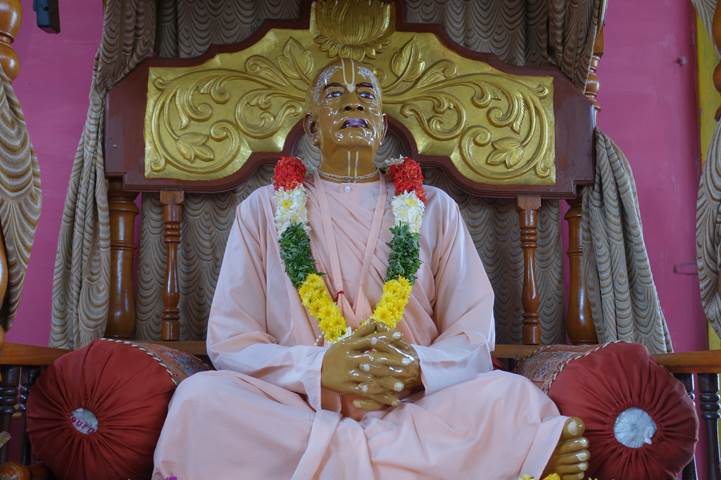
His Divine Grace A.C.
Bhaktivedanta Swami Prabhupada
Founder-Acarya of
International Society for Krishna Consciousness (ISKCON)
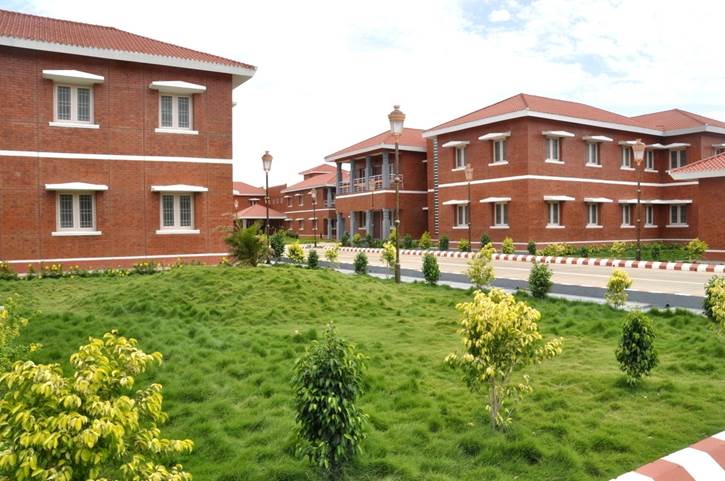
Guest house of
Srirangam temple - Sree Renga Vilas - very nice accommodation facility
Temples Around Srirangam
1. House
of Srila Gopal Bhatta Goswami and Jagannatha Math:
House of
Srila Gopal Bhatta Goswami and Jagannatha Math is just
behind Srirangam temple. Srila Gopala Bhatta Gosvami is one of the Six
Gosvami’s of Vrindavana. He was the son of Venkata
Bhatta. In the year 1433 Sakabda
(A.D. 1511), when Lord Caitanya Mahaprabhu was
touring South India, He stayed for four months during the period of Caturmasya
at the house of Venkata Bhatta,
who then got the opportunity to serve the Lord to his heart’s content. Gopala
Bhatta also got the opportunity to serve
the Lord at this time.
Sri
Caitanya Caritamrta Madha-lila
chapter 9 verses 79-165 describe visit of Lord Caitanya to Srirangam.
After visiting the holy place named Siva-ksetra,
Caitanya Mahaprabhu arrived at Papanasana
and there saw the temple of Lord Visnu. Then He
finally reached Sri Ranga-ksetra.
After bathing in the river Kaveri,
Sri
Caitanya Mahaprabhu saw the temple of Ranganatha
and offered His ardent prayers and obeisances. Thus He felt Himself successful.
In the temple of Ranganatha, Sri
Caitanya Mahaprabhu chanted and danced in ecstatic
love of Godhead. Seeing His performance, everyone was struck with wonder. A Vaisnava
known as Venkata Bhatta
then invited Sri Caitanya
Mahaprabhu to his home with great
respect. Sri Venkata
Bhatta took Sri
Caitanya Mahaprabhu to his home. After he washed
the Lord’s feet, all the members of his family drank the water. After offering
lunch to the Lord, Venkata Bhatta
submitted that the period of Caturmasya
had already arrived. Venkata Bhatta
said, “Please be merciful to me and stay at my house during Caturmasya.
Speak about Lord Krishna’s pastimes and kindly deliver
me by Your mercy.” Sri
Caitanya Mahaprabhu remained at the house of Venkata
Bhatta for four continuous months. The
Lord passed His days in great happiness, enjoying the transcendental mellow of
discussing Lord Krishna’s pastimes.
While there, Sri
Caitanya Mahaprabhu took His bath in the river Kaveri
and visited the temple of Sri Ranga.
Every day the Lord also danced in ecstasy. The beauty of Lord Caitanya’s body
and His ecstatic love of God were witnessed by everyone. Many people used to
come see Him, and as soon as they saw Him, all their unhappiness and distress
vanished. Many hundreds of thousands of people from various countries came to
see the Lord, and after seeing Him they all chanted the Hare Krishna
maha-mantra. Indeed, they did not chant
anything but the Hare Krishna maha-mantra,
and all of them became Lord Krishna’s devotees. Thus the general populace was
astonished. All the Vaisnava brahmanas
residing in Sri Ranga-ksetra
invited the Lord to their homes. Indeed, He had an invitation every day. Each
day the Lord was invited by a different brahmana,
but some of the brahmanas did not
get the opportunity to offer Him lunch because the period of Caturmasya
came to an end.
In the holy place of Sri
Ranga-ksetra, a brahmana
Vaishnava used to visit the temple daily
and recite the entire text of the Bhagavad-Gita.
The brahmana regularly
read the 18 chapters of the Bhagavad-Gita
in great transcendental ecstasy, but because he could not pronounce the words
correctly, people used to joke about him. Due to his incorrect pronunciation,
people sometimes criticized him and laughed at him, but he did not care. He was
full of ecstasy due to reading the Bhagavad-Gita
and was personally very happy. While reading the book, the brahmana
experienced transcendental bodily transformations. The hairs on his body stood
on end, tears welled up in his eyes, and his body trembled and perspired as he
read. Seeing this, Sri Caitanya
Mahaprabhu became very happy.
Sri
Caitanya Mahaprabhu asked the brahmana,
“My dear sir, why are you in such ecstatic love? Which portion of the Bhagavad-Gita
gives you such transcendental pleasure?” The brahmana
replied, “I am illiterate and therefore do not know the meaning of the words.
Sometimes I read the Bhagavad-Gita
correctly and sometimes incorrectly, but in any case I am doing this in
compliance with the orders of my spiritual master.” The brahmana
continued, “Actually I only see Lord Krishna sitting
on a chariot as Arjuna’s charioteer. Taking the reins in His hands, He appears
very beautiful and blackish. While seeing Lord Krishna
sitting in a chariot and instructing Arjuna, I am filled with ecstatic
happiness. As long as I read the Bhagavad-Gita,
I simply see the Lord’s beautiful features. It is for this reason that I am
reading the Bhagavad-Gita, and
my mind cannot be distracted from this.”
After saying this, Lord Caitanya Mahaprabhu
embraced the brahmana, and the
brahmana, catching
the lotus feet of the Lord, began to cry. The brahmana
said, “Upon seeing You, my happiness is doubled. I
take it that You are the same Lord Krishna.”
The mind of the brahmana was
purified by the revelation of Lord Krishna, and
therefore he could understand the truth of Sri
Caitanya Mahaprabhu in all details. Sri
Caitanya Mahaprabhu then taught the brahmana
very thoroughly and requested him not to disclose the fact that He was Lord Krishna
Himself. That brahmana became a
great devotee of Sri Caitanya
Mahaprabhu, and for four continuous
months he did not give up the Lord’s company.
Sri
Caitanya Mahaprabhu remained at the house of Venkata
Bhatta and constantly talked with him
about Lord Krishna. In this way He was very happy.
Being a Vaisnava in the Ramanuja-sampradaya,
Venkata Bhatta
worshiped the Deities of Laksmi
and Narayana.
Seeing his pure devotion, Sri Caitanya
Mahaprabhu was very satisfied. Constantly
associating with each other, Sri
Caitanya Mahaprabhu and Venkata
Bhatta gradually developed a friendly
relationship. Indeed, sometimes they laughed and joked together. Sri
Caitanya Mahaprabhu told the Bhattacarya,
“Your worshipable goddess of fortune, Laksmi,
always remains on the chest of Narayana,
and she is certainly the most chaste woman in the
creation. However, my Lord is Lord Sri
Krishna, a cowherd boy who is engaged in tending
cows. Why is it that Laksmi, being
such a chaste wife, wants to associate with My Lord? Just to associate with Krishna,
Laksmi abandoned
all transcendental happiness in Vaikuntha and for
a long time accepted vows and regulative principles and performed unlimited
austerities.” Caitanya Mahaprabhu then
said, “O Lord, we do not know how the serpent Kaliya
attained such an opportunity to be touched by the dust of Your
lotus feet. Even the goddess of fortune, for this end, performed austerities
for centuries, giving up all other desires and observing austere vows. Indeed,
we do not know how the serpent Kaliya got
such an opportunity.”
Venkata
Bhatta then said, “Lord Krishna and
Lord Narayana
are one and the same, but the pastimes of Krishna are more relishable due to
their sportive nature. Since Krishna and Narayana
are the same personality, Laksmi’s
association with Krishna does not break her vow of chastity. Rather, it was in
great fun that the goddess of fortune wanted to associate with Lord Krishna.”
Venkata Bhatta
continued, “According to transcendental realization, there is no difference
between the forms of Narayana
and Krishna. Yet in Krishna there is a special transcendental attraction due to
the conjugal mellow, and consequently He surpasses Narayana.
This is the conclusion of transcendental mellows.’ The goddess of fortune
considered that her vow of chastity would not be damaged by her relationship
with Krishna. Rather, by associating with Krishna she could enjoy the benefit
of the rasa dance.” Venkata
Bhatta further explained, “Mother Laksmi,
the goddess of fortune, is also an enjoyer of transcendental bliss; therefore
if she wanted to enjoy herself with Krishna, what fault is there? Why are You joking so about this?”
Lord Caitanya Mahaprabhu
replied, “I know that there is no fault on the part of the goddess of fortune,
but still she could not enter into the rasa dance.
We hear this from the revealed scriptures. ‘When Lord Sri
Krishna was dancing with the gopis in the rasa-lila,
the gopis were embraced around the neck by
the Lord’s arms. This transcendental favor was never bestowed upon the goddess
of fortune or the other consorts in the spiritual world. Nor was such a thing
ever imagined by the most beautiful girls in the heavenly planets, girls whose
bodily luster and aroma exactly resemble the beauty and fragrance of lotus
flowers. And what to speak of worldly women, who may be very,
very beautiful according to material estimation?’ But can you tell Me why the goddess of fortune, Laksmi,
could not enter the rasa dance? The authorities of Vedic
knowledge could enter the dance and associate with Krishna. ‘Great sages conquer
the mind and senses by practicing the mystic yoga system and controlling the
breath. Thus engaging in mystic yoga, they see the Supersoul within their
hearts and ultimately enter into impersonal Brahman. But even the enemies of
the Supreme Personality of Godhead attain that position simply by thinking of
the Supreme Lord. However, the damsels of Vraja, the gopis,
being attracted by the beauty of Krishna, simply wanted to embrace Him and His
arms, which are like serpents. Thus the gopis
ultimately tasted the nectar of the lotus feet of the Lord. Similarly, we Upanisads
can also taste the nectar of His lotus feet by following in the footsteps of
the gopis.’ ”
Having been asked by Caitanya Mahaprabhu
why the goddess of fortune could not enter into the rasa
dance whereas the authorities on Vedic knowledge could, Venkata
Bhatta replied, “I cannot enter into the
mysteries of this behavior.” Venkata
Bhatta then said, “I am an ordinary human
being. Since my intelligence is very limited and I am easily agitated, my mind
cannot enter within the deep ocean of the pastimes of the Lord. You are the
Supreme Personality of Godhead, Krishna Himself. You know the purport of Your activities, and the person whom You enlighten can also
understand Your pastimes.”
The Lord replied, “Lord Krishna has a
special characteristic: He attracts everyone’s heart by the mellow of His
personal conjugal love. By following in the footsteps of the inhabitants of the
planet known as Vrajaloka or Goloka Vrindavana,
one can attain the shelter of the lotus feet of Sri
Krishna. However, in that planet the inhabitants do not know that Lord Krishna
is the Supreme Personality of Godhead. There someone may accept Him as a son
and sometimes bind Him to a grinding mortar. Someone else may accept Him as an
intimate friend and, attaining victory over Him, playfully mount His shoulders.
The inhabitants of Vrajabhumi know Krishna as the son of Maharaja
Nanda, the King of Vrajabhumi, and they consider that they can
have no relationship with the Lord in the rasa of opulence. One who worships
the Lord by following in the footsteps of the inhabitants of Vrajabhumi
attains Him in the transcendental planet of Vraja, where He is known as the son
of Maharaja Nanda.”
Caitanya Mahaprabhu then
quoted, “ ‘The
Supreme Personality of Godhead, Krishna, the son of mother Yasoda,
is accessible to those devotees engaged in spontaneous loving service, but He
is not as easily accessible to mental speculators, to those striving for
self-realization by severe austerities and penances, or to those who consider
the body the same as the self.’ The authorities in
the Vedic literature who are known as the sruti-ganas
worshiped Lord Krishna in the ecstasy of the gopis and
followed in their footsteps. The personified authorities on the Vedic hymns
acquired bodies like those of the gopis and
took birth in Vrajabhumi. In those bodies they were allowed
to enter into the Lord’s rasa-lila
dance. Lord Krishna belongs to the cowherd community, and the gopis
are the dear-most lovers of Krishna. Although the wives of the denizens of the
heavenly planets are most opulent within the material world, neither they nor
any other women in the material universe can acquire Krishna’s association. The
goddess of fortune, Laksmi, wanted to
enjoy Krishna and at the same time retain her spiritual body in the form of Laksmi.
However, she did not follow in the footsteps of the gopis
in her worship of Krishna. Vyasadeva, the
supreme authority on Vedic literature, composed the verse beginning ‘nayam
sukhapo bhagavan’
because no one can enter into the rasa-lila
dance in any body other than that of a gopi.”
Before this explanation was given by Sri
Caitanya Mahaprabhu, Venkata
Bhatta thought that Sri
Narayana
was the Supreme Personality of Godhead. Thinking in this way, Venkata
Bhatta believed that worship of Narayana
was the supreme form of worship, superior to all other
processes of devotional service, for it was followed by the Sri
Vaisnava disciples of Ramanujacarya.
Sri
Caitanya Mahaprabhu had understood this
misconception of Venkata Bhatta’s,
and to correct it the Lord talked so much in a joking way.
The Lord then continued, “My dear Venkata
Bhatta, please do not continue doubting.
Lord Krishna is the Supreme Personality of Godhead, and this is the conclusion
of the Vedic literatures. Lord Narayana,
the opulent form of Krishna, attracts the minds of the goddess of fortune and
her followers. ‘All these incarnations of Godhead are either plenary portions
or parts of the plenary portions of the purusa-avataras.
But Krishna is the Supreme Personality of Godhead Himself. In every age He
protects the world through His different features when the world is disturbed
by the enemies of Indra.’ Because Krishna has four extraordinary qualities
not possessed by Lord Narayana,
the goddess of fortune, Laksmi,
always desires His company. You have recited the sloka
beginning with ‘siddhantatas tv abhede ’pi.’ That very
verse is evidence that Krishna is the Supreme Personality of Godhead. ‘According
to transcendental realization, there is no difference between the forms of
Krishna and Narayana.
Yet in Krishna there is a special transcendental attraction due to the conjugal
mellow, and consequently He surpasses Narayana.
This is the conclusion of transcendental mellows.’ The Supreme Personality
of Godhead, Krishna, attracts the mind of the goddess of fortune, but Lord Narayana
cannot attract the minds of the gopis. This
proves the superexcellence of Krishna. To say nothing of Lord Narayana
personally, Lord Krishna Himself appeared as Narayana
just to play a joke on the gopis. Although
Krishna assumed the four-armed form of Narayana,
He could not attract the serious attention of the gopis
in ecstatic love. ‘Once Lord Sri
Krishna playfully manifested Himself as Narayana,
with four victorious hands and a very beautiful form. When the gopis
saw this exalted form, however, their ecstatic feelings were crippled. A
learned scholar, therefore, cannot understand the gopis’
ecstatic feelings, which are firmly fixed upon the original form of Lord
Krishna as the son of Nanda Maharaja.
The wonderful feelings of the gopis in
ecstatic parama-rasa with Krishna constitute the greatest mystery in spiritual
life.’ ”
In this way Lord Sri
Caitanya Mahaprabhu deflated the pride of Venkata
Bhatta, but just to make him happy again,
He spoke as follows. The Lord pacified Venkata
Bhatta by saying, “Actually whatever I
have said is by way of jest. Now you can hear from Me
the conclusion of the sastras, in which every Vaisnava
devotee has firm faith. There is no difference between Lord Krishna and Lord Narayana,
for They are of the same form. Similarly, there is no
difference between the gopis and
the goddess of fortune, for they also are of the same form. The goddess of
fortune enjoys the association of Krishna through the gopis.
One should not differentiate between the forms of the Lord, for such a
conception is offensive. There is no difference between the transcendental
forms of the Lord. Different forms are manifested due to different attachments
of different devotees. Actually the Lord is one, but He appears in different
forms just to satisfy His devotees. ‘When the jewel known as vaidurya touches
various other materials, it appears to be separated into different colors, and
consequently its forms also appear different. Similarly, according to the
meditational ecstasy of the devotee, the Lord, who is known as Acyuta [“the
infallible one”], appears in different forms, although He is essentially one.’ ”
Venkata
Bhatta then said, “I am an ordinary
fallen living entity, but You are Krishna, the Supreme
Personality of Godhead Himself. The transcendental pastimes of the Lord are
unfathomable, and I do not know anything about them. Whatever You say I accept as the truth. I have been engaged in the
service of Laksmi-Narayana,
and it is due to Their mercy that I have been able to
see Your lotus feet. Out of Your causeless mercy You
have told me of the glories of Lord Krishna. No one can reach the end of the
opulence, qualities and forms of the Lord. I can now understand that devotional
service unto Lord Krishna is the supreme form of worship. Out of Your causeless
mercy You have made my life successful simply by
explaining the facts.”
After saying this, Venkata
Bhatta fell down before the lotus feet of
the Lord, and the Lord, out of His causeless mercy, embraced him. When the
period of Caturmasya was
completed, Sri Caitanya
Mahaprabhu took permission to leave from
Venkata Bhatta,
and after visiting Sri Ranga,
He proceeded further toward southern India. Venkata
Bhatta did not want to return home but
also wanted to go with the Lord. It was with great endeavor that Sri
Caitanya Mahaprabhu bade him farewell. When He did
so, Venkata Bhatta
fell down unconscious. Such are the pastimes of Lord Sri
Caitanya Mahaprabhu, the son of mother Saci,
at Sri Ranga-ksetra.
[Ref.
Sri Caitanya Caritamrta Madha-lila chapter 9 verses 79-165]
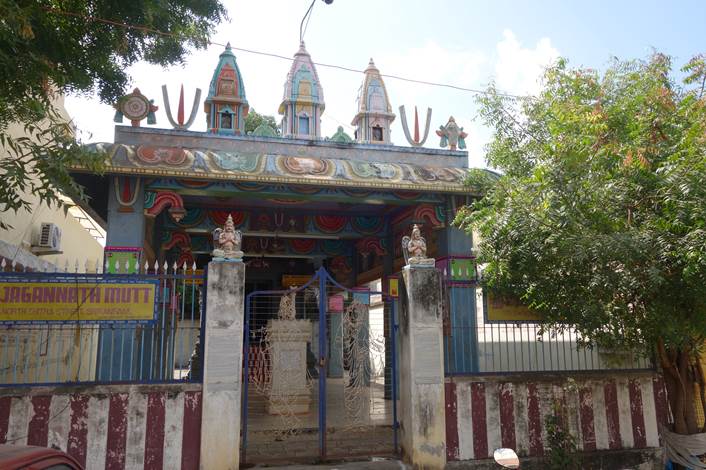
Sri Jagannatha Math at
Srirangam
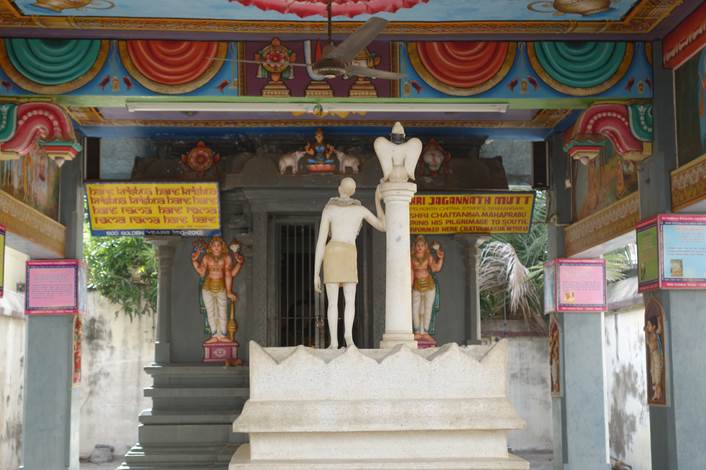
Sri Jagannatha Math at
Srirangam
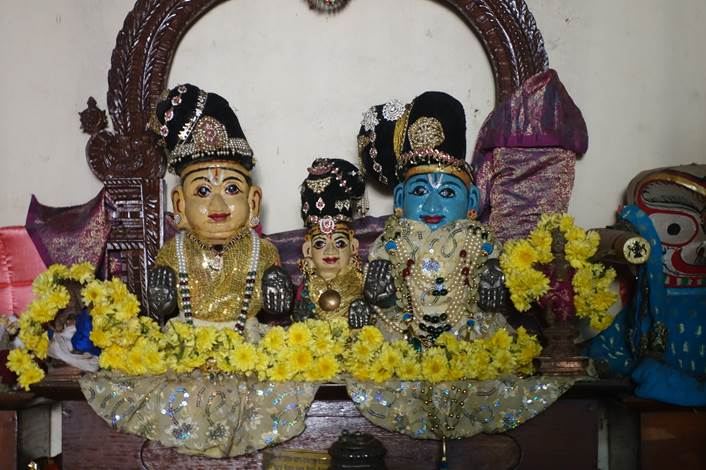
Their Lordships Sri
Sri Jagannatha, Baladeva, Subhadra personally carved by Sri Caitanya Mahaprabhu
at Sri Jagannatha Math at Srirangam
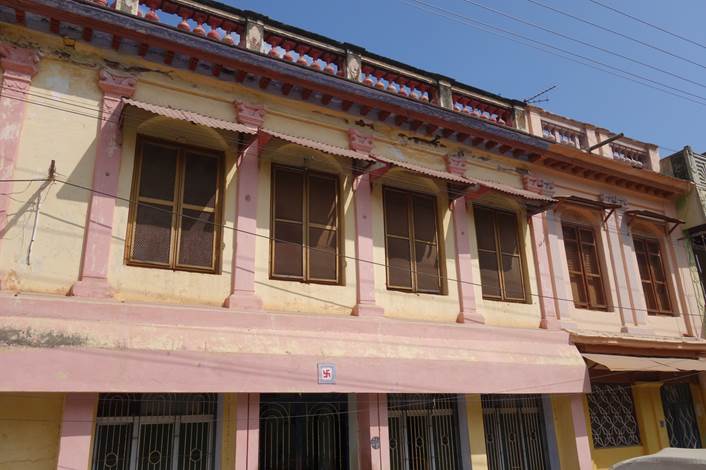
House of Venkata
Bhatta, father of Sri Gopala Bhatta Gosvami at Srirangam
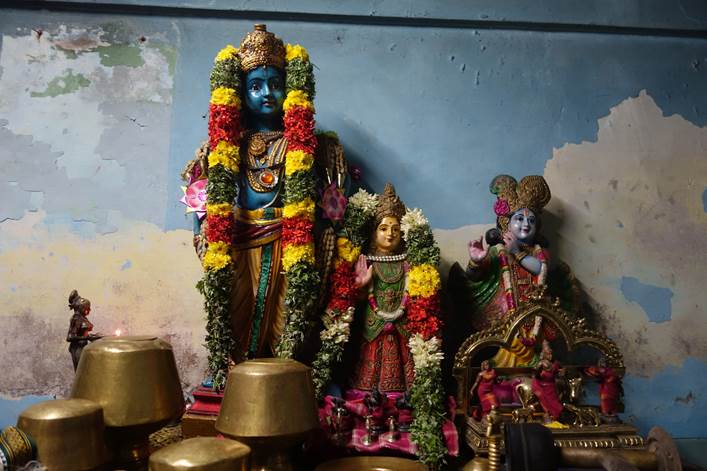
Personal Deities
worshipped by Venkata Bhatta at his house in Srirangam
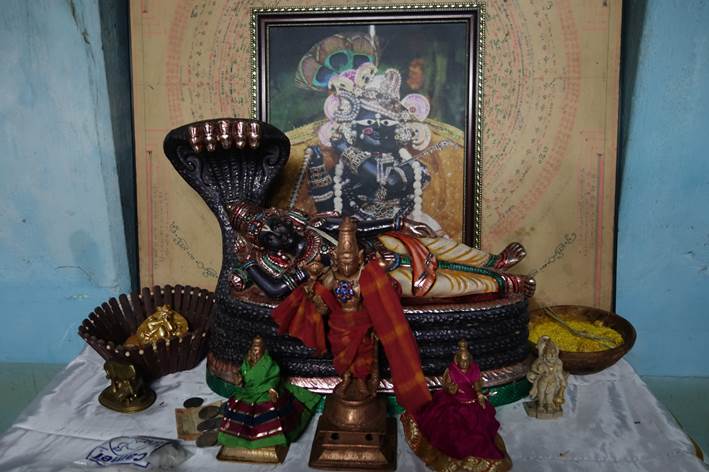
Personal Deities
worshipped by Venkata Bhatta at his house in Srirangam
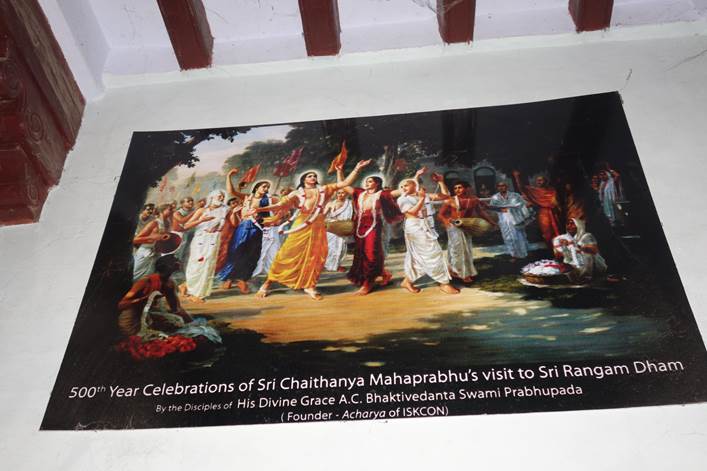
Year 2010 marked the
500th Year celebrations of Sri Caitanya Mahaprabhu’s visit to
Srirangam
2. Sri
Adi Narayana Perumal Temple at Gopurapatti
Gopurapatti
is a village 16 km from Srirangam near Manasanallur between two rivers
Peruvalavan and Kamba (these have gone into extinction and are currently seen
in the form of a small canal) is the Adi Nayaka Perumal temple in Gopurapatti,
where the moolavar is seen in a Bala Sayana posture with a Measuring
Instrument. Though that village is very small, it protected Vaisnavism more
than any other town in Tamil Nadu.
In
1323, Ulugh khan, a Moghul king attacked Srirangam. During this period, lasting
close to 50 years some of the residents fled the place but many others stayed
on to fight the invaders. And at that time, there were 12,000 Vaishnavas in
Srirangam. Amongst those 11,250 were massacred. The remaining 750 Vaishnavas
somehow or other escaped to the village Gopurapatti. According to
Koyilozhugu, an authentic record of events relating to Srirangam, Sri
Vaishnavites were scattered during the invasion. Divided into various teams,
each team took upon various responsibilities for protection of the temple.
Thus, a team led by Pillailokachariar took up an important mission of protecting
the Deities and treasures of the temple. They took the temple's processional
Deity of Azhagiya Manavalan into safe custody. A stone wall was built
across the sanctum sanctorum of Sri Ranganatha Swamy to protect it from any
damage.
In
Gopurapatti, in the year 1320, there was the installation of Ranganatha similar
to that in Srirangam. In that village also, two rivers are flowing and
Ranganatha is staying in the midst facing south. So the Vaishnavas
who escaped to that place, performed the final rites for the Vaishnavas who
were killed in Srirangam. Even today the people of Gopurapatti remember the
Vaishnavas who were beheaded in Srirangam and continue to offer shraddha.
After 1498 no proper worship took place in the temple. There was one more
attack and the temple was destroyed. 512 years later, the temple was renovated
again in 2010.
In
memory of the Vaishnavas killed, every year, during the No Moon day in the
Tamil Calendar month of Aadi, Tharpanam takes place on the banks of the
Peruvalavan River in Gopurapatti. It was a km from here at the Sundara Raja
Perumal Koil in Azhagiya Manavalam that Namperumal, the Utsava deity of
Srirangam, was safeguarded during those years and was taken back to the
Srirangam temple at the end of the battle against the invaders.
Measuring Instrument: There was a lot of land belonging to the Srirangam
temple in the area around Azhagiya Manavalam and Gopurapatti. It was here at
the Adi Nayaka temple that the farmers congregated to measure the rice they
would present every month to the Srirangam temple. Hence, the Lord here is seen
with a measuring tool.
Sri Adi Nayaka Perumal faces south with its feet gently
wide apart with a little space. Legend has it that the little space is aimed to
hold an infant. The temple was in a dilapidated condition, including the
presiding deity were found nearly abandoned. A team of
devotees floated Adhinayaka Perumal Kainkarya Sabha and renovated the temple.
The Samprokshanam was performed on August 27, 2010.
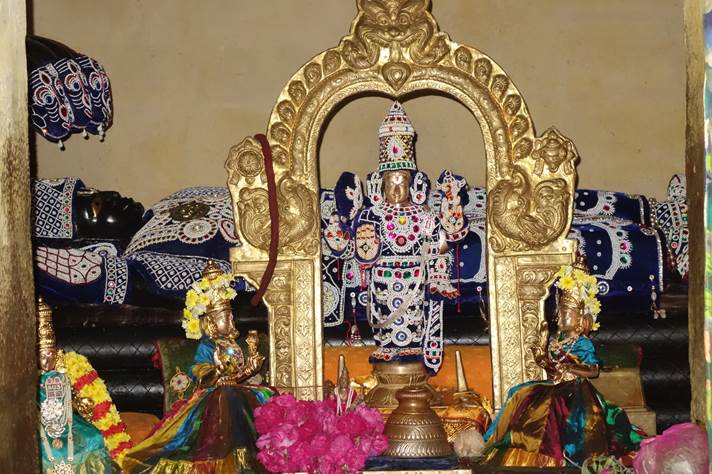
Their Lordships Sri
Adi Nayaka Perumal at Gopurapatti
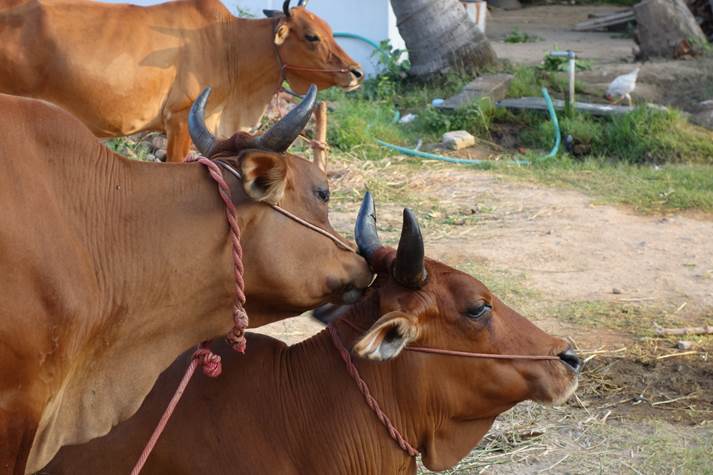
Mother cow at Gopurapatti
3. Sri
Pundarikaksha Perumal Temple at Thiruvellarai
Thiruvellarai
or Sri Pundarikaksha Perumal Temple
is 14 km from Srirangam main temple. This is a very beautiful
temple built by great Sibi Chakravarthi, king of Ayodhya in Treta Yuga, seven
generations before the appearance Lord Ramacandra. The word Vellarai
means white rock. Owing to the presence of white rocks in the region, the place
is historically referred as Thiru Vellara. The temple
is on a white rock hill of 50 feet height. Temple has beautiful deity of Lord
Pundarikaksha. This is the 4th temple in 108 divya-deshams
dedicated to Vishnu, who is worshipped as Pundarikaksha and His consort Lakshmi
as Pankajavalli. This temple dates back to a time much before Srirangam temple
as can be seen from the fact that Sibi, the forefather of Ramacandra, built
this temple. There are 18 steps to the temple representing the 18 chapters of Bhagavad-Gita.
The next 4 steps to entrance represent the Four Vedas. Then after
worshipping the Bali-peeta, one has to cross five steps representing the
panchabhutas called earth, water, fire, air and ether.
It is said that Surya and Chandra come here and
perform chamara seva to the Lord. Legends say that the eyes of the Deity
of Hanuman in the temple complex are growing bigger and wider each year. This
can be known from unusually big eyes of Hanumanji compared to the size of
deity. This is the place where the famous verse “Om pavitra pavitro va…” had its origin. Another belief is that no Sri Vaishnava
can achieve perfection without visiting Thiruvellarai. Hence, there is this
tradition at the temple to call Thiruvellarai Kandeero- Thiruvellarai Kanden
Aiyyaa (the devotees informing the Lord that they have seen Thiruvellarai and
that they are now ready/eligible for going back to Godhead), a voice that is
said to echo to the Lord up there in Vaikuntha.
Pastime:
Once, Lord Visnu being pleased with Laxmi requested
her to ask for a boon. Being fully satisfied to get a place on Lord’s heart, She did not ask for anything. On being persistently asked by
the Lord, she then requested that she be granted the leading rights at some
temples, as She felt that the Lord gets priority over
her in all the temples.
Meanwhile, Markandeya was destined to die at age 16. When Yama came to
take him, he clutched on to the Siva-lingam at Thirukadaiyur. Pleased
with this, Lord Siva blessed him that he will remain there forever as 16. After
enjoying life to the full, Markandeya once again prayed to Lord Siva asking for
deliverance. He was guided by Siva to go to Thiruvellarai to invoke the
blessing of Lord Vishnu.
King Sibi (Lord Rama’s ancestor) came here with a big army with the
intention of killing the Lankan King Ravana. While here, he encountered a white
pig which gave the army a fight. Angered at this, Sibi chased the white pig.
After stopping at 5 places, the pig disappeared into a pit. The king soon
realized that the white pig was not an ordinary one.
King Sibi then approached Markandeya Rishi who was performing penance
here. He asked Sibi to pray to Lord Vishnu. The Muni told the king how lucky he
was to see the lord in the form of the swine while he himself was waiting long
for Lord’s darshan and so he advised the king to perform milk abishek
to an anthill near the pit. The Lord in this Deity form of Pundarikaksha
appeared before the Muni and the King.
Answering Sibi’s prayers, an invisible voice asked him not to pursue his
quest to defeat Ravana and that he go back to his kingdom as time had not come
for Ravana to be defeated yet and that he himself will be born later to defeat Ravana.
A disappointed King Sibi pleaded with the Lord that he could not possibly go
back empty handed, without fulfilling the purpose for which he had come. The
Lord asked Sibi to fulfill the wishes of goddess Lakshmi by building a temple
here that would give Her the first rights at all
festivities. It is also here that Lord Vishnu then gave darshan and
deliverance to Markandeya.
Only in three divya-desam temples does the Goddess get the first
rights over the Lord - Nachiyar temple in Thiru Naraiyur, Aandal temple in
Srivilliputhur and here at Thiruvellarai. As per the boon of the Lord, Mother
Shenbagavalli (Lakshmi) took the premier place in the temple and comes before
the lord in palanquin during the festival occasions.
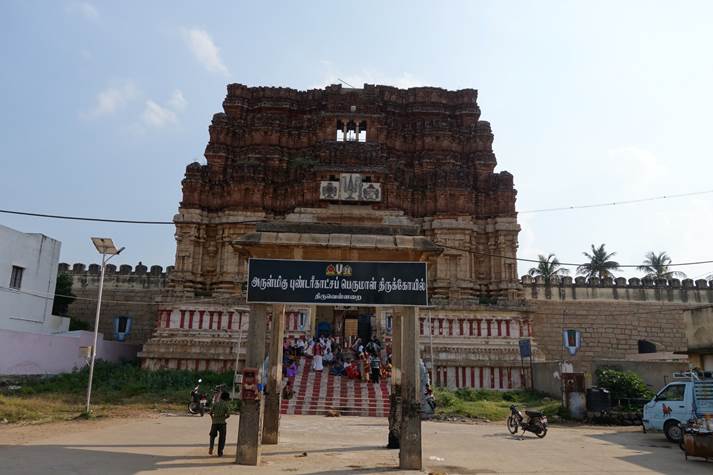
Sri Pundarikaksha Perumal Temple at Thiruvellarai
There are 18 steps to the
temple representing the 18 chapters of Bhagavad-Gita. The next 4 steps
to entrance represent the Four Vedas.
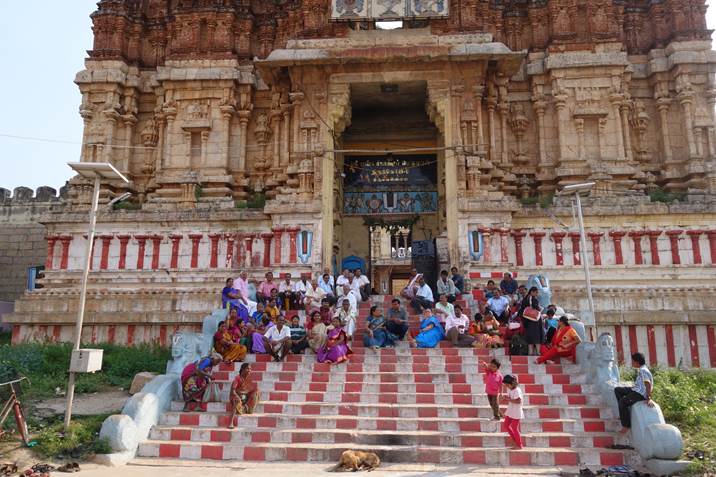
Sri Pundarikaksha Perumal Temple at Thiruvellarai
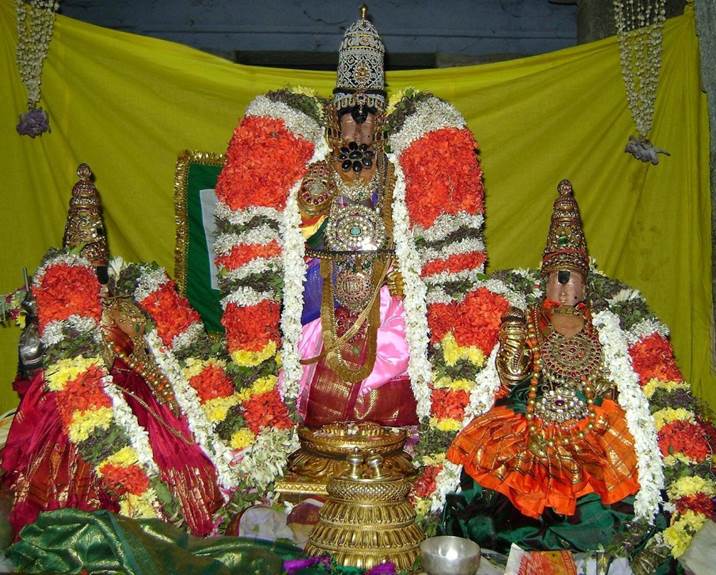
Lord Sri Pundarikaksha Perumal at Thiruvellarai
4.
Uthamar Kovil (also known as Thirukkarambanoor or Bhikshandar Kovil)
Uthamar
Kovil (also known
as Thirukkarambanoor or Bhikshandar Kovil) is 10 km from Srirangam. This
temple is unique as there are Deities of Lord Vishnu, Lord Siva and Lord
Brahma. Lord Vishnu emerged as a Kadambha tree at this place, giving
the name "Kathambanur", which later became "Karambanur".
The temple is commonly called "Uthamar Kovil" after the name of the
presiding deity. The temple is also called Bhikshandar Kovil as the Lord Siva
is present in the form of Bhishadanar (a mendicant) and believed to have attained
cure by worshiping Vishnu at this place. This is the
3rd temple in 108 divya-deshams dedicated to Vishnu
worshipped as Purushothama Perumal.
Pastime: As per pastime, Brahma and Siva both had originally five
heads. Parvathi, the wife of Siva once got confused and performed patha
pooja (ablution of feet, considered an act of respect) to Brahma instead of
Siva. Siva got enraged and cut off one of the heads of Brahma. The cut head got
stuck in his hand of Siva on account of a curse of Brahma. To get rid of the
sin, Siva worshipped Vishnu at this place as Bhikshadana, where a part of his
sin was relieved. He got his curse fully relieved after visiting Vishnu at
Thirukandiyur and taking a holy dip in the temple tank, Kamala Pushkarani at Hara
Saabha Vimocchana Perumal Temple. After the incident, the tank came to be
known as Kapala Theertham (kapala indicates skull). Siva was
pleased and he built the Hara Sabha Vimochana temple and also built a temple
for himself near it.
As per another pastime, once Lord Vishnu wanted to test
the devotion of Brahma. He raised as a Kadhamba tree
in the place and Brahma, knowing this, started his worship practice with Thirumanjanam
(ablution). The water from the ablution filled a tank nearby, which came to be
known as "Kathamba Theertham". Vishnu was satisfied with the devotion
of Brahma and gave a boon to Brahma to have a shrine in this place. Siva wanted
to get rid of the sin holding the cut head of Brahma and went on a sacred trip.
While coming to this place, Vishnu requested his consort Lakshmi to give alms
to Siva. Siva's grail was filled by the alms and Lakshmi came to be known as Poornavalli
Thayar (the one who filled the grail).
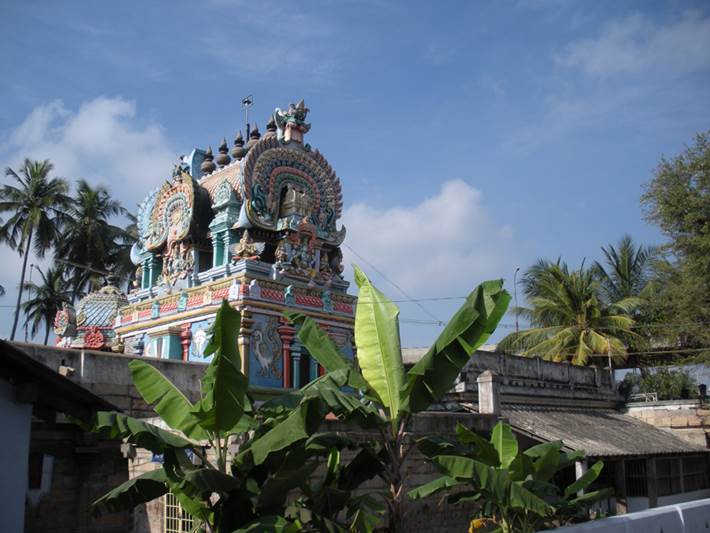
The shine of temple
seen with the temple tree, Kadhali Tree(red banana
(red banana)
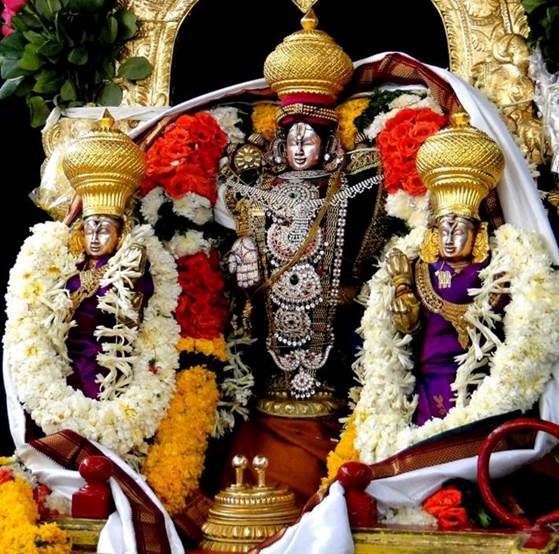
Lord Sri Purushothama
Perumal at Uthamar Kovil
5. Sri
Anbil Sundararaja Perumal Temple
Anbil
Sundararaja Perumal Temple (also known as Sri Vadivazhagiya Nambi Perumal) is 20 km from Srirangam temple. This
is the 3rd temple in 108 divya-deshams dedicated to Vishnu worshipped as Sundaramoorthaye
Poornaya Perumal. This temple is considered to be very old (some say it is
almost 6000 years old). There are numerous inscriptions at this temple which
indicate the political and religious history in those days. There are
inscriptions mentioning that this is the appearance place of saint Valmiki. It
is believed that Lord blessed him before he relocated to north India.
Pastime: Sage Mandaka was doing penance at this place. He had
to powers to reside both in water and land. Sage Durvasa once came to meet
Mandaka Rsi but had to wait long as the latter was in deep meditation, under
the river. Durvasa, who is known for his instant anger, cursed Mandaka Rsi
turning him into a frog. Mandaka requested Durvasa on the penance he had to do
to get relieved off the curse. Durvasa explained him that the curse was on
account of the sin he committed in his previous birth and Vishnu would appear
to him to relieve him. For 48 days he observed a vrata and prayed to
Lord regularly. Lord Vishnu appeared before him and redeemed him from the curse.
This pushkarani has therefore been named after the rsi who got
free from being a Mandukam (frog).
As per
another legend, once there was a discussion between Lord
Brahma and Saint Valmiki about the beautifulness of Lord Vishnu in His sayana
posture. This conversation led them to the fight. Lord Vishnu appeared before
them and said "in sayana posture I am beautiful in Thiru Anbil".
So Lord Vishnu here is worshipped as "Vadhivazhagiya Nambi".
This divya desam is also known as Premapuri and
Triveni. It is known as Triveni as the three rivers Kaveri, Savitri and
Phalguni are said to have merged into one and flow near this divya desam.
Savitri and Phalguni are said to be flowing underground. Hence this place is
also known as Dakshina Gaya. Those who cannot go to Gaya in North
India, can perform the shraddha ceremony for
their forefathers here with an equal effect.
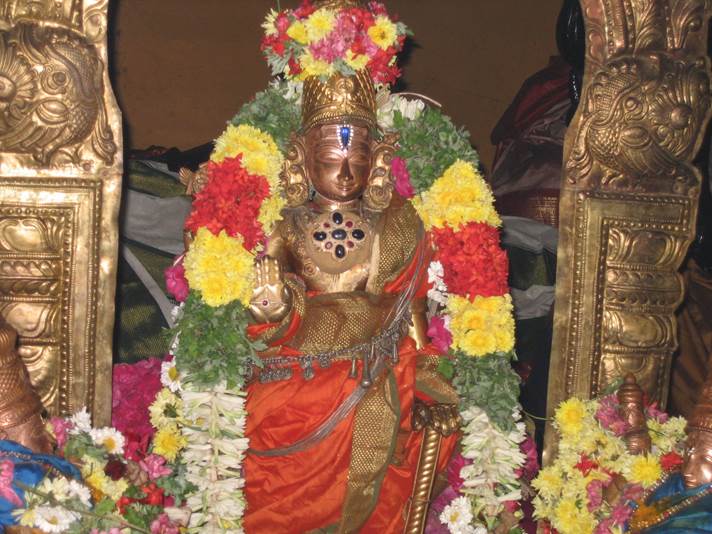
Sri Anbil Sundararaja
Perumal
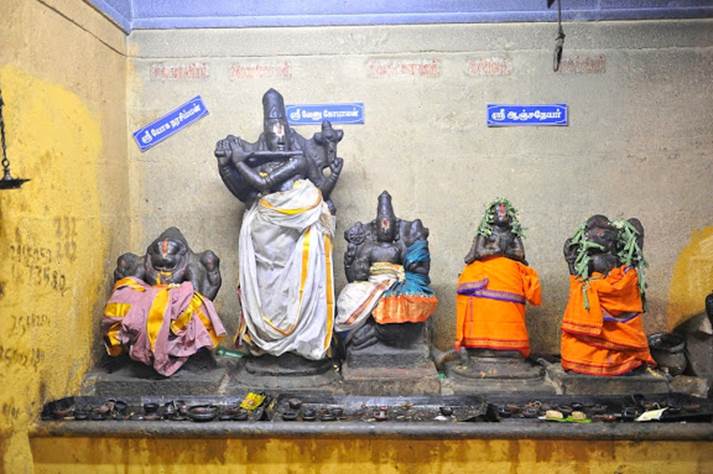
Sri Anbil Sundararaja
Perumal Temple
6.
Azhagiya Manavala Perumal Temple or Kamalavalli Nachiyar Kovil at Uraiyur
Azhagiya
Manavala Perumal Temple
is 6 km south of Srirangam temple at Uraiyur, a divya desam whose
pastime relates to the love story of Kamalavalli Nachiyar and her wedlock with
the handsome young lad Ranganatha of Srirangam.
Pastime: Lord Vishnu was pleased by the worship of the
childless Chola king Nanda Chola and blessed the king that Lakshmi, His
consort, would be born to him and at appropriate age, He would get married with
her. The
king found the child in a lotus tank while hunting in a forest. Since the she
was born out of Lotus,
the Goddess here is called Kamalavalli Nachiyar [Kamala means Lotus]. As years
went by, Kamalavalli grew into a beautiful young girl. Time came
when Kamalavalli fell in love with Lord Vishnu in the form of Ranganath, the
presiding deity of Srirangam Ranganatha Swamy temple. Chola king readily got
her married to Ranganatha.
Delighted at this, Nanda Chola built a temple at Uraiyur to celebrate the
(home) coming of Lord Ranganatha to Uraiyur to take the hand of his daughter.
Every year in the month of Panguni,
a significant event takes place at the Uraiyur temple. Festival uthsav
deity of Lord
Ranganatha, in all His splendour, leaves the Srirangam temple at 4am to take
the 6 km journey across the Kaveri in a golden palanquin to meet his beloved
Kamalavalli Nachiyar for the ‘Kalyana Utsavam’ (marriage festivities). On this
auspicious day the entire marriage formalities between Lord Ranganatha and
Kamalavalli Nachiyar is enacted at the Uraiyur Temple. Lord Ranganatha takes
the trip back to Srirangam across the Kaveri that same night. The
event is celebrated as Servai festival every year. Since Lord Vishnu appeared
as Azhagiya Manavalan, meaning a beautiful groom, the temple is called Azhagiya
Manavalan Temple. At
the Uraiyur temple, Kamalavalli Nachiyar is seen in a grand sitting posture,
all set to get married. Being the handsome man in wedding attire, Lord
Ranganatha here is called ‘Azhagiya Mana Vaalan’. This is the 2nd temple in 108
divya-deshams dedicated to Vishnu worshipped as Azhagiya Manavala
Perumal.
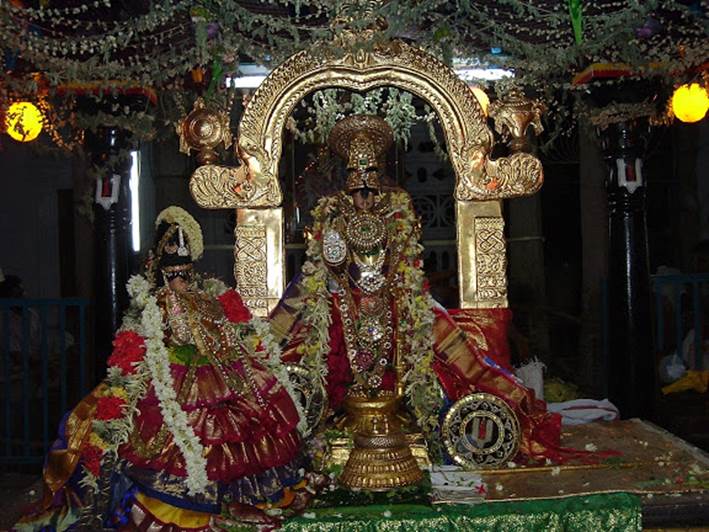
Namperumal -
Kamalavalli Nachiyar Serthi at Worayur Nachiyar Koil
7. Thiru
Koviladi - Appakudathaan Temple
Appakkudathaan Perumal Temple or Thirupper
Nagar is 25 km east of Srirangam. This place is named after
‘Appam’, a traditional sweet rice cake which is a favorite of the Lord here.
Deity is called Appala
Ranganatha Perumal, a form similar to Lord Ranganatha Swamy at Srirangam.
Pastime: Once
a king by name Ubhamanyu earned the wrath of sage Durvasa and lost all his
physical strength. To get rid of the curse, he was asked to feed one lakh
people every day. One day, Lord Vishnu disguised Himself as an old man,
appeared before the king and asked for a meal. The king went on donating and
the old man consumed all the food prepared for the people. The king was shocked
and bewildered at this strange act. The old man asked for a kudam (pot) of
Neyyaappam (a sweatmeal), stating that only it can fulfill his hunger. The king
fulfilled the wish and later realised that it was Vishnu who had appeared as
the old man. The king was relieved of the sage's curse by the blessings of
Vishnu. Because of this pastime, Lord Vishnu is called
"Appakkudathaan" in the temple. It is believed that this temple is where
sage Markandeya was liberated from his curse from Yama (god of death), who
cursed Markandeya to die at 16 years old. The central deity is Ranganatha. The
place is called "Koviladi" because it is located downstream of the
Srirangam Ranganatha Swamy temple, which is referred as kovil in Vaishnava
tradition. The temple is called as "Tiruppernagar" because the region
was called "Per Nagar" during Chola times. This is the 6th
temple in 108 divya-deshams dedicated to Vishnu worshipped as Appala
Ranganatha Perumal.
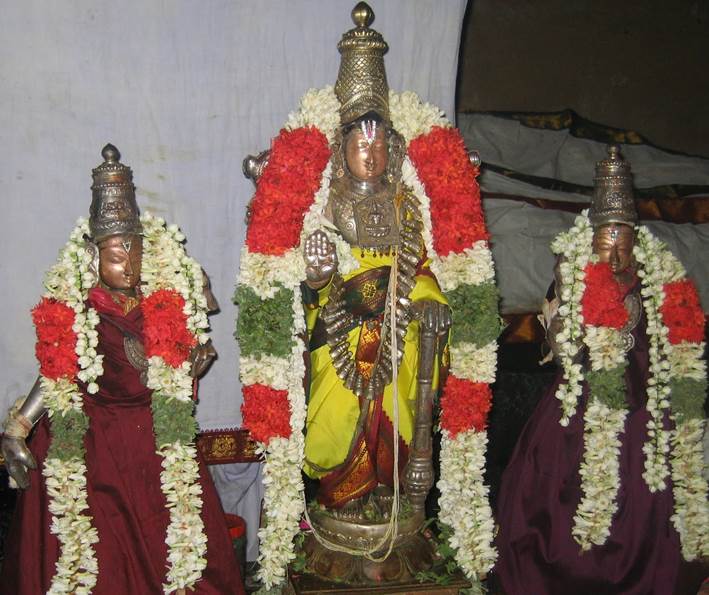
Appakkudathaan Perumal
- Thiru Koviladi
8. Sri
Prasanna Venkatachalapathy Temple at Gunaseelam
This is a
very important temple situated 18 km from Srirangam on Tiruchirappalli-Salem
road near a tourist spot of Mukkambu. The deity of this temple is called Prasana
Venkateshwara, who is a sculptural form of Lord Vishnu.
Pastime: In Bhavishyotra Puranam, one finds reference to the
significance of this temple in Gunaseela Mahaatmiyam. Thaalpiya Maharishi along
with his disciple Gunaseela Rsi once went to the Himalayas. On his way back,
Gunaseela Rsi stayed back at Tirupati and was so attracted to Lord
Venkatachalapathy that he wanted the Lord to appear in Gunaseelam and bless the
devotees. He came back, bathed in the Cauvery and undertook severe penance here
in his ashram in Gunaseelam. Impressed with his sincerity, the Lord appeared
before him along with Goddess and promised to remain here till the end of Kali
Yuga. Pleased with the darshan of Prasanna Venkatachalapathy,
Gunaseela Maharishi continued to offer his daily poojas to the lord from his
ashram here. At the end of the Dwapara Yuga, the Gunaseela Maharishi’s
Guru wanted him to go to Naimisharanya. Gunaseela Rishi designated his young
disciple to continue the daily poojas. However, floods in the Cauvery and
dangerous animals in the forest led the disciple to flee the place and thus the
poojas came to an abrupt end. The Lord decided to hide himself in a pit. After
several years, Chola king Nyana Varma, who ruled this place with Uraiyur as the
capital, used to visit Gunaseelam regularly. Every day, cowherds would milk the
cows from near the pit and carry the milk all the way back to his court.
One day, to
everyone’s shock, the milk that was filled to the brim of the pot vanished all
of a sudden. An invisible voice wanted the king to dissolve the pit by pouring
milk. The king brought in his army and used thousands of liters of milk to
complete this exercise. Once dissolved, Vaikuntha Vasudevan is said to have
appeared before the king as Prasanna Venkatesan. As per the king’s wishes, the
Lord agreed to remain here till the end of Kali Yuga and help fulfil all
the prayers of the devotees, who visit this temple. Delighted at the darshan
of Prasanna Venkatachalapathy, the king shifted from Uraiyur to Kallur, (this
place was then called ‘Badra Chakra Pattinam’) near Gunaseelam and built the
beautiful Gunaseelam temple and laid down the process of the daily poojas as
directed by Prasanna Venkatesan. He also allocated a lot of land for the temple
as well as funds to undertake the daily pooja formalities. This temple attracts
lot of pilgrims and people also believe that worshipping the deity here helps
one to cure mental and physical ailments.
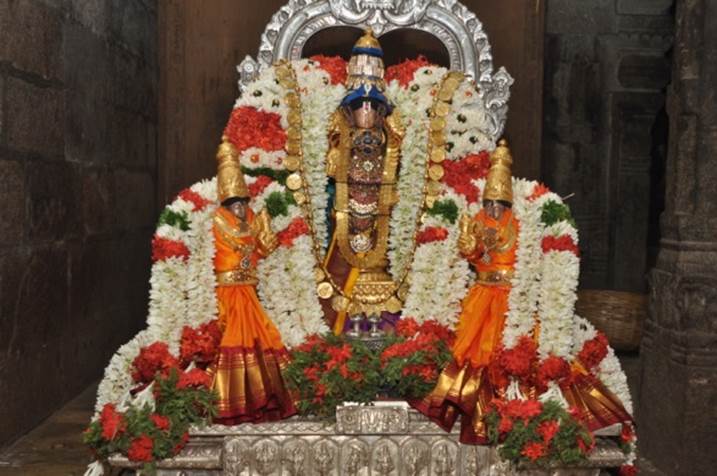
Sri Prasanna
Venkatachalapathy Temple at Gunaseelam
9.
Kattu Narasimha Perumal Temple (Azhagiya Singar - handsome jungle God)
The Kattu Narasimhaperumal Temple
is situated in Srirangam at a distance of 1 km from the Srirangam railway
station. It is also known as Azhagiya Singar temple. The temple predates the
Sri Ranganathaswamy Temple, Srirangam and is one of the oldest temples in the
city.
Pastime:
This kshetram
was a forest thousands of years ago, surrounded by the two rivers – Cauvery in
the South and Coleroon in the North, and inhabited only by the rishis and their
families. Time and again, wild animals would attack the families of the rishis
and consume them for a meal. While the rishis had the power to burn the animals
just by their looks, they would not forego the fruits of their penance by
killing these wild animals. Instead they undertook a more severe form of
penance invoking the blessings of Lord Narasimha. Pleased with their
prayers, Lord Narasimha appeared here providing darshan to these rishis.
As per their request, he stayed here with Goddess Lakshmi protecting the lives
of all those who offer their sincere prayers at this place.
The
place was a jungle in the olden days with elephant menace. Elephants
cannot be killed according to scriptures as it would put people in a circle of
sins. People were struggling for safety. They prayed to
Narasimha building a temple for him. The animals slowly left the place. Hence
the Lord is named Kattuzhagiasingar (handsome jungle God).
Centuries
ago, with this temple being in the midst of a forest and with minimal human
existence, it was considered unsafe and hence the Utsava deity was
placed inside the Koorathaazhvan Sannidhi at the Srirangam Ranganatha temple.
That tradition has come to stay and today one finds the Utsava deity of
Lord Narasimha not at the Kaattazhagivya Singa Perumal Koil but at the
Srirangam Ranganatha temple. Old time residents say that this place was very
much like a forest till the early 1970s. It is only in the last 3 decades that
there has been development around the Kaatazhagiya Singar temple.
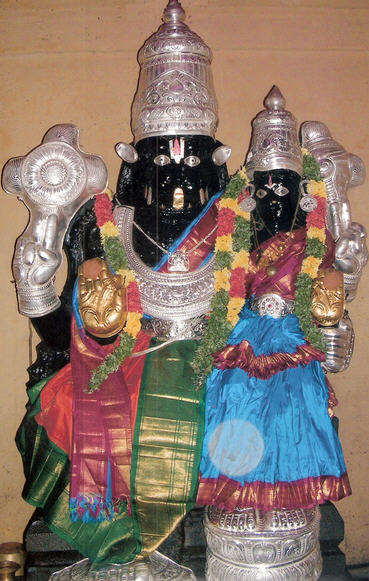
Lord Nrsimhadeva at Kattu
Narasimha Perumal Temple
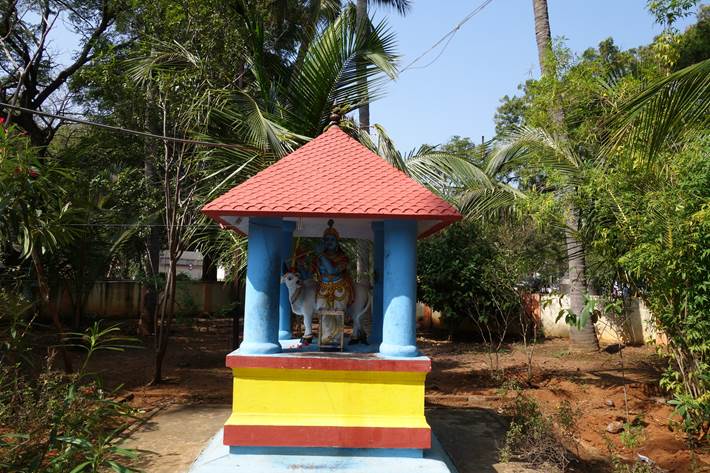
Lord Sri Krishna at
BHEL Temple, Tiruchirappalli
Life and
Teachings of Sripad Ramanujacarya
by HH
Radhanath Swami Maharaj
The four Sampradayas:
Towards the beginning of the creation Lord Narayana spoke to Brahma, Lord Narayana
spoke to Lakshmi that pure devotional service is also given to Rudra and to the
four Kumaras. And it is explained by all great and authorized Vaisnavas
that without receiving the knowledge from one of these four sampradayas,
true understanding of Krishna consciousness cannot take place. In fact
Srila Rupa Goswami quotes from the sastra that without being initiated
and receiving siksha from the unbroken lines of these four
sampradayas one cannot understand Krishna Consciousness, one cannot
understand what is Vaikuntha. So if
we have read in Bhagavad-Gita as time goes on you will meet these great sampradayas:
evam parampara-praptam imam rajarsayo viduh (Bhagavad-Gita 4.2).
In the eyes of the masses and
therefore either the Lord Himself appears or He sends one of his most empowered
representatives to create a spiritual revival or to re-establish the real
spirit of bhakti that is the essence of every sampradaya. So
through the Rudra sampradaya Vishnu Swami appeared, through
the Kumar Sampradaya Nimbarkacarya appeared, through the Brahma
sampradaya Sri Madhavacarya appeared and to re-establish the truth and
the essence of the spirit of what Lord Narayana spoke to Lakshmi Devi in the
mood of pure devotional service Sri Ramanujacarya appeared.
Yajna performed for the birth of a
son:
We read about his books it was at a
time when the greatest of all of the acaryas of South India were Sri
Yamunacarya and he had his headquarters in Srirangam. Sri Yamunacarya came
in this great line of Sri Sampradaya and he made his teachings
in line with the Alvars. The Alvars were very, very great
devotees who lived some hundreds of years before and they wrote beautiful poems
glorifying the Lord. Now one of these great disciples of Yamunacarya was
a sannyasi of the name of Sailapurna. Sailapurna had two
sisters one was Kantimati and one is Diptimati. Sailapurna helped to
arrange the marriage of his 2 sisters. After they were married he went to
Srirangam and completely dedicated his life only to the service of the lotus
feet of his Guru. Kantimati married a very, very great brahmana
of the name of Asuri Kesavacarya and he was very expert in performing yajnas he
was also known as Sarvakrati and they had one great anxiety in their hearts
that they had no son. He had great faith in the lotus feet of Lord
Narayana. He was a very good devotee, very advanced devotee. He decided
that he would go to the temple of Parthasarthy which is close to the ocean in
the modern day Madras. In those days that area was called Brindaranya and
he performed a wonderful yajna for the pleasure of Lord
Parthasarthy and requested that a son would be born and it is explained while
there the night of that yajna the Lord appeared to him in a
dream and told him that, “You and your wife should return to your native place
and an incarnation of myself will be born to you”. So with great happiness
and confidence he returned home.
Birth of Ramanuja:
Some months later Kantimati gave
birth to a beautiful and auspicious child, it was in the year 1017 of the
Christian era. Just at that same time her sister Diptimati also gave birth
to a baby child. After few days the two sisters came together also
bringing their children together and they were both just merged in great
happiness. When this news came to Srirangam to Sailapurna, he decided to
come to give the blessings of his Gurudeva to these two
nephews of him. They were living in the place called Bhutipuri and when he
came there he saw the beautiful qualities of this son of Kantimati and he could
understand that the prophecy given by the great, great devotee Nammalvar has
been fulfilled. What he prophesized that Laxmana the brother of Ramacandra
would take birth as a great acarya to deliver all the
people. So he named this child Ramanuja which is another name of Laxmana
which means following in the brother of Sri Rama and he named Diptimati’s son
Govinda. Their parents were very, very great devotees and very much
cultured brahmana’s so they performed all the samskaras to
their children and from the very birth Ramanuja was just an ocean of good
qualities very obedient, very humble, very submissive, very, very learned, very
anxious to always hear and learn more and more about the Lord. In fact he
was a natural devotee of Lord Narayana in his earliest ages.
Early life of Ramanuja:
When he was about 16 years old, his
father very much insisted that he married, so he got married. Just one
month after his marriage his father died; he was only 16 years old. So it
was very difficult for them to remain in the same place without
father. Ramanuja being very responsible son as well as husband, he
arranged for a house in Kanchipuram which was a close city and there they
resided. Now during his very earlier years before even his marriage there
was a great devotee who was also a disciple of Yamunacarya, his name was
Kancipurna and he used to go from one village to another to worship the deity
and on the way he would always pass the home of Ramanujacarya. Ramanujacarya
was always very, very attracted by this person’s great, great love and
devotion. In fact although this person Kancipurna was born in a sudra family even great, great brahmanas
would worship his lotus feet because he had such simple and humble devotion and
he was always simply anxious to please the Lord. He worshiped the deity of
Varadaraja which is in Vishnu Kanchi (Kanchipuram). What he would do is
just very simple worship, he would fan the deity, in the summer he would dip
the fan in water and fan him. He would bring the best nicest fruits to the
deity and in this way he had such a loving relationship that it is said that he
would be able to have conversation with the Lord and it was known by many great
devotees that whatever Lord wanted people to know, he would speak through
Kancipurna. So Ramanuja was very, very happy and much honoured to have
the darshan of this person from time to time and they became
very, very close and loving friends.
One day Kancipurna was passing and
Ramanuja invited him to his home and when he invited him to his home they
offered him some prasad and then Ramanuja wanted to massage this great saints
lotus feet and Kancipurna said “No, no you cannot massage my feet, you are the
highest caste brahmana and I am a sudra and I am a very
fallen soul. This is not proper for you to massage my feet.” Ramanuja
replied, “If my being born as a brahmana is an impediment in serving the lotus
feet of the great devotee of the Lord, then I consider this brahmana
birth to be a curse and utterly useless.”
Because when someone is a great
devotee of the Lord there is no question of caste distinction. A devotee
of the Lord wherever he is born, however he is born and deliver all of the world with pure devotional service. So
Kancipurna was very much happy to hear this young boy’s complete faith in the
process of bhakti.
Discipleship under Yadavaprakash:
After they moved to Sri Kanchipuram,
Ramanuja was sent to the gurukul the ashram of
one very, very great learned acaryas at least he was famous as
such. His name was Yadavaprakash. Yadavaprakash was a follower of
Shankaracarya, he was a staunch mayavadi but he was very
highly learned. So Ramanuja very much wanted to understand the Vedas. He
was so intelligent that whatever he would hear he would immediately learn and
understand and grasp. Whenever he would hear the mayavad conclusions
of his teacher it would just cause too much pain to his heart but because by
nature he was very mild, very gentle and very humble he would just somehow or
other restrain and tolerate his feelings.
Ramanuja correcting his guru:
One day it is explained that
Yadavaprakash after the classes he asked Ramanuja to stay back because Ramanuja
was his favourite and dear most of all students because he was so obedient and
so humble and so anxious to learn and so capable of learning. So he sent
all the other students away he asked Ramanuja to massage his legs with oil.
Ramanuja was very humbly massaging his legs and then one student came back and
he asked his teacher that, “I have a question in terms of one of the slokas
from the Chandogya Upanishad, here it is described that the lotus eyes of Lord
Narayana they are the beautiful reddish colour. Can you explain this in
more detail?”
So his guru explained
according to Shankaracarya’s verse that the meaning of this is that he used
Sanskrit that “The eyes of Narayana are beautiful reddish colour like the rear
end of a monkey.” He was going on explaining in this way and Ramanujacarya
when he heard this blaspheme of Lord Narayana just tears started flowing from
his eyes and tears were hot and they started falling on the body of his guru and
his guru felt these burning hot tears and he looked up and saw
Ramanuja in great distress crying.
So Yadavaprakash said, “Why are you
crying?”
He said, “Because I cannot tolerate
hearing this blaspheme of my Lord.”
“What do you mean?”
He said, “How could you compare
lotus eyes of Lord Narayana to the rear end of a monkey?”
He said, “This is Shankaracarya’s
explanation, I am repeating. Can you think of something better?”
Then Ramanuja very, very expertly
and poetically explained the same Sanskrit verse to explain that the real
meaning is that, “His eyes are red like the red lotus that is in the
presence of the shining sun.”
At that time Yadavaprakash became
very angry, he said, “You think you know better than our acarya Shankar? You
think you know better than your own guru.” At that time there
became a great tension between the two of them.
Growing tension with Yadavaprakash:
On another occasion Yadavaprakash was
giving a lecture and he was explaining how the form of the Lord is illusion,
how the Supreme Absolute Truth is sat-cit-ananda and how he is
beyond sat-cit-ananda. When Ramanuja was hearing this, he
could not control himself, he stood up and he gave a counter explanation which
completely defeated his guru and his guru became
very angry. He said, “Why do you even come here to learn from me?” He
chastised him, very seriously he said, “You are very impudent, you think you
can challenge your spiritual master you are a rascal.”
Yadavaprakash became very worried,
that this boy he is so learned and he has a pure heart, so much devotion to
Narayana that he will completely destroy the philosophy of monism, he will
completely discredit Shankaracarya if he is allowed to continue on. He
called some of his disciples to a secret meeting to discuss what to do about
him. One of the disciples said, “Why don’t you expel him from school?”
Another disciple said, “That is even
worse, if he expels him from school, he will start his own school and the way
he is speaking his school will completely defeat and discredit all of our guru’s
philosophy and make an ass out of our guru.”
So then the guru said,
“The only way that we can protect our mission is this boy must be killed.”
So they planned out a way to kill
him. He said, “I will take all of my students on a pilgrimage to the
Ganges in northern India. This will take many, many months and during that
time we will figure out same way to kill him and then when we come back we will
tell them that during the trip he fell ill and he died and then no one will
question us.”
Yadavaprakash’s attempt to murder
Ramanuja:
So they planned out this trip to the
Ganges and Ramanuja when he heard that they were going to Ganga and guru is
taking us on a pilgrimage he became very, very happy ready to go. And his
cousin Govinda also decided that he would go because he was also a
student. So they all went together and when they came to one place near
the Vindhya Mountain, it is explained that they were in the forest just living
in forest beside a river and Yadavaprakash sent Ramanuja out to do some errands
to collect some flowers and so forth to bring back for worship and while he was
away, gurudeva told the disciples: ”This
is a proper time that we should kill him in the forest, no one will ever know.”
While he was speaking it was just
about evening, the sun was about to set and Govinda happened to be in the trees
in the forest nearby and he heard the whole diabolical plan. Govinda was
very much disturbed and he approached Ramanuja in the forest and he told him
that, “You should not come back because Yadavaprakash and his disciples they
were so envious and fearful of you that they planned to kill you on this very
evening.”
So Ramanuja began to run through the
forest to get away and when he did not come for a long time, the guru and
the disciples they all started calling him and searching everywhere. When
night was beginning to fall they realized that he must have been killed by some
wild animals and therefore he must be dead because they didn’t suspect that he
knew. So they were all very happy and joyful in their hearts but because
Govinda was there they pretended as if they were very sad and Yadavaprakash
began to preach to Govinda, the difference between the body and the soul and
how you should not lament over the death of a body because the soul is eternal
and Govinda was listening patiently.
Protected by the Lord:
Ramanuja was running through the
forest and he was very young, he was only 18 years old and he didn’t know where
he was. He was a long, long way from home, so many hundreds and hundreds
of miles from home. He became very fearful and then in his fearful
condition the night was coming and in the jungle he did not know where to go,
where to not go. He started to think that Lord Narayana is the Supreme
controller of everyone and I am his devotee so why should I be afraid, He will
protect me. And just upon remembering the mercy of Lord Narayana all of
his fear was vanished and just after he came to that conclusion of taking
shelter of lotus feet of Narayana. He saw a hunter with his wife walking
through the forest. They were very surprised to see this young man, “Where
are you going?”
He said, “I am going to Kanchipuram,
but I do not know how to get there. It is such a long way.” They said, “We
are also going to Kanchipuram. We had already been travelled for over one
month such a long distance.”
Ramanuja said, “So far away, why are
you going to Kanchipuram?” The hunter said, “Well, you see we kill birds for
profession myself and my wife and this is a very sinful activity, so we must go
to Rameswaram and Kanchipuram to perform yajna and to worship
the lotus feet of the Lord to neutralize the offense of our sins. But we will
guide you all the way back.”
So they walked for about an hour,
they came to a river bank. He started the fire, the wife of this hunter
said she was very thirsty and the hunter said, “Now it is too dark but there is
a well very close nearby and from that well we will get water in the morning.”
But the next morning they came upon
that well and Ramanuja climbed down the mountain to where that well was and he
brought water to the lady and she drank but she was still thirsty so he went
back and forth bringing more and more water as she drank. One time when he
was bringing it, she disappeared she was no longer there. He brought the
water up, she was no longer there and the hunter was not there, no one was there
and he was wondering ‘how will I find Kanchipuram now’? And just as he was
thinking that way he looked above the trees he saw big beautiful temples, ‘What
city is this?’ Then he saw someone passing by toward the well. He
said, “What is this city?”
They said, “You don’t know this
city? It is the famous city of Kanchipuram. And you are one of the
bright students of Yadavaprakash, you live here. How you do not know the
city of Kanchipuram.” Then that person walked away.
Ramanujacarya could understand that,
that hunter and his wife were Lakshmi and Narayana. He got that realization
from within his heart. When he was lost in a helpless condition in the
forest, he prayed that the shelter of Lord Narayana always protects his
devotees. So, on the basis of that humble prayer Lord Narayana personally
came with Lakshmi to bring him back to his home. Then he just sat by the
well weeping and crying in ecstasy thinking of the great mercy he had just
received from the Lord. And
then he went back to his home, his mother was very happy to see him, she was
thinking it would be at least 6 months but he had returned only after about a
month and he told her the story, why he returned early, how Yadavaprakash was
planning to kill him. So she was simultaneously very sad to hear this but
very happy that Lord Narayana saved her son. Well, he was at home and then
some months later, Yadavaprakash returned and when he found Ramanuja was at
home with his mother, he went to the house and pretended to be very, very
joyful, very happy, “Oh! We thought you were dead, we see that you are alive.
You have been saved by the Lord.” He and his disciples made a big show of
showing great happiness. But they knew that there was something
else. In this way Yadavaprakash he saw that Ramanuja was becoming so, so
incredibly influential that he wanted him to return to his school so that he
could find some other means. So he returned for some time.
Yamunacarya visits Kanchipuram:
On another occasion there was a
philosophical confrontation. Yadavaprakash became so angry that he just
had to kick him away. It is explained that at one time when he was again
the student of Yadavaprakash, Yamunacarya came from Srirangam for the darshan of
Varadraj and when he was walking through Kanchipuram, he saw this beautiful
sight of Ramanuja. Now Ramanujacarya had already written a particular
commentary on a sloka from Upanishads which completely defeated
Shankar’s philosophy and that sloka became so famous, Yadavaprakash
hated it. When it came to Srirangam and Yamunacarya read it, he thought,
‘this person is divinely empowered’. So he saw Ramanuja and Yadavaprakash
had his hand on Ramanuja’s shoulder and Yamunacarya who was then over 100 years
old, he asked one of his followers, “Who is that?”
He said, “That is Ramanujacarya.” He
said, “He is the one that wrote that beautiful commentary establishing the
eternality of jiva and establishing the pure bhakti of
the highest goal of life.” “Yes, that is him.” He said, “What is he doing with
this mayavadi Yadavaprakash, rascal?” He said, “He is his student.”
Yamunacarya was just so anxious to
run out and embrace Ramanujacarya but Yamunacarya would never associate with mayavadis
so he began to offer prayers to Lord Narayana. He began to offer prayers
that, “Please, rescue this Ramanuja, such a wonderful devotee, rescue him from
this terrible, terrible association it is so contaminating to the heart and
bring him again to your lotus feet and the association of Vaishnavas.” Yamunacarya
after offering this prayer, he went for the darshan and
returned back to Srirangam. Then there was a big confrontation and Ramanuja
ultimately left his guru his teacher.
Ramanuja desired to be initiated by
Kancipurna:
After Ramanuja left, he desired to
be initiated by Kancipurna, who was a great Vaishnava but
happened to be a sudra. When
Kancipurna came they would meet regularly and Ramanuja said, “Now I am no
longer associating with this Yadavaprakash, so please, I beg you to initiate me
and I will be your humble disciple.”
Kancipurna was very humble, he said,
“How can I initiate you? How is it possible? You are so learned, you
are a great brahmana and I am a low class. I have no real devotion
how can I initiate you? It is not possible.”
At that time Kancipurna, he went to
the temple of Varadaraj and he said, “I have dedicated my life only to be Your humble simple servant that’s all I want. But now
somehow or other You are putting me in situations
where great brahmanas want to be my disciples and You want to put me in
situation of being an acarya. I do not like this at
all. So with your permission I want to leave Kanchipuram and go to
Tirupati to worship your form of Balaji.”
Varadaraj murti said, “Yes, you go
and worship Me in Tirupati.” So he just
left. After 6 months the summer came and Balaji spoke to Kancipurna and
said that, “I am very hot and no one refreshes Me
with such loving service as you, so you must return to Kanchipuram and you must
serve Me in my form of Varadaraj.” So then he returned.
Again Ramanuja asked Kancipurna for
initiation and he told him, “I cannot do this.” Ramanuja started to think,
‘that the reason why he is refusing to accept me as a disciple is because I
have such a sinful heart and I have no devotional sentiments therefore he does
not want such a useless disciple as me.’
Kancipurna is invited to the home of
Ramanuja for prasad:
So he was thinking if somehow or
other I get the remnants of this great devotees food, this maha, maha prasad
then perhaps I will become purified and be worthy to be his disciple. With
this plan in mind he invited Kancipurna to his house for prasad. He told
his wife, her name was Rakshakambala, that, “You must make the best possible
prasad for this great Vaishnava devotee. She worked very
hard on his order and cooked so many beautiful preparations and Ramanuja just
about noon time he went to the home of Kancipurna to personally escort him to
his house for prasad. So after he left Kancipurna knew Ramanuja’s plan, so
he came to the house from another way. He told Rakshakambala that, “I am
in a great hurry, Varadaraj is calling me, and I must do seva for
him. You must give me prasad immediately.”
She said, “But Ramanuja has already
gone to your place, you must have come another way. He will be here only
in a few minutes.” Kancipurna said, “I cannot wait, I cannot keep the Lord
waiting for my service just to feed my belly so serve me just now.”
So very carefully with great
attention she served him all the different preparation and he ate them all and
then got up. He was so humble he washed his place with cow dung and water
mixture and then he threw his leaf plate. What she did is she just cleaned
up everything and Kancipurna left and Ramanuja returned.
Ramanuja said, “Why are you cooking
again?” She was cooking again. “Where is Kancipurna? I could not find him”
She said, “He was here, he already
ate.” He said, “He ate? Where are his remnants?”
She said, “Well, he is a sudra, how could I give you his remnants. You
are a brahmana, we are both Brahmans. I have given his
remnants to a sudra woman and now I
am cooking again for you.”
Ramanuja became so much upset, so
much disturbed, he said, “You are a rascal woman, you are the most
unfortunate. What an offense you have committed to a great soul, thinking
of him to be of a certain caste. He is a greatest devotee. The goal
of my life was to be fulfilled by taking his remnants and you have spoiled
everything.” He sat down with his head in his hands and began to cry.
Yamunacarya leave this world after
giving final instructions to his disciple:
Ramanuja asked Kancipurna about his
initiation. So Kancipurna spoke to Varadaraj the murti and had
many, many instructions for Ramanuja’s life that he gave him about the nature
of the atma the nature of paramatma his
duties to preach the glories of the Lord and he also explained that you should
accept initiation from one of the great, great senior devotees of
Yamunacarya. Actually this happened a little later. What happened
first is Yamunacarya, he was very old and he became very much sick and all of
his disciples gathered around him and this was in Srirangam. It appeared
that he was going to leave his body any day. So Yamunacarya was
remembering Ramanuja and one of his very dear-most disciple, Mahapurna, he told
him that, “You must go to Kanchipuram and bring Ramanuja here before I die.”
So Mahapurna went to Kanchipuram; it
takes 4 to 5 days to reach there by walk. When Ramanuja heard that Yamunacarya
was calling for him, he was just bringing some fruits and flowers for
Varadaraj, he said, “Let me just bring this to the deity and then I will go.”
So he brought them to the deity, he made his offering he said, “Now let us go.”
This great devotee of the Lord, Mahapurna said, “What about you wife and your
mother? You will not even tell them where you are going?”
Ramanuja said, “On the order
of guru one cannot even consider one’s family. He is
calling for me this is my great fortune. I cannot hesitate.” And they just
went to Srirangam. It took several days of walking. During that trip
Yamunacarya left this world after he gave his final instructions to his
devotees. Essentially his final instructions were to always offer flowers
and the best of whatever you have to the deity of Sri Ranganath and always
remember his lotus feet, depend always on His mercy and free yourself from
false ego by always serving the Vaishnavas. This was his final
instructions and then he left.
An Ideal disciple:
Devotees began to make the funeral
arrangements for Yamunacarya. Devotees brought him to the river Kaveri and
they were about to put him in Samadhi and at that time
Mahapurna and Ramanuja arrive and when they arrived in Srirangam, they heard
that Yamunacarya had left his body. Upon hearing this Mahapurna fell
unconscious, and Ramanuja was beside himself with grief. They both ran to the
banks of river Kaveri where the body of Yamunacharya was kept for last darshan.
When Ramanuja saw his guru laying
there, he felt his presence so strongly. It did not appear like a dead body
to him, it appeared like full of life, full of bhakti.
Three fingers
People saw how Ramanuja was looking
at the beautiful form of guru and it was great wonder in
everyone’s mind and then Ramanuja noticed that three of the fingers of Yamunacarya
very tightly and intensely closed.
So Ramanuja asked, “Did Yamunacarya
usually keep his fingers closed like this?”
Devotees replied, “No, no we have
never seen him like this.”
So then Ramanuja understanding the inner
heart of Yamunacarya, effulgence came on his face, and he said, “I will take 3
vows on this day:
(1)
One
is I vow to spread the message of pure devotional service by my example, by my
words throughout all of the land.” When he said that, one of the fingers opened
and became straight.
(2)
Then
Ramanuja said,
“I vow to write a Vaishnava commentary of the Vedanta Sutra of the name Sri
Bhasya, which refutes Shankaracarya’s arguments and establishes pure devotional
service and eternal servitude to the Lord as Supreme.” When he spoke that
the second finger opened.
(3)
Ramanuja
said, “Due to great gratitude and appreciation for Parasara Muni the father of
Vedavyasa and the exponent of so many instructions and the glories of Narayana from
the Vishnu Purana, I will name one disciple after him.” At that time the
third finger opened.
When everyone saw this, they could
understand that Ramanuja really was being empowered by Yamunacarya to take over
his mission. Because Yamunacarya although he preached and wrote so many
beautiful, beautiful prayers and writings such as Stotra-ratna and
others, these were the three missions that were left unfulfilled in his
life. The three things that Yamunacarya wanted to do, but he was not given
the time to do. So Ramanuja being the very, very dear disciple understood
what his guru wanted. So everyone was struck with wonder
and everyone could see that he was truly empowered by the mercy of Sri Gurudeva
Yamunacarya.
Accepting Initiation:
Then Ramanuja decided that he would
go back to Kanchipuram so he returned. On his way the devotees said,
“Don’t you want to see Ranganath before you go?” He said, “How can I see that
Lord? The real Lord of my life, Yamunacarya who was my eternal guide, my
eternal preceptor my shelter my refuge he has taken away before I could even
meet with him or speak to him.” In this mood he went back to Kanchipuram. It
was unbearable for him to see the Samadhi ceremony of his gurudev. There
he was meeting with Kancipurna, this great devotee regularly. It was there
then that Kancipurna told him that “The Lord has told me that you will take
initiation from a very, very great disciple of Yamunacarya. His name is
Mahapurna.”
One year went by and the devotees at
Srirangam, they celebrated the first anniversary of the disappearance of
Yamunacarya and they began to think, since he has left there are so many great
devotees but nobody could speak and inspire people the way Yamunacarya
did. Therefore, there is becoming much complacency and stagnancy in our
mission in our sampradaya. The devotees felt so lost without
the physical presence of Yamunacharya. He was nourishing them like a father.
They were fully surrendered to whatever he said. They decided that Ramanuja is
obviously and naturally his successor and he must be brought back to Srirangam.
They appealed to Mahapurna to bring him and initiate him. So Mahapurna along
with his wife started for Kanchipuram. They were also from a lower caste sudra caste by birth.
Meanwhile Lord Varadraj revealed to
Kanchipurna that Ramanuja should get initiated from Mahapurna. When Ramanuja
came to know this, he started walking towards Srirangam and he met Mahapurna.
Ramanuja said please initiate me immediately. We don’t know how long we will
live. To dedicate my life to the service of guru is my life and soul. So they
performed the initiation ceremony under the tree. Ramanuja then returned to
Kanchipuram along with Mahapurna. Ramanuja was so happy that he divided his
house in half and gave half to Mahapurna. He also ordered his wife to accept
initiation. He was so happy for many months to serving his guru. Although,
he accepted Yamunacarya as guru because he never accepted
initiation from him, he accepted from one of his disciples, and therefore, he
was the disciple in one sense in the siksha level of his own
god brother. His siksha guru was Yamunacarya but his diksha
guru was his god brother.
Quarrelsome wife:
One day when Ramanuja was out, his
wife was drawing water from a well and Mahapurna’s wife was also there and
accidentally a few drops from Mahapurna’s wife’s bucket entered into
Rakshakambala’s bucket. She became very angry and furious, she said, “You
have spoiled all this water. You think I can use this water after it has
touched the water from a bucket of a sudra? Just
because your husband has initiated us that my husband is so crazy we lost all
our distinctions of caste.” And she began to chastise her severely.
She said, “Now all this water has to
be thrown away. It is all a waste because of your carelessness.”
Mahapurna’s wife was very humble and very shy so she didn’t say
anything. She just sat down and started to cry. So when her husband
came back, Mahapurna asked, “What happened?” His wife told him. He said,
“It is the arrangement of Lord Narayana that we return to Srirangam. This
is his indication that we should not stay here any longer.” So they immediately
left.
When Ramanuja returned home, he
said, “Where is my guru gone?” He was looking all over
and his wife explained that “I just gently chastised her for doing like this.”
“What? You crazy woman, you have insulted the wife of my guru. You
have insulted my guru himself, by considering him to be
a sudra.” He said, “You are such a
sinful creature. It is a sin to even see your face.” And he walked out. He
was very upset by all this. Although, she was a very obedient wife and
always ready to help her husband in every way and she was so beautiful, she was
beautiful like an apsara and she performed all rituals, she believed
in Lord Narayana but she did not have that spirit of devotion that her husband
had the inner feelings of the essence of real devotion. Thus she was
becoming a great impediment but she was very much upset by her husband’s words.
Ramanuja tricks his wife:
Shortly after this one brahmana
was begging alms came to the house. Rakshakambala was there, Ramanuja was
out and when he saw this brahmana he said, “Brahmana, why are you
looking so dejected? You look very hungry. Did you not get nice
food?” He said, “I went to your house, but your wife she was very angry and she
kicked me away and called me a beggar.”
Ramanuja began to think very deeply
for a few moments, he said, “I have a plan by which my wife will feed you very
nicely.” He wrote a letter, he said, “You bring this letter to my wife, tell
her that this letter is from her father in her native place.” So he brought the
letter and when she heard that this man was a messenger of her father, she
became very happy. “Oh! You are a messenger of my father!” She
read the letter and she was very happy and served him all nice wonderful prasad
and then sent him on his way.
Then Ramanuja came, she said, “I
have received a letter from my father” and he read. It was a letter to
Ramanuja saying, “My dear son, your wife sister is about to be married and
there is so much work to be done and your mother-in-law cannot do it
herself. Please, it is urgent and you must send Rakshakambala right away
and if you can come that is very good but if you have some urgent business at
least send your wife immediately.”
So Ramanuja said to his wife, “I
have urgent business, I cannot go now but you should go immediately and when
you go offer all my respects and love to your parents and to everyone and tell
them if I can take care of my business I will come as soon as possible.” She
was very happy, she packed her things and she left and just after she left he
went to the temple of Varadraj and said that, “Today, I want to surrender
everything to You. Today I want to completely take shelter of Your lotus feet. I do not want any distraction from my
service to You and from preaching Your glories.”
Accepting sannyasa:
Ramanuja, he brought saffron cloth
and he made a tridanda and he went to the banks of river and
there he started a fire to perform a fire sacrifice and just at that time
Kancipurna came and Kancipurna he gave him sannyasa and he
gave sannyasa name Yatiraj. Ramanuja went back into the
town of Kanchipuram and when everyone saw that he had become a sanyasi he
was such a young man and his wife was so beautiful and she didn’t even know
what was happening. Some people condemned him, they thought he had gone
mad, they thought he was crazy but others who were more sincere understood that
he is the most compassionate, most benevolent. He had given up such
pleasures of such a beautiful wife, his mother had already died some time
before and people one by one started coming to seek shelter of his lotus feet
and he began preaching with such force and such devotion that gradually so many
people were coming and coming. Ultimately the devotees in Srirangam, they
requested him to come to Srirangam to make his base there because that’s where
his gurudeva was residing. He went to Srirangam and made
his base and in this way he preached the great philosophy of Vishishtadvaita and
of course, we can speak for many hours about the life of Ramanujacarya, so many
wonderful incidents. Such a pure and great philosophy, he was really the
first acarya to combat against the monistic views of
Shankaracarya. In fact he became so popular amongst the devotees that
throughout the land people were falling at his lotus feet but amongst the mayavadis they
either had to surrender to him or they had to hate him and there were even
plots to kill him.
Transcendental competition:
Not long after he accepted sannyasa,
one day his gurudev, Mahapurna, told him, “I want you to hear a mantra
and the depth of explanation of this mantra. And there is no one more
qualified than Gosthipurna to reveal you this mantra. Go there, serve
him and hear the mantra from him.”
This is something very beautiful.
Compassion is
not a materialistic competitive idea. Everyone was working together for the
greatest thing for guru and greatest thing for each devotee and ultimately for
service of Lord Krishna. Transcendental competition is when there is no envy, there is no arrogance, because there is nothing
transcendental about arrogance and envy. Transcendental competition is when I
am trying to do the most I could do, even trying to do more than you with the
hope that it will encourage you to do more and that will encourage all of us to
do more. And the more we all do together, the more people in the world are
touched by the mercy of Krishna and greater pleasure Krishna receives.
Our success is not winning. Our
success is pleasing Lord Krishna. Krishna is not pleased by who is best,
because spiritually we are all part and parcel of Krishna, and in His eyes we
all are essentially the best; He wants to see that best come out of all of us.
He comes to this world to deliver fallen souls. However many more fallen souls
are being uplifted by His mercy, by our unified efforts, Krishna is pleased. Do
your part the best we can and inspire each other to do better and better.
So Mahapurna is not saying, “this is my disciple.” Everything belongs to my gurudev and
here is the man who can give you the mantra and is more qualified than me, so
go to him.
Ramanujacarya receives the mantra:
So Sripad Ramanujacarya walked to
the village of Thirukostiyur (74 km from Madurai), where Gosthipurna resided.
He saw the house of Gosthipurna and offered his obeisances again and again. At
that time Gosthipurna was giving a talk and he completely ignored
Ramanujacarya. Ramanujacarya was not offended. He was humble.
Humble people don’t get offended so
much. Everything
is positive when we have humility. There can be no peace when a person is
proud. Whatever happens, I deserve worst. What a happy state to be in. Whatever
good happens, we are grateful. Whatever difficulties come upon us, we feel ‘I
deserve worst, I got only this much and it is meant for my purification.’
Everything is positive when we have humility. But when we are arrogant,
whatever we get is not enough; we think we deserve more good things. When the test
and trials come, we think, ‘how is this possible, why? Somebody else fault it
is not my fault.’ There can be no peace when a person is proud.
Ramanujacarya stood patiently before
his gurudev and one day Gosthipurna asked him why he has come. Ramanujacarya
explained that his guru Mahapurna had sent him to for receiving the eight
syllable mantra. Gosthipurna said that this is not an ordinary mantra
and cannot be given to anyone unless one is qualified. Gosthipurna asked him to
go back and come back some other time. Ramanujacarya walked 100 miles and later
on came again. On this occasion Gosthipurna told him to beg alms and do menial
service. So Ramanujacarya was begging door to door while singing the songs of
Andal in the mood of the gopis searching for Lord Krishna. While begging
he came to the door of Gosthipurna and his daughter, Devaki, opened the door.
Upon seeing her Ramanujacarya went into the mood of a gopi searching for
Krishna and fell unconscious. Devaki informed her father and Gosthiourna asked
her what he was singing and Devaki told him what she had heard.
Another time Ramanujacarya came and
asked Devaki, what was her father doing. She said that he was meditating and
Ramanujacarya asked permission to meet him. He asked Gosthipurna what he was meditating
upon and he replied that he was meditating upon his guru Yamunacarya. In his
mediation he saw his guru taking bath in Kaveri, with his head inside the water
and only his back was visible. This reminded Gosthipurna about Kurma avatar
- how guru gives foundation and sustenance to
one’s spiritual life.
Ramanujacarya understood that
because I do not have sufficient faith and devotion towards my guru, he is not
giving me that mantra. He stayed there for some days. Gosthipurna said,
“I have not decided whether to give the mantra or not.” Then Ramanujacarya went
back to Srirangam. At that time Gosthipurna came to attend one festival. The
priest had received a message from the deity that Gosthipurna should initiate
Ramanujacarya. Gosthipurna replied that only the person who has done severe
austerities can possibly receive this mantra. The deity told the priest that
Ramanuja is perfectly qualified.
Gosthipurna walked back to his
village and Ramanujacarya walked another 100 miles. He walked back and forth
17 times and never got the mantra. One time a devotee from Thirukostiyur
came to Srirangam to meet Ramanujacarya. Upon meeting him, Ramanujacarya began
to cry like a child, “I am not fit to receive the mantra from him.” This
person went back and told Gosthipurna, “This man is a perfect learned man and
he is crying like a baby from separation of this mantra. Why don’t you give him
the mantra?”
The next time when Ramanujacarya
arrived, Gosthipurna said, “you have to fast for one
month, no water, and do menial service.” About 16 days passed with no food and
water. His physical body was on the verge of death. Kuresa and Dasarathi went
to Gosthipurna and requested but he said, “No this is required to purify him.
This is not a cheap thing. If he lives I will give him the mantra and if he
dies, longing for the mantra, he will go to my gurudev and he will give him the
mantra.”
Finally Gosthipurna permitted
Ramanujacarya to take some charnamrita. This way he sustained for 30
days. At the end of the month Gosthipurna agreed to give him the mantra. He
said, “Unless the person is completely pure with no ego, he cannot achieve this
mantra. Anyone who hears or chants this mantra will receive the supreme mercy
of Lord Narayana.” You must promise me you will never tell anyone unless they
are tested like I tested you and they are completely free from any material
desire. Ramanujacarya promised and he whispered the mantra in his ears and
explained the significance to him. His body lit up and was thrilled with
ecstatic love.
He felt compassionate about the
common people and he called thousands of people. He walked up the stairs to the
temple and cried out the eight-syllable mantra that he had received.
“Om
namo Narayanaya!
Om
namo Narayanaya!
Om
namo Narayanaya!”
People had never experienced
anything like this. Some of them were crying, even enemies, competitors were
looking at each other as spirit souls. They were already in Vaikuntha. Srila
Prabhupada explains that Vaikuntha is a place in the brahmajyoti where
Lord’s eternal pastimes are taking place. But the spirit and the
consciousness can be experienced in this world, when we are thinking everyone
else is loved by Krishna, everyone else is better than me so let me serve
everyone. That is the Vaikuntha consciousness and until we develop this
Vaikuntha consciousness we cannot be elevated to live there.
When Gosthipurna heard this loud
chanting he was very upset. Meanwhile Ramanujacarya came to Gosthipurna’s house
to offer his obeisances, but Gosthipurna was very angry at Ramanujacarya. He
said, “You promised to not tell the mantra to anyone and you told it to
everyone. For this offence you will certainly suffer in hell.” Ramanujacarya
with deep humility stood with folded palms, “My dear master, I know. I knew that
before I revealed this mantra. But you told me that anyone who chants this
mantra will go to Vaikuntha. If they all go back to godhead, it is not
significant if one person like me goes to hell perpetually.”
When Gosthipurna heard these words
of compassion he cried, he said “Such compassion, such kindness I have never
seen in anyone. You are my guru and I am your disciple. You are a great soul.
You are ready to go to hell for the deliverance of other living beings. I am
just an ordinary being, please shower your mercy on me. I had read in the
scriptures that someone like you is going to come in our sampradaya and our
great sampradaya will be known as Ramanuja Sampradaya.” Ramanujacarya
caught the lotus feet of his guru and gave all credit to his guru.
Lord Caitanya took this maha-mantra
and distributed it freely to anyone and everyone irrespective of their
qualifications or disqualifications. Simply we must give up material pursuits
and chant this mantra offenselessly. We must cultivate the quality of being
humbler than a blade of grass, to be more tolerant than a tree, ready to give
all respects to others and expect none in return.
If we are simply sincere, Krishna
will empower us to have these qualities, but we have to try as our highest aspiration
and then through this chanting of the maha mantra we can attain perfection. In
Kaliyuga people are simply not qualified. When we asked Srila Prabhupada, what
was our qualification to achieve this knowledge, he said “you had no
qualification, I made your qualification.”
Yamunacharya said,
all problems can be overcome if we simply follow one principle in our life - to
follow in the footsteps of the great souls. Sri Caitanya Mahaprabhu said
that even by perfectly studying sastras, performing thousands of yajnas,
enduring severe tapasya, excellently offering elaborate puja, one will
not understand the goal of life. The only way to realize the goal of life is by
following in the footsteps of the great soul.
We cannot imitate these great souls
like Prahlada. But we can understand what they represent - see their humility,
see their compassion, see their steadfast determination and we could hear their
prayers. And to follow in their footsteps, Krishna is pleased and by His grace
and by the mercy coming through the holy names and the Vaishnavas all
perfection is possible to anyone, everyone, whoever one may be.
This is what Srila Prabhupada
emphasized. Just take this Krishna Consciousness sincerely. This is what it
means to be sincere, to be honest, earnest and humble and with great
determination follow in the footsteps of the great souls.
Kolatunga’s atrocities and Kuresa
defeats the king’s ministers:
There was a king of the. Chola
dynasty name Kolatunga who was a fanatic. We find throughout religious history
this type of fanaticism blemishes the good name of God consciousness.
Spirituality is to make us humble,
forgiving and at the same time very strict and very serious about practicing
our own faith and feeling compassion for all living beings. There cannot be
hate in the heart of one who loves God. Basically religious fanaticism is not
about God or religion, its about the false ego or the
ahankar. Ahankar has a very powerful tool to fulfill itself in the form of so
called religion. Because then we can bring it to absolute dimensions that
justifies in doing anything to anyone, anywhere at anytime. It is the feast for
the ego.
Kolatunga was a Saivaite and he
wanted to convert everyone. He had a minister called Chaturgrama. He was a
disciple of Kuresa and an associate of Ramanuja. But somehow because of too
much false ego he became bitter, antagonistic. Chaturgrama suggested Kolatunga
that if he wanted the kingdom to convert to his religion, then, either he will have
to convert Ramanujacarya or kill him.
So the king sent military to
Srirangam to invite Ramanujacarya to come to Kanchipuram for a debate. When the
soldiers came Ramanujacarya was bathing in the river. He was collecting
everything and was ready to go. There was a disciple of Ramanuja,
his name was Kuresa (also known as Koorathazhwan and Kuresan). He was a
very, very devoted disciple, he was so pure and so simple and so humble but yet
so learned in his philosophy. He told Ramanuja his gurudeva,
“Please I beg you, you are so important to this world but I am
insignificant. If this world loses your association then it has lost
everything, there is no hope. But I am insignificant, so please let me go
and accept this debate and you hide, otherwise they will kill you.”
So Ramanujacarya, seeing the great
desire of his devotee, he put on the white cloth and left Srirangam in the
guise of a grihasta and nobody knew where he was leaving and
Kuresa put on his guru’s sannyasa’s robes. Mahapurna
said, “I will go with you and defend the truth.” So they left with the
soldiers, and meanwhile Ramanujacarya and his disciples went into exile.
So Mahapurna and Kuresa came to the
court of Kolatunga. Kolatunga asked them ‘what is the goal and purpose of
life.’ Kuresa replied that goal of life is to surrender to Lord Vishnu.
Hearing this Kolatunga became very angry. He brought the best pundits in the
kingdom but Mahapurna and Kuresa defeated each one of them.
The king said, sign this statement
or you will be tortured and killed. There was a paper which read, “Siva is
supreme.” Mahapurna and Kuresa signed the paper. Kolatunga was very happy until
he read what was written. They had written that, “Even dron is greater than
Siva.” (dron and siva are measuring
weights). The king was outraged and he ordered the soldiers to take them to the
forest. He said that because in childhood days “Ramanujacarya saved the life of
my daughter, I’ll not kill him but remove his eyes.”
So he told his soldiers to pluck out their eyes. The soldiers had red hot iron
rods and they blinded them. Kuresa folded his arms and prayed for the guards.
Even guards hearts melted.
The Haunted Princess:
There was an incident that took
place sometime before. When Ramanujacarya was still a student at the ashram of
Yadavaprakash, Yadavaprakash was not only a great mayavadi but
he was also a mystic yogi and a magician. He was very famous for
exorcising ghost, remove them from haunted people. So the kings daughter
princess, she was being haunted by a ghost. She was just totally mad and
crazy all blasphemes were coming from her mouth, although she was a very quiet
shy girl. So they called for Yadavaprakash and he was doing all of his
rituals to exorcise the ghost and the ghost with a high shrills spoke through
the mouth of this girl the princess. She said, “Yadavaprakash, you have no
power to get rid to me, you might as well give up all your futile
attempts. I am so much more powerful than you.” And Yadavaprakash,
his whole image and his reputation was on the line, so he was trying again and
again with no avail. But finally the ghost again spoke in a terrible
shrilling voice through the mouth of this young princess that, “There is no
hope, the only possibility is if your disciple, your youngest disciple Ramanuja
comes, because of his purity of heart I will be forced to leave.”
So others heard this, so
Yadavaprakash was forced to call his disciple Ramanuja and Ramanuja came very
gentle and very humble and he began to pray to Lord Narayana, “Please, save
this girl.” And at that time while he was praying the ghost spoke through the
mouth of the girl and said, “Ramanuja, I will only leave the body of this girl
if you put your lotus feet on my head.”
So then the princess who was
completely being controlled by the ghost bowed down and put her head on the
ground and then Ramanuja placed his feet on the princess head and then Ramanuja
said to the ghost, “What will be the sign that you have actually left this
girl?”
She said, “There is a banyan tree
that we are sitting under and she said, the highest branch of this banyan tree
will crack and fall to the ground as soon as I leave.” Just within seconds the
highest branch of the banyan tree cracked and fell to the ground.
Kuresa an ideal disciple:
After Kuresa defeated the ministers,
they wanted to kill him but the princess appeared she said, “He saved my life,
how can you kill him? He saved me from that ghost, you cannot kill him.”
So instead of killing they burned his eyes out.
Just see the great dedication of a
disciple for his spiritual master. Then they took Kuresa and they just threw
him in a jungle area where he was completely lost and they left him
there. So Kuresa was feeling very grateful to Lord Narayana that he was
allowed to do such a wonderful service for his spiritual master. He was
not thinking, oh! I have surrendered I have done all this for
my guru and look what is happening. I am blind and lost and
probably starved to death. He was very grateful. He was very happy
that “By your mercy my Lord, you are so kind you have allowed me to do such a
wonderful seva for my gurudeva.”
This is the quality of a real
disciple. He is willing to give his life for his guru. He is
willing to accept any inconvenience gladly with a grateful, happy and joyful
heart.
Mahapurna said, “I cannot continue.
It is time for me to pass on. In this state I have no power to walk on. I want
to show the world that you don’t have to go to holy place to die to achieve
perfection. The holy place is in our heart If our
heart is filled with love and devotion for guru, Krishna and the Vaishnavas -
that is Vaikuntha, the spiritual world. Let me leave this example behind.” He
laid his head on the lap of Kuresa and said, “All holy places are in the heart
of a Vaishnava. By laying my head in your lap, and giving up my body, I am in
Vaikuntha.” While chanting the holy names he passed from this world.
Sripad Ramanujacarya was in
Melakote, where he was given shelter by a king whom he had just transformed
into a great saint. In Melakote there is a big beautiful lake, there is yoga
Narsimha on top of the mountain. Prahiada was in this lake and he was praying
to Lord Nrsimhadeva that ‘my father had to die just because of me’ and he was
feeling bad about that. Prahiad was called upon this hill where Lord
Nrsimhadeva appeared in this form and told that his father had already been
liberated. So Prahiada was very happy.
Krishna is dayanidhi, He derives
great satisfaction in delivering the poor conditioned souls. And
takes even greater satisfaction, when He sees His devotees taking this mission
to their heart.
Glorious Kuresa:
Kuresa came to Srirangam but when he
heard that Sripad Ramanujacarya was not allowed in the temple, so Kuresa also
didn’t enter the temple. Ramanujacarya sent a message to Kuresa to go to
Kanchipuram. He told him to please Lord Varadaraj by singing songs and prayers
and then ask Him for his eyes. Kuresa did that and when Varadaraj asked him
what does he want. Kuresa said, “This disciple, who is the cause of the death
of my mahaguru,
what hellish sufferings he is going to
suffer. Please elevate him to the highest planet.” News camp to Ramanujacarya
and he asked Kuresa to sing prayers again. This time Kuresa asked the Lord to
deliver Kolatunga. Ramanujacarya came back to see Kuresa and said, “please ask for your vision to be restored.”
So he sang prayers and Lord offered
him any benediction. The Lord said, “Your guru maharaj wants you to see, you
have already liberated your enemies. Let Me give you your eyes.” Kuresa said,
“I have no desire to see the material world. My only desire is to see my
beloved gurudev Ramanujacarya.”
Ramanujacarya came back, saw his
eyes were still burnt but Lord revealed that he was given divine vision. Kuresa
could explain the flowers on the Lord’s body, His lovely beautiful eyes and
give vivid description of the Lord’s form. Ramanujacarya understood that he was
given the supreme vision. He was given the eyes of divine love where you could
see God everywhere. That divine vision is the vision of the atma (soul)
and that vision is eternal.
Ranganath’s sons:
One day Kuresa was very hungry.
Andal could, not see him in that starving situation. She prayed to Ranganath.
At that time offering was going on in the temple and the Lord told the priest,
“you keep all the Prasad in a palanquin and bring it
to the house of Kuresa.” When Kuresa saw that mahaprasad, he asked his wife if
she had prayed to Lord Ranagnath. He said, “We should never ask the Lord to
serve us. We should always serve the Lord.” Kuresa took a little bit and gave
rest to Andal. Andal took some and gave the rest to the general public.
From that mahaprasad that was sent
by Ranganath, Andal conceived twins. When the children were born Ramanujacarya
was very pleased and he named the children as Vyasa and Parashar. He regularly
proclaimed that these are directly Ranganatha and Laxmi’s children. Just near
the feet of Ranganath there was a little swing with the little babies swinging
near the altar as the personal children of the Lord. They grew up and Parashar
Bhatt was made the next, acarya by Ramanuja.
Kuresa’s last wish:
One day Kuresa was singing beautiful
prayers before Ranganath and Ranganath said, “I wish to fulfil all your
desires.” Kuresa said please release me from this material world and take me to
Your eternal abode. And one more thing whosoever is
close to me let them also enter Vaikuntha. Upon hearing this Ramanujacarya
became ecstatic and started dancing and chanting the holy names of the Lord.
Other disciples were bewildered and they asked why he was dancing when his
disciple was about to die. Ramanujacarya replied, “He said, anyone who is close
to him gets to go to Vaikuntha and I am his guru, so I am close to him and
because of him I get to go to Vaikuntha.”
Then he became grave and asked why do you wish to die. Kuresa replied, “I know you and all the
god brothers are going to come back to Vaikuntha. I wish to go ahead and keep
everything ready for your arrival.”
We all know how powerful lust,
anger, envy, greed, egoism, illusion are. They are insurmountable, but if we
just learn to pray like the great souls have taught us and make this our
ultimate aspiration to be the dust of the feet of Rupa and Raghunath then by
the Lord’s mercy He can carry us to that cherished destination.
And it is available and accessible
with special concession to everyone in this age of kali. In earlier ages you
had to be specially qualified. But in kaliyuga no one is qualified. So whatever
be your background, whosoever you are just give up your attachments, just try
to serve and by the grace of the Lord, who has descended in his names, every
one of us can achieve perfection. With this hope and prayer we chant the holy
names.
Hare
Krishna Hare Krishna Krishna Krishna Hare Hare |
Hare Rama
Hare Rama Rama Rama Hare Hare ||
Vishishtadvaita Philosophy:
Ramanujacarya was both loved and
hated like all acaryas. Those who were representatives of darkness
hated him, they were threatened by him but those who were innocent, who were
receptive to the truth, their hearts were utterly surrendered with love at his
lotus feet. He preached very far and wide the teachings of Vishishtadvaita
Philosophy. Vishishtadvaita philosophy essentially explains
that the Supreme Personality of Godhead Narayana has an eternal form, has an
eternal abode and is ever emerged in loving pastimes with his devotees and he
explains that there are three most important principles:
·
There is cit- which is the spirit soul the
individual jivatma and then,
·
There is sat- which is the material existence
explains that there is individual jivatma there is the material existence,
·
And then there is ishwara-God or Narayana who is
the source of everything.
He refuted Shankar’s explanation who
said that the jivatma and material nature are all illusion,
the only truth is ishwara the only truth is Brahman.
Sri Bhasya:
In his Sri Bhasya,
Ramanujacarya explained (Srimad-Bhagavatam verse 1.1.1) janmady asya
yato - that everybody is emanating from the absolute truth that means the jivatmas
are emanating from the absolute truth and also material nature is emanating
from the absolute truth because everything is emanating from the absolute truth
so how could anything emanating from the absolute truth be an illusion. We must
understand that they are the energies of the absolute truth emanating from the
absolute truth. They are not illusions, and he compared that Lord Krishna is
like the soul and that material energy maya energy the jivatma are like
his body that all have a relationship through the soul and in this way he
established the eternality of material nature and the eternality of the jivatma
and he explained very, very deep philosophical terms the relationships between
the three and established this Vishishtadvaita which means qualified oneness.
Qualified in the sense that there is an eternal relationship between the Lord
and his energies which qualifies the oneness whereas Sripad Shankaracarya he
thought monism which means simply that Brahma satyam jagan mithya- that
everything is illusion except Brahman except the absolute truth - unqualified
oneness.
Ramanujacarya really established the
philosophical principles of Vaishnavism very strongly and what he did was he
took the devotional sentiments of the Alvars of Yamunacarya that they had such
love and devotion to the Supreme Absolute Truth - Narayana but he put it in
terms of philosophy which had not been done before in the Sri Sampradaya. He
took these devotional sentiments and wrote them in terms of such a philosophy
that it was irrefutable and undefeatable and especially with this philosophy he
extinguished the principles of monism established by Sri Shankaracarya. Of
course, Sri Caitanya Mahaprabhu he took from the Ramanuja Sampradaya so much of
the essence of these very, very divine teachings of pure bhakti and of course,
Madhavacarya, he also simply expanded on the teachings of Ramanujacarya. He no
way contradicted the teachings but expanded upon the teachings with Advaita
Philosophy and Sri Caitanya Mahaprabhu he culminated the complete comprehension
of the absolute Truth through his philosophy of acintya-bhedabheda-tattva.
This way we can understand how the
Lord through his empowered representatives has staged the scene for Sri
Caitanya Mahaprabhu’s appearance of the Yuga-Avatar. First to annihilate the
misuse of the Vedas, he appeared as Buddha then after Buddha established
non-violence, moral conduct, austerity, meditation pure life then the Lord was
able to re-establish the Vedas but in order to do so he had to keep the same
conclusion as the Buddhist and in the form of Lord Siva who is an expansion of
Lord Narayana himself he came and appeared in order to re-establish the
conclusions of the Vedas and then he appeared in his form of Ramanujacarya said
to be Laxmana incarnation, he came to establish the real essence of the Vedas
which was pure devotional service. Ramanujacarya was very strict he considered
the only valid evidence anywhere is in the sastra not from inference
anywhere else, only the sastra’s authority. In this way he was able to
keep right to the sastra and establish Narayana as the Supreme Absolute
Truth through the Upanishad’s, through the Vedas through all of this.
Especially he dealt with the Upanishad’s and the Vedanta sutra’s because he
knew that was the only scriptures that the staunch mayavadis accept as the
highest truth. So Ramanujacarya did not deal so much with the Puranas,
he did not make commentaries on the Srimad-Bhagavatam, although, he
accepted it. Most of his teachings were on the basis of Upanishad’s and
the Vedanta Sutra because that’s where he could really convince people
of the truth of the Vedas and take away the illusions of Shankar’s teachings.
So in this way Ramanuja came to re-establish the principles of pure bhakti and
then Madhavacarya came to establish the worship of Krishna and then Sri
Caitanya Mahaprabhu came to bring them all together and just the final ultimate
essence of all philosophy acintya-bhedabheda-tattva and not only that he
has given within the field of acintya-bhedabheda-tattva philosophy the
most purest, essential highest relationships that can be developed through the
five rasas with Lord Sri Krishna in Goloka Vrindavana.
So on this very holy day the
appearance day of such great acaryas it is very auspicious to remember
their lives to nourish our minds by hearing their teachings and also by praying
at their lotus feet because factually these great acaryas are also within our
line in the sense that Sri Caitanya Mahaprabhu who is Krishna himself he
imbibed the essence of all the four great sampradayas. All the four great
sampradayas in the purest, highest most essential form were all merged together
in the teachings of Sri Caitanya Mahaprabhu. Although in the disciplic line we
are following strictly according to the Brahma-Sampradaya, the Madhava-sampradaya
but in essence Mahaprabhu who was the Lord Narayana himself, Krishna himself he
has come to synthesize all the sampradayas. So by surrendering to his teachings
one is actually surrendering and getting the true substance and the mercy of
all the acaryas of all the previous sampradayas of the 4 great lines
coming from the Lord. In this way Ramanujacarya certainly is one of our great acaryas
and it is auspicious to worship guru before we worship God and Balarama is the
representation of a guru and Laxmana is Balarama and so Rama Navami is coming
up I am thinking it is very auspicious that today by hearing and chanting the
glories of Laxmana who is the most intimate associate of Lord Rama and the
representative of guru of Rama that we have begun our worship of Sri Rama
Navami by falling at the lotus feet of Ramanujacarya.
Disappearance of Sripad
Ramanujacarya:
One day Ramanujacarya
brought the son of Kuresa, Parasara Bhattar in front of the deity of Sri
Ranganatha, and prayed to Sri Ranganatha to empower him, to be the acarya
of the Sri Sampradaya. At that time, one of the pujari's came to
give garland to Ramanujacarya, but he had the pujari give the garland to
Parasara Bhattar, and Ramanujacarya took the prasada of his disciple,
just to establish the position of his successor. He placed Parasara on the vyasasana,
put garland on him, and embraced him, with tears of love, and told all the
devotees to accept him as his representative. Then, on the last day, of
Ramanujacarya's physical life in this world, he gave wonderful instructions his
devotees. Then, he fed a wonderful feast while the Vaishnavas.
With folded hands, he
begged forgiveness. He begged forgiveness from the pujaris, because
Ramanujacarya was very strict about the execution of Pancharitika vidhi,
following the proper rules and regulations in the service of the Lord. Why? All
these rules, all these regulations, all these rituals are only for one purpose:
to give pleasure to the Lord. As long as we are on a condition state,
trying to serve, we must serve following in the footsteps of great souls. So
for a real devotee, when we perform these rituals, and chant these mantras,
what are we really doing?
Unfortunately,
sometimes, people consider the ritual to be a thing of itself.
It is called Smartha Brahmin. Learn many mantras, many
purifications, mantra, tantra, yantra, mudra.
In this way, if you do not do that correctly, then you are useless. But in the
line of Sripad Ramanujacarya, we find Kanchipurna. He did not know the rituals
so well. He did not know all the mantras so well. He was from sudra birth, but he fan the Lord with such simplicity
and such purity, that the Lord spoke to him. The Lord revealed the innermost
feelings of his heart to Kanchipurna, whereas other brahmanas who were
chanting mantras and doing all the mudras and mantra, tantra,
yantra ... so many pujas ... Sometimes, the Lord does not only not talk to
them, but the Lord does not even care to accept their offerings. patram puspam phalam toyam yo me bhaktya
prayacchati (Bhagavad-Gita 9.26). Lord Krishna tells in Bhagavad-Gita,
that, "Even if you offer Me a leaf of flower,
of fruit or water, if it is offered with devotion, I will accept."
Krishna accepts our devotion. Srila Prabhupada, he explains that Krishna does
not accept the thing you offer, Krishna accepts the purpose, the intention in
which you offer it. If it is offered with love, Krishna accepts that love, and
Krishna becomes indebted to the love of His devotee. So, all of these rituals
of the Pancharitika vidhi and all of the mantras, we should see
them this way. That by following them, we are humbling
ourselves before the previous acaryas. This is the way they are
telling us to do it. So, even if we have little realisation, it should be a
feeling of humility. I cannot approach the Lord directly. I am approaching
through the path of the previous acaryas, (mahajano yena gatah sa
panthah), and if this is how the previous acaryas are telling us,
the type of respect, the type of honour, the type of purity, and cleanliness,
internally and externally, it is our humble offering to follow in this way, and
that all of the rituals, mantra, tantra, yantra, mudra, pudrah, they all
become glorious offerings of bhakti, devotion.
So, Ramanujacarya begged
forgiveness of pujaris, that, "I have given you many rules to
follow, and it may have given you some inconvenience." He begged
forgiveness with folded hands, from all of his disciples, from his god
brothers, with tears in his eyes, and a genuinely humble heart. He begged
forgiveness from everyone, with folded palms, and his disciples, tears were
bursting from their eyes; dear Gurudev, why are you begging forgiveness from
us. Everything you have done is perfect, everything you have taught us,
everything you have done for us, it's the
unconditional mercy of the Lord. You have spread Bhakti throughout the
world? Why are you begging forgiveness from us? But Sripad Ramanujacarya, from
the core of his heart, demonstrated the natural humility of a great soul. Our param
Guru, Srila Bhaktisiddhanta Sarasvati Thakura, in his last evening, before he
departed from this world, he also folded his hands with tears in his eyes, and
begged forgiveness from everyone. And our beloved Guru Maharaj, His Divine
Grace A.C. Bhaktivedanta Swami Prabhupada also followed in the footsteps of
these great souls. From his heart of hearts, with tears in his eyes, he begged
forgiveness, for any offence he committed to anyone. Prabhupada said,
"Sometimes I used harsh words like 'rascal,' but I did it only for the
service of the Lord, but still, if I have hurt anyone's heart, I beg
forgiveness."
After begging forgiveness from all the devotees, and all living
entities, Ramanujacarya gave his last instruction. All of you serve Lord
Ranganatha, with sincere love and devotion, and live cooperatively with all the
Vaishnavas. Let that be your happiness. Our Guru Maharaj followed in
footsteps. That was also his last instruction, to worship the Lord, to chant
the holy name of the Lord, and to live cooperatively with devotees. And make
that our happiness. Love means our happiness is the Lord's happiness. And this
is the Lord's happiness, when He sees devotees are humble, and cooperative with
one another in a mood of service. trnad api sunicena taror api sahisnuna
amanina manadena kirtaniyah sada harih, to be humble like a blade of grass,
tolerant like tree, eager to offer all respect to all others, and expect no
respect for oneself. In this way, Lord Krishna will be pleased, and empower us
to constantly chant his holy name.
After speaking these
words, Sripad Ramanujacarya laid his head in the lap of his beloved cousin
brother, Govinda, who was initiated as sannyasi by him. With his head in the
lap of Govinda, and his feet on the lap of his loyal, faithful servant,
Andrapurna, he called for the devotees. All the devotees loudly chanted, they
did mantras, his favourite passages of the scriptures, and many chanted around
him, the holy names of the Lord. The tumultuous sound of the holy names
surrounded Sripad Ramanujacarya, and then, he asked the devotees to bring the
sandals of his Guru Mahapurna, and he set the sandals before him, and he gazed
on the feet of his Guru Macharajanis with his eyes, and in his heart of heart,
he meditated on the lotus feet of his most beloved spiritual master, Sri
Yamunacarya, and in that most auspicious setting, surrounded by the
glorification of the holy name, Sripad Ramanujacarya gave up his life.
The devotees were weeping and crying. Some were even considering
suicide, but Ramanujacarya previously forbid them to do so. When we were at
Ramanujacarya's birthplace, we told the story, how some of the devotees, they
were so attached to him, they lived in his association for so long. "How
will we survive when you leave this world." Sripad Ramanujacarya said, "I
am living through my instruction, and those who follow my instructions are
living with me always," but for those of you who are very deeply attached
to my physical form, I will be here with you. And here at Srirangam, he calls
some sculptures to make a deity, which was a replica of Ramanujacarya. Sripad
Ramanujacarya embraced that deity, and breathed upon that deity, and giving his
own life into that deity, the Archa Vigraha. And he sent that deity to
his birthplace, Sriperumbudur. On the day it was installed, Ramanujacarya began
to cry blood from his eyes, just to emphasise that he is ever living in that
deity. It was at noon, on the 10th day of the bright fortnight of the month of
Magh, when Sripad Ramanujacarya, in the most exemplary way, gave up his life
here in Srirangam. His intimate disciples, Dasarati, and others, they performed
the ceremony of the Samadhi.
[reference:
His Holiness Radhanath Swami Maharaj’s lecture on the Life and Teachings of
Sripad Ramanujacarya]
Srirangam is 10 km from
Tiruchirappalli (also called Trichy), a prominent city in Tamil Nadu one can
reach by air, rail or road. One can take a taxi or a city bus from Trichy to
Srirangam.
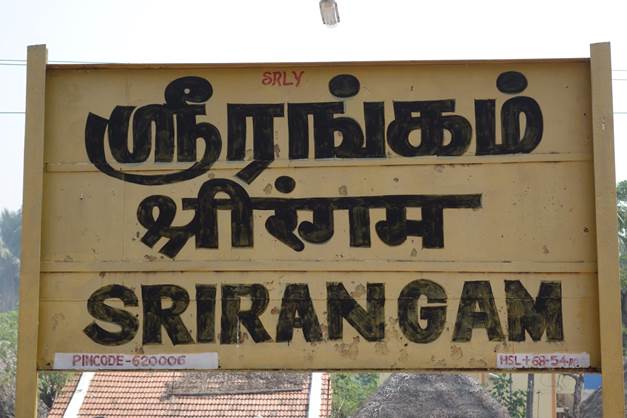
Srirangam Yatra
lectures:
Srirangam Yatra 2005 - lecture 1: www.youtube.com/watch?v=MQhVgiopG4E
Srirangam Yatra 2005
- lecture 2: www.youtube.com/watch?v=gd4woOnmqyo
Srirangam Yatra 2005
- lecture 3: www.youtube.com/watch?v=myri8MYIm3c
Srirangam Yatra 2005
- lecture 4: www.youtube.com/watch?v=7qzAP9P5peg
Srirangam Yatra 2010
- welcoming: www.youtube.com/watch?v=2N_3MbJvTUY
Audio lectures:
Srirangam Ranganatha
Swamy Temple Kumbabishekam 2015: https://www.youtube.com/watch?v=hGdQ4uW3Qns
Kanchipuram Yatra: www.dandavats.com/?p=33599
Mayapur TV: http://Mayapur.tv / Vrindavana
TV: http://Vrindavana.tv
Holy
Pilgrimages: www.Holy-Pilgrimages.com
Holy
Dham: www.HolyDham.com
HARE KRISHNA HARE
KRISHNA KRISHNA KRISHNA HARE HARE |
HARE RAMA HARE RAMA
RAMA RAMA HARE HARE ||